
The ERAS 2027 Worksheet is now available for download. IMGs can start preparing residency applications early, avoid common ERAS mistakes, and improve Match 2027 chances with strategic planning. Download link below.
Table of Contents
Intro
The ERAS 2027 Worksheet is now available for download, which means IMG applicants have a head start on organizing their residency applications before the portal even opens.
For IMGs, that timing matters more than most people realize. The worksheet itself is a planning document, not the actual application, but it’s where well-prepared applicants do most of their real work. You gather your experiences, draft your descriptions, verify your dates, and figure out what your application actually looks like before you touch the ERAS system.
Competition has tightened every cycle. The applicants who consistently produce stronger applications aren’t smarter or more qualified, they just started earlier.
This guide covers what the ERAS 2027 worksheet is, why it matters for IMGs specifically, what’s in it, and how to use it without wasting time.
What is the ERAS 2027 Applicant Worksheet?
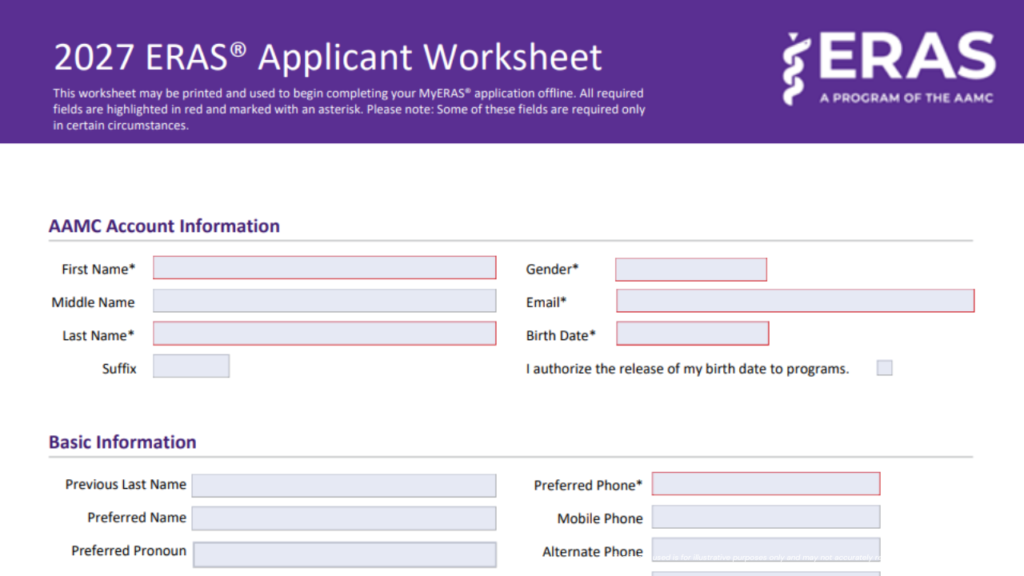
The worksheet is a downloadable PDF that maps out every section of the ERAS application. You fill it in offline, revise it as much as you need, and then transfer the polished content into ERAS when the portal opens.
It is not the actual application. You still have to complete that online.
But for IMGs, particularly those with complex educational histories, internships across multiple countries, or clinical experiences from different healthcare systems, working through the worksheet first prevents a lot of problems later.
Why the ERAS worksheet matters for IMGs
1. It produces better application entries
ERAS asks for more detail than most applicants expect. When you’re trying to do everything at once in the final weeks before submission, descriptions get rushed and experiences get left out.
Working through the worksheet early means you can actually think through what you did, how to describe it, and whether each entry reflects what the experience was worth. That difference shows in the final application.
2. It reduces the chaos of submission season
September is brutal for applicants who haven’t prepared. You’re uploading documents, chasing letters of recommendation, finalizing personal statements, assigning programs, and requesting USMLE transcripts, all at once, all under deadline.
If you’ve already written your experience descriptions and personal statement drafts, September becomes a matter of finishing, not starting.
3. It’s especially important for older graduates and non-traditional applicants
More years out of medical school means more to document. A longer work history, clinical experiences across different settings, research spread over several years, it takes time to organize that accurately. And accuracy matters, because programs notice when timelines don’t add up.
What sections are in the ERAS 2027 worksheet?
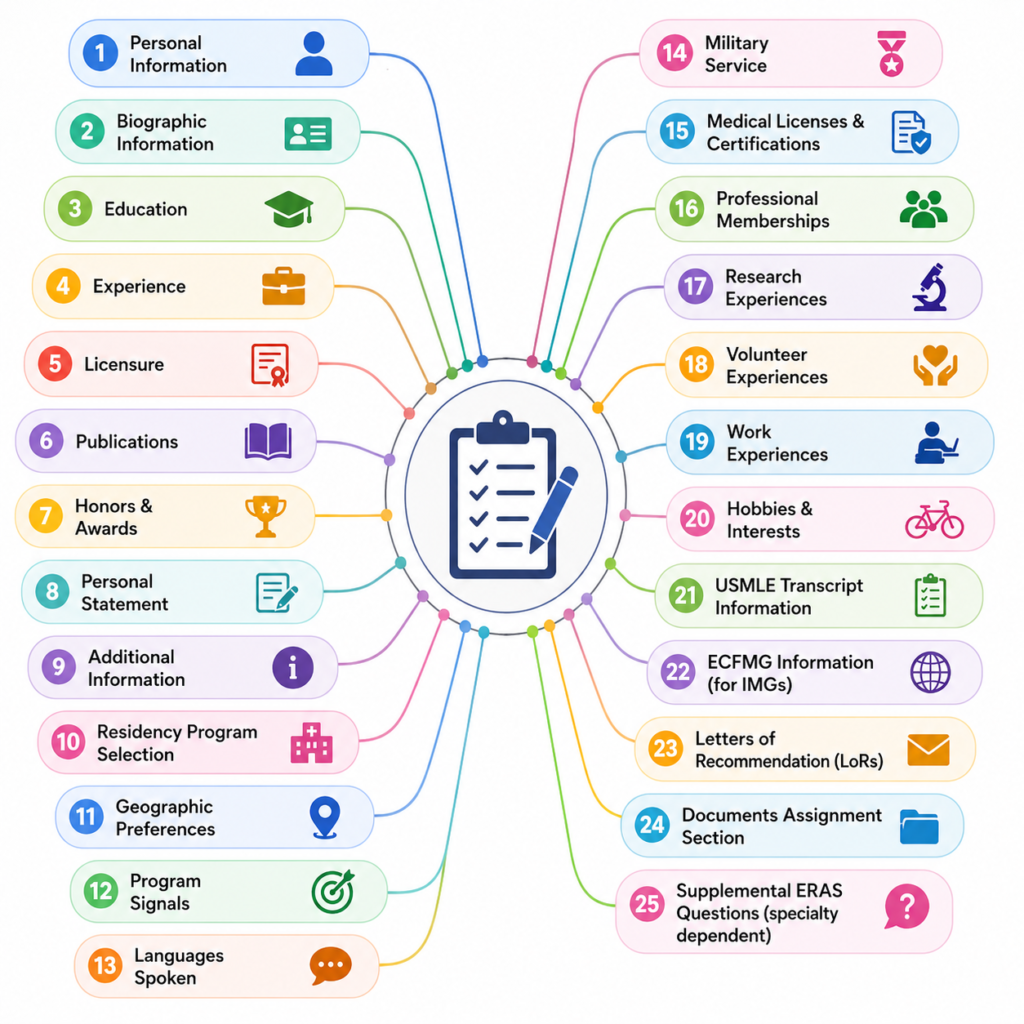
Personal information
Legal name, contact details, citizenship status, visa requirements, AAMC ID, and ECFMG status.
If you need visa sponsorship, this section deserves attention. Programs factor immigration requirements into their decisions, and how you present this information matters.
Education history
Medical school details, graduation dates, degree information, and clinical training history including internship experiences.
Discrepancies between your ERAS entries and ECFMG records create verification delays. Get this right the first time.
Experiences
This is the section program directors spend the most time on.
You can include US clinical experience (USCE), observerships, externships, research positions, volunteer work, leadership roles, and teaching activities. The quality of your descriptions matters more than the number of entries. Most applicants write too many weak entries when a handful of specific, well-written ones would serve them better.
Publications and research
Published papers, abstracts, poster presentations, oral presentations, ongoing projects, document all of it.
For competitive specialties, research productivity can move an application into a different pile. Even a poster from a regional conference belongs here.
Licensure and exams
USMLE scores, other licensing exams, certifications, state licenses if applicable.
Incorrect exam reporting causes verification problems that can delay your application at a moment when timing matters. Double-check every entry.
Honors and awards
Scholarships, academic distinctions, research awards, leadership recognitions.
Smaller achievements are worth listing. When programs are reading dozens of similar applications, specific recognitions, even modest ones, help an application feel like a person rather than a form.
How to use the ERAS 2027 worksheet strategically
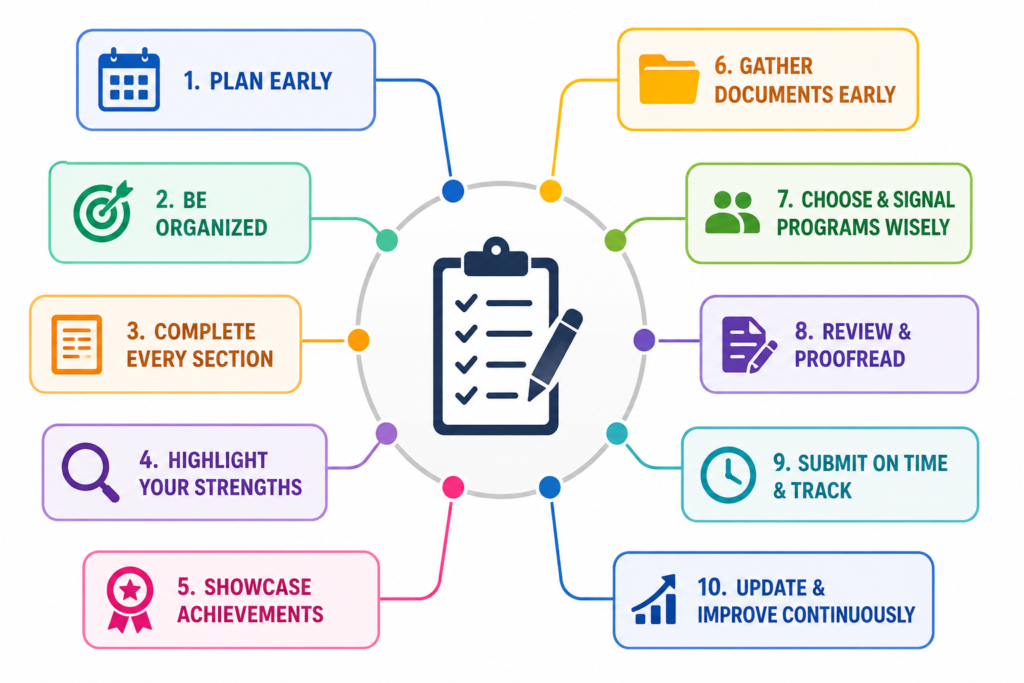
Write descriptions that actually describe something
The most common mistake in ERAS experience entries is vagueness.
Weak:
“Observed doctors in Internal Medicine.”
Better:
“Participated in inpatient rounds, patient case discussions, EMR documentation review, and multidisciplinary team meetings during a 4-week Internal Medicine observership at a tertiary care hospital.”
The second version tells a program director what you did. The first tells them nothing. Programs read quickly, vague entries get skipped.
A few strong entries beat a long list of thin ones
There’s a tendency to include every experience you’ve ever had. It usually backfires. Programs aren’t looking for volume. They’re looking for clinical depth, consistency, and evidence that you were actually engaged, not just present.
Three well-described experiences carry more weight than ten one-liners.
Use the worksheet to develop your personal statement
Most strong personal statements take three to four months to develop properly, not because they’re long, but because the good ones go through many drafts.
The worksheet is a useful prompt to start identifying what you want to say: what drew you to the specialty, which experiences shaped your decision, what you’d want a program director to know about you that doesn’t appear anywhere else in the application.
Start now. You’ll use those early drafts even if you throw them away.
ERAS 2027 trends IMGs should know
Programs are doing genuine holistic review now
Most programs have moved away from score-first screening over the past few cycles. They’re looking at clinical experience, letters of recommendation, research, leadership, and communication alongside USMLE scores.
This isn’t a reason to dismiss scores, they still matter. But it does mean the rest of your application has more weight than it used to.
US clinical experience is still the strongest predictor of interview invitations for IMGs
Everything else has shifted. This hasn’t.
Programs want applicants who have worked in US clinical settings, have letters from US physicians who can speak to their performance, and understand how care is delivered here. If your USCE descriptions are thin or your letters aren’t from US attendings, that’s worth addressing before anything else.
Think about program selection before you open ERAS
Most applicants figure out their program list after submission. The ones who do it before tend to apply more strategically, right geographic mix, realistic spread between reach and safe programs, attention to which states and specialties are more accessible for IMGs.
The worksheet period is a good time to work through this, not September.
Common mistakes in ERAS applications
- Date inconsistencies. Mismatched timelines — start dates, graduation dates, research periods, and employment history — are reliable red flags for program directors. They raise questions you do not want raised. Verify every date before finalizing your application.
- Generic descriptions. Statements like “Worked with patients in a clinical setting” communicate very little. Programs review hundreds of applications, and vague descriptions are often ignored. Clearly describe your role, contributions, and what you specifically learned or accomplished.
- Leaving out volunteer work. Many IMGs skip volunteer experiences because they seem less important than clinical work. That is usually a mistake. Volunteer activities demonstrate community engagement, communication skills, and broader professional values. With holistic review now standard at many programs, this section carries meaningful weight.
ERAS 2027 preparation timeline for IMGs
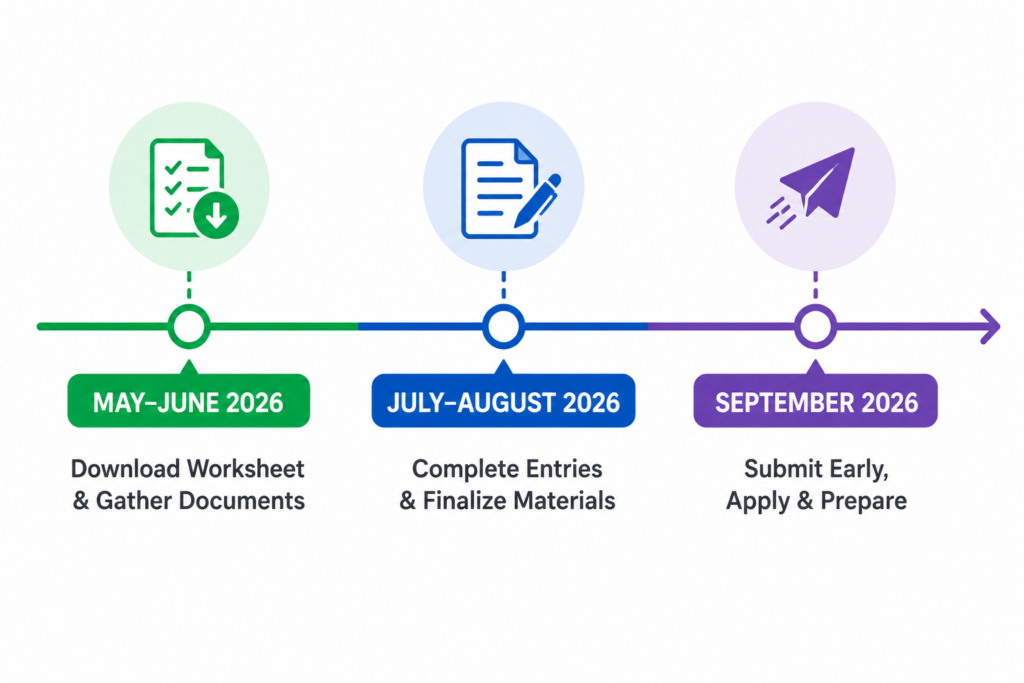
May–June 2026: Download the worksheet. Gather your documents and verify your dates. Start a first draft of your personal statement — even a rough one.
July–August 2026: Finalize your letters of recommendation. Finish and revise your experience descriptions. Review every ERAS entry for accuracy and completeness.
September 2026: Submit early. Apply broadly. Start preparing for interviews.
The early submission point is worth taking seriously. Many programs review on a rolling basis. Being in the first wave of applications has a real effect on interview volume.
How competitive will Match 2027 be for IMGs?
Competitive. Applicant numbers keep growing, more US graduates are entering the match, and programs have better tools for early filtering than they did five years ago.
That said, IMGs match every year, including into strong programs in competitive specialties. The ones who match aren’t necessarily the ones with the highest scores. They’re usually the ones with solid USCE, well-written applications, strong letters from US physicians, a realistic program list, and preparation that started before most people were paying attention.
That last part is something you can actually control.
FAQ on ERAS 2027 Applicant Worksheet
Is the ERAS worksheet required?
No, it’s optional. Most applicants who skip it end up writing experience descriptions under deadline pressure, and the difference between a prepared entry and a rushed one is usually visible.
Can IMGs use the ERAS worksheet?
Yes. It’s particularly useful for IMGs because many have more complex educational and clinical histories to document than US graduates.
Does the worksheet replace the actual ERAS application?
No. It’s a preparation tool. You still complete the official application online through the ERAS portal.
Should applicants start preparing before ERAS opens?
Yes. Early preparation gives you time to write better descriptions, develop your personal statement over multiple drafts, and avoid the September crunch that catches most applicants off guard.
One last thing
Most applicants who download the ERAS 2027 worksheet for IMGs now won’t look at it seriously for another two or three months. That gap is where preparation either happens or doesn’t.
The worksheet doesn’t do anything by itself. But working through it now methodically, without rushing, is how you avoid writing your ERAS application under pressure in September.
Feel free to check our USMLE Cost Calculator & YOG Risk Calculator

Ready to Apply? Let Medvily Guide You!
Medvily offers a complete suite of services including:
- Tutoring / Mentoring
- Clinical Electives
- Observerships & Externships
- Clinical Research
- Residency Application Support
- Mock Interviews & IV Prep
- Medical Licensing Support
Disclaimer: All trademarks referenced herein are the property of their respective owners. Medvily disclaims any affiliation, sponsorship, or endorsement by such trademark owners or their affiliated companies. The information provided is for general informational purposes only.
[…] Feel free to check out New Residency Programs for Match 2027 and ERAS 2027 Worksheet Download […]