The Virginia dental hygienist license for foreign-trained dentists is emerging as one of the most powerful 2026 opportunities to enter the U.S. dental workforce without repeating a full DDS.
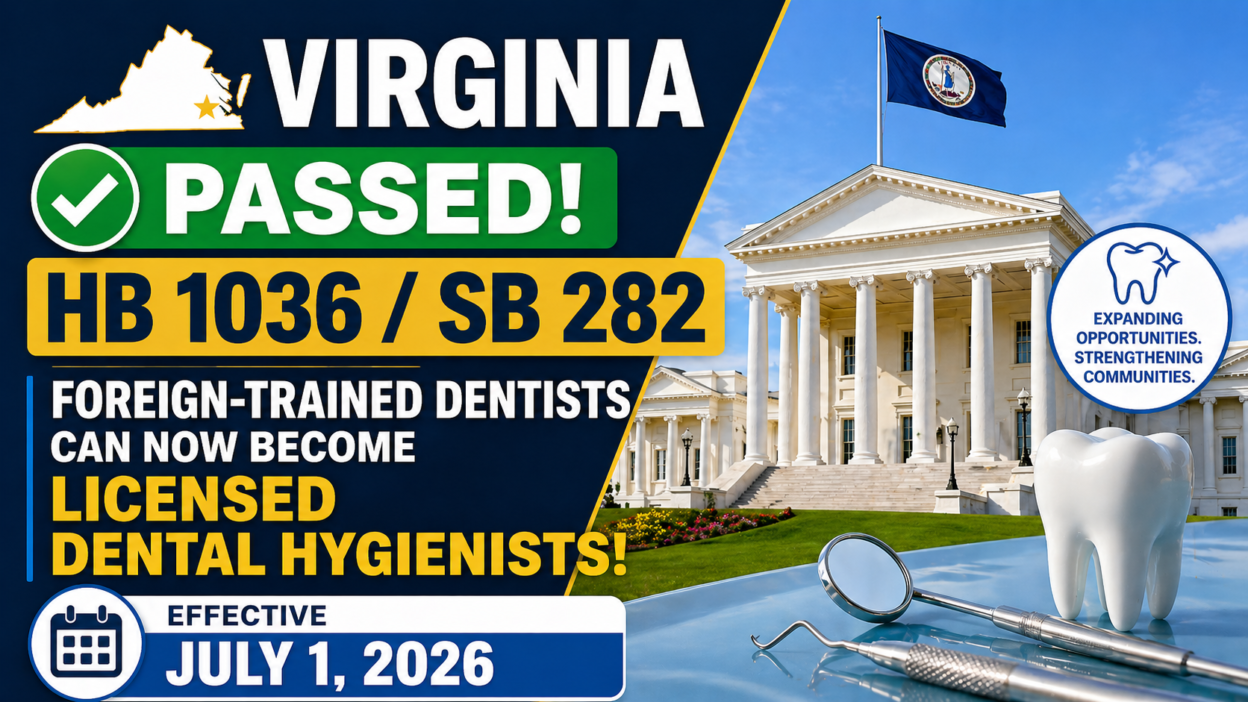
Starting July 1, 2026, Virginia allows foreign-trained dentists to become licensed dental hygienists. Learn about eligibility, exams, costs, salary expectations, and a step-by-step strategy to take full advantage of this breakthrough route.
Updated April 26, 2026
Table of Contents
Intro
Most foreign-trained dentists who come to the United States hit the same wall within months of arriving: you either go back to school or you wait. That’s been the reality for years.
A BDS or DDS from another country means very little at the licensing board level. You can have a decade of clinical experience, hundreds of patients, and expertise in complex oral surgery, and U.S. regulators will still tell you to repeat dental school.
Advanced standing programs exist, but they cost anywhere from $150,000 to $400,000, take two to four years, and accept maybe a few dozen candidates per year nationwide. For most international dentists, that math doesn’t work.
Virginia just changed something. Not everything — but something real.
Under legislation passed in 2026, foreign-trained dentists who hold a recognized dental degree can now pursue licensure as dental hygienists in Virginia without completing a U.S. DDS or DMD program. It’s a narrower scope than full dental practice, yes. But it’s also a faster, cheaper, and more achievable path into the U.S. dental workforce, and for a lot of people, that matters more right now than waiting another four years.
This guide breaks down exactly what the law says, who qualifies, what exams you’ll need to pass, what it will cost you, and how to think about this strategically if you’re deciding whether it makes sense for your situation.
What Is the New Law on Virginia Dental Hygienist License for Foreign-Trained Dentists?
Virginia passed HB 1036 / SB 282, a workforce expansion bill that addresses dental provider shortages in the state. One component of that legislation opens a new pathway specifically for foreign-trained dentists who want to become licensed dental hygienists.
Under this law, candidates who hold a dental degree from outside the United States — a BDS, DDS, or equivalent, can apply for dental hygienist licensure in Virginia without first obtaining a U.S. dental license. That’s the core shift.
The Virginia Board of Dentistry will define the specific eligibility criteria, credential evaluation requirements, and application procedures. Final regulations weren’t published at the time of writing, so some details will require monitoring as the implementation process unfolds.
- Foreign-trained dentists can apply for dental hygienist licensure in Virginia
- A U.S. DDS or DMD is not required — which is a significant departure from prior rules
- Candidates must pass the National Board Dental Hygiene Examination (NBDHE) and a clinical exam (ADEX or equivalent)
- Eligibility criteria will be set by the Virginia Board of Dentistry
- The goal is faster workforce integration into a state with documented provider shortages
Why This Law Is a Big Deal for Foreign-Trained Dentists
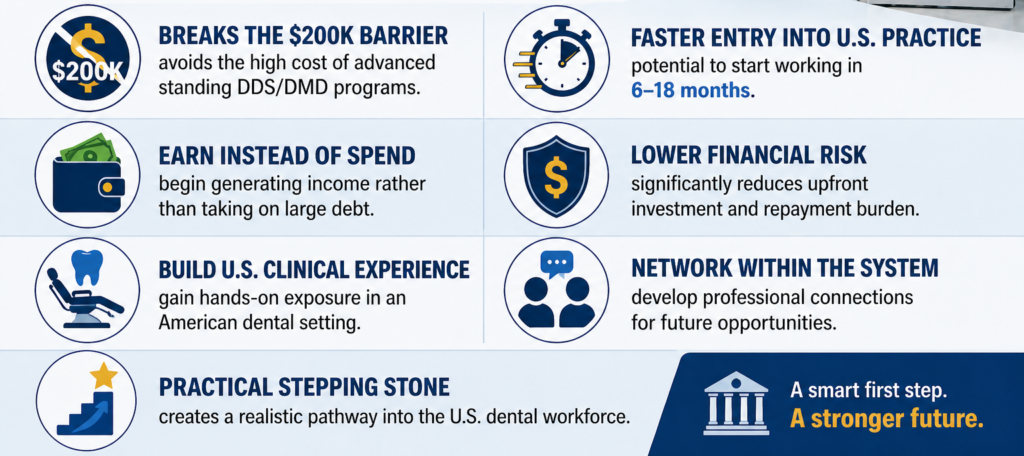
To understand why this matters, consider what the alternatives have looked like.
The traditional path to practicing dentistry in the U.S. as a foreign graduate runs through one of about a dozen advanced standing programs. These programs compress the U.S. curriculum into roughly two years, but they’re competitive and expensive. Tuition alone can exceed $200,000. Add living expenses, and you’re looking at a total investment that takes years to repay even after you’re licensed.
The hygienist pathway Virginia is now offering doesn’t get you to full dental licensure. You’ll be working with a narrower scope, at a lower salary, and under the supervision of a licensed dentist. That’s a real trade-off and it’s worth naming honestly.
But here’s what you get in exchange:
- You can potentially be working in a clinical dental setting within 6 to 18 months
- You earn while you’re here, rather than spending
- You build U.S. clinical hours and professional contacts
- You reduce financial pressure substantially
Traditional DDS Pathway vs. Hygienist Pathway (Virginia 2026)
| Factor | Traditional DDS Route | Hygienist Pathway |
|---|---|---|
| Time | 2–4 years | 6–18 months (estimated) |
| Cost | $150K–$400K | ~$5K–$15K |
| Competitiveness | Very high | Moderate |
| Income Start | Delayed | Faster |
| Licensing | Full dentist | Limited scope (RDH) |
Why Virginia Passed This Law
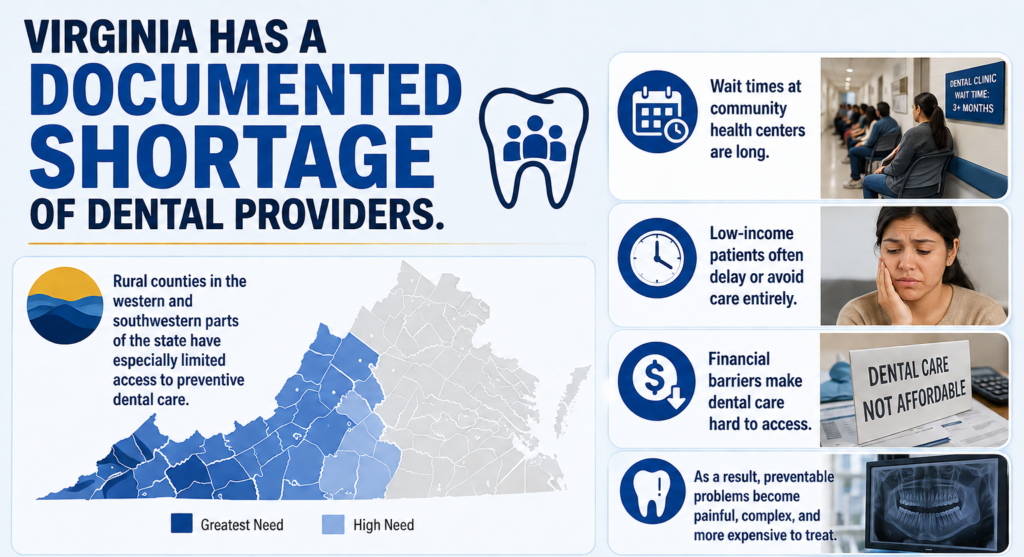
Virginia has a documented shortage of dental providers. Rural counties in the western and southwestern parts of the state have especially limited access to preventive dental care. Wait times at community health centers are long. Low-income patients often delay or avoid care entirely.
This isn’t a new problem — state health departments have tracked it for years.
Foreign-trained dentists represent a pool of clinically trained professionals who are already in the country, many of them on dependent visas or other immigration categories that don’t allow easy workforce entry. Allowing them to work as hygienists doesn’t solve every access problem, but it does move more trained clinicians into positions where they can see patients.
The law isn’t charity toward international dentists. It’s a workforce policy responding to a public health gap. That framing matters, because it means the state has an ongoing interest in making the pathway work, not just passing it and forgetting it.
When Does It Take Effect?
But “takes effect” and “applications open” are not the same thing. The Virginia Board of Dentistry needs to finalize regulations, publish eligibility criteria, and set up the application process.
Based on how similar licensing changes have rolled out in other states, expect a gap of three to nine months between the law’s effective date and the point where you can actually submit a complete application.
If you’re planning around this pathway, start preparing now, exams, credentials, documentation, rather than waiting for the application window to open.
What a Dental Hygienist Can and Cannot Do in Virginia
The scope of practice for a registered dental hygienist (RDH) is specific. If you’re accustomed to full dental practice, you’ll notice what’s missing.
What You CAN Do as a Licensed Dental Hygienist in Virginia
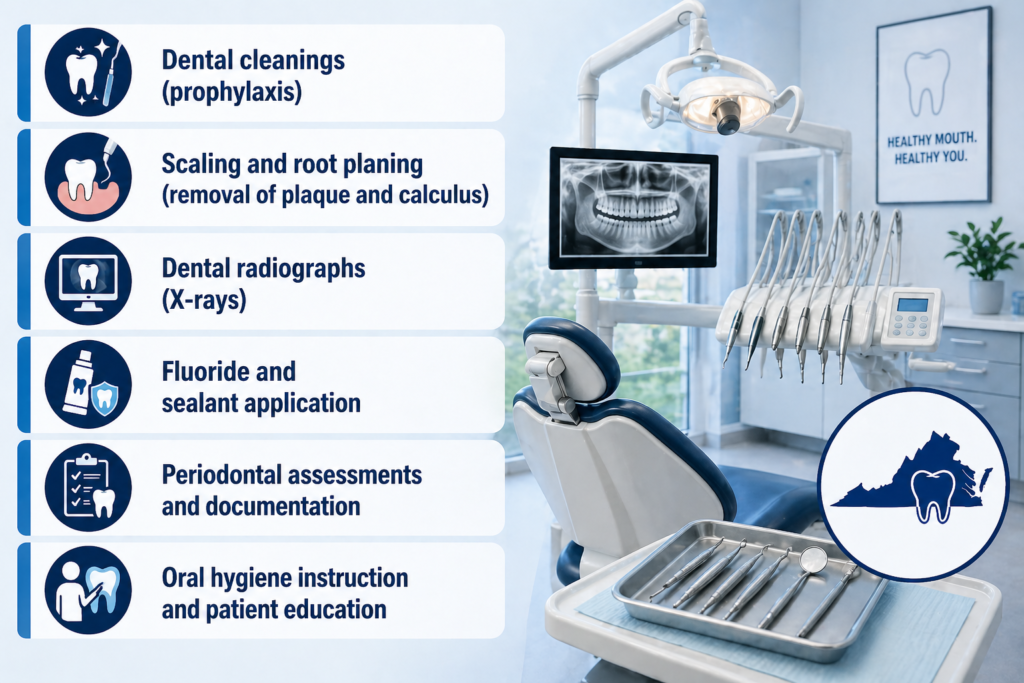
These are core preventive services, in high demand across all practice settings. They require genuine clinical skill, and a dentist who trained abroad often brings technical precision that shows in this work.
What You CANNOT Do as a Licensed Dental Hygienist in Virginia
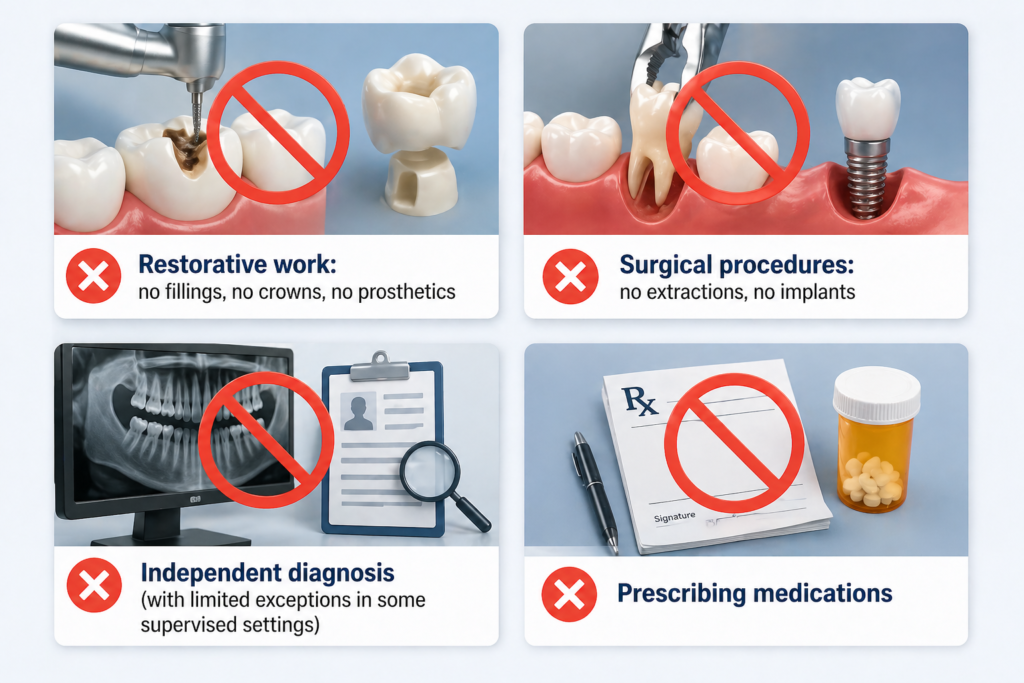
If you’re coming from a full dental practice background, this is a real adjustment. You’ll be handling the preventive side of dentistry while the treating dentist manages everything else.
Some people find this frustrating. Others find it clarifying — the scope is consistent, the patient load is predictable, and the focus is clear.
Who Is Eligible? (Expected Requirements)
Final regulations are pending, but based on the legislation’s text and patterns from comparable state policies, expected eligibility criteria include:
- A dental degree from an internationally recognized institution (BDS, DDS, or equivalent)
- Credential evaluation from an approved agency (such as ECE or NACES members)
- Transcripts and proof of clinical training hours
- English proficiency documentation (if required by the board)
- A clean disciplinary record, no revocations, suspensions, or significant violations
- Application to the Virginia Board of Dentistry The dental hygienist license in Indiana is overseen by the Virginia Board of Dentistry. You’ll submit your application through the Virginia Licensing portal.
- Background check A criminal background check is required, as it is for all healthcare licensure in Virginia.
If your degree is from a country with strong bilateral recognition or accreditation partnerships, the credential evaluation process may be smoother. If your institution is less commonly evaluated, budget extra time for that step and consider reaching out to the board directly before you apply.
What Exams Do You Need to Pass?
Two exams stand between you and licensure. Neither is a formality.
1. National Board Dental Hygiene Examination (NBDHE)
The NBDHE is a written examination covering:
- Clinical dental hygiene knowledge
- Patient care principles
- Sciences underlying preventive dentistry
It’s required in all U.S. states for hygienist licensure, not just Virginia. The exam is computer-based and administered through designated testing centers.
The exam is designed around U.S. standards and the hygienist’s specific scope of practice rather than a dentist’s full scope. Study specifically for this exam. Most candidates who prepare seriously take three to six months.
2. ADEX Dental Hygiene Examination
The ADEX clinical examination tests hands-on competency. You’ll:
- Perform scaling procedures on patients or simulation units
- Demonstrate instrument selection and technique
- Show clinical judgment in patient management scenarios
This is where clinically trained dentists sometimes overestimate their readiness. Hygiene instrumentation has its own technique, wrist and hand movements differ from restorative work, and the evaluation criteria are specific.
Practice on dental hygiene patients specifically, and ideally work with a mentor or simulation course before sitting for the exam.
3. Virginia Jurisprudence Exam
In Virginia, the exam is formally known as the Virginia Dental Law Exam.
- Format: It is a non-clinical, written exam (often taken online or at a testing center).
- Content: It focuses on the Virginia Drug Control Act and the Virginia Board of Dentistry Regulations.
Important note: Eligibility criteria, exam requirements, and licensure processes may change and vary by individual case. Applicants should verify all details with the Virginia Board of Dentistry and relevant authorities. This content is for informational purposes only and does not constitute legal or professional advice.
What Will It Cost? (Approximate Breakdown)
These are estimates and individual costs will vary.
| Item | Estimated Cost |
|---|---|
| NBDHE exam fee | $400–$600 |
| ADEX clinical exam fee | $1,500–$3,000 |
| Credential evaluation | $200–$500 |
| State application and licensing fees | $200–$400 |
| Study materials | $300–$1,000 |
| Optional coaching or prep course | $1,000–$4,000 |
| Total (estimated) | $3,600–$10,500 |
That’s a wide range, but even the top end is a fraction of advanced standing DDS program costs. If you’re self-funding without institutional support, this pathway is genuinely accessible in a way that DDS programs aren’t for most candidates.
Visa Options for Foreign-Trained Dentists Pursuing This Pathway
Visa strategy is where many candidates underestimate the complexity.
Here’s a breakdown of the most relevant visa categories:
| Visa Type | Feasibility | Notes |
|---|---|---|
| H-1B | low | Dental hygienist may qualify. Requires proving the job needs a 4-year degree. |
| TN Visa (Canada/Mexico) | High | Consult immigration attorney; dentist category exists but hygienist is separate |
| F-1 OPT | High | OPT must relate to degree field; dental/health science graduates may qualify |
| Green Card | High | No restrictions. Full work authorization. |
| H-4 Visa (EAD) | High (if eligible) | Requires spouse on H-1B with approved I-140 |
| L-2 Visa (EAD) | Very High | Requires spouse on L-1 visa |
Important note: Talk to an immigration attorney before making any moves. Visa law changes, and your individual situation, your current status, employer, spouse’s status, affects which options are available to you.
How Much Will You Actually Earn as a Dental Hygienist in Virginia?
Salary ranges for registered dental hygienists in Virginia in 2026:
- Hourly: $40–$60
- Annual: $75,000–$110,000+
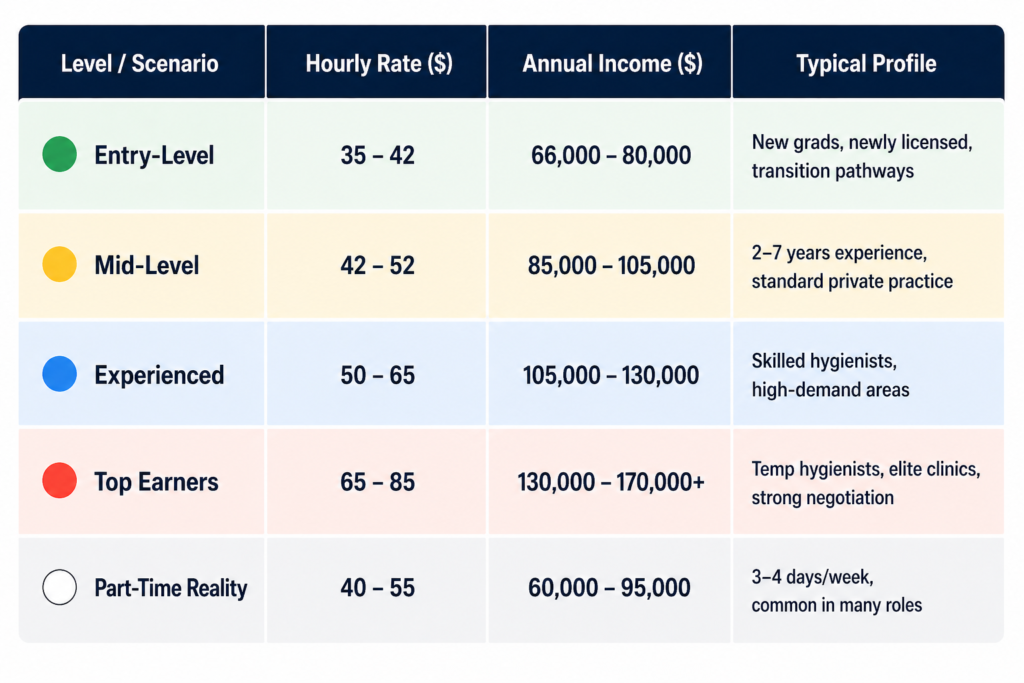
Factors that affect where you land in that range:
- Location — Northern Virginia and the D.C. suburbs pay more than rural areas
- Practice type — private practices often pay higher than community health centers, though benefits and schedule may differ
- Experience level
How to Actually Apply: Step-by-Step
Step 1: Verify Your Eligibility
Before anything else, confirm that your degree qualifies. Check the Virginia Board of Dentistry’s published criteria once regulations are finalized. If there’s ambiguity, contact the board directly.
Step 2: Credential Evaluation
Submit your transcripts, diploma, and clinical documentation to an approved credential evaluation agency. This confirms that your foreign dental degree is equivalent to U.S. standards. Common agencies include ECE (Educational Credential Evaluators) and World Education Services (WES), though the board may specify a preferred agency.
Step 3: Prepare for the NBDHE
Study systematically using current NBDHE prep materials, not just your dental school notes. The exam tests clinical hygiene concepts and U.S. patient care standards. Budget at least three to six months of focused preparation.
Step 4: Pass the NBDHE
Schedule your exam through the American Dental Association (ADA) Joint Commission on National Dental Examinations. You need to pass before moving to the clinical exam.
Step 5: Take the ADEX Clinical Exam
After passing the NBDHE, schedule your ADEX clinical examination. Practice specifically on hygiene technique, not general dentistry. If you can shadow a working hygienist or take a clinical simulation course, do it.
Step 6: Apply to the Virginia Board of Dentistry
Submit your exam scores, credential evaluation, documentation, and application fees. Keep copies of everything.
Step 7: Obtain Your License and Begin Work
Once approved, you hold a Virginia RDH license and can start applying for positions.
Estimated total timeline: 6–18 months depending on preparation pace, exam scheduling, and board processing times.
Who Should Seriously Consider This?
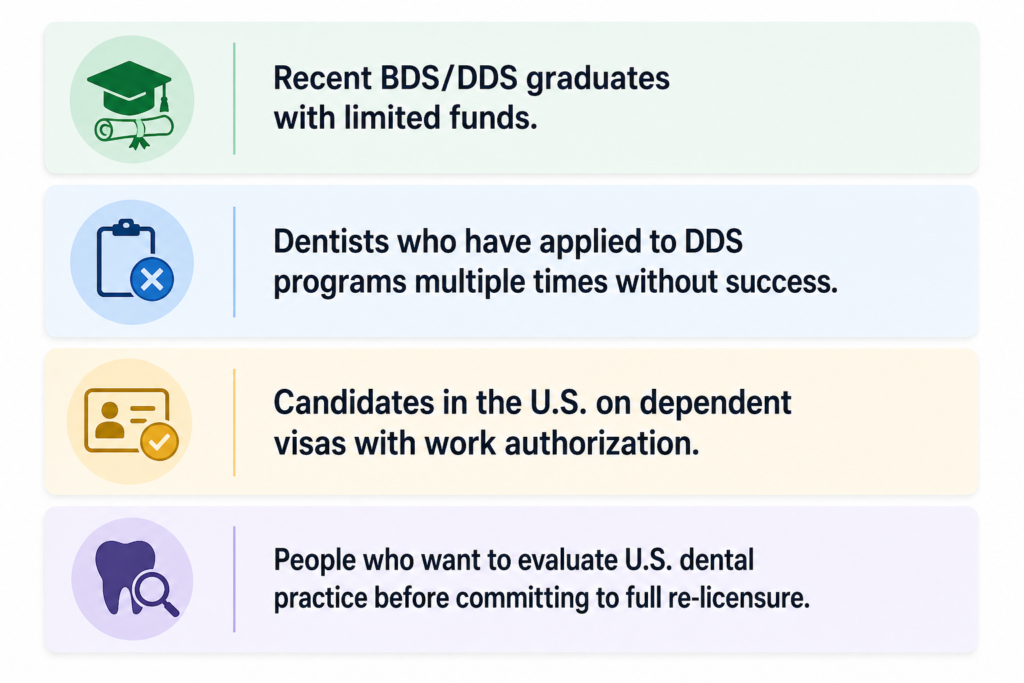
- Recent BDS/DDS graduates with limited funds. If you finished dental school recently and don’t have $200,000+ available for an advanced standing program, this pathway gets you working and earning while you plan your next move.
- Dentists who have applied to DDS programs multiple times without success. Admissions to advanced standing programs are competitive and sometimes opaque. If you’re stuck in a cycle of applications and rejections, a different entry point may be worth considering.
- Candidates in the U.S. on dependent visas with work authorization. If you already have EAD or work authorization, you have a real opportunity here. The licensing pathway is the main obstacle.
- People who want to evaluate U.S. dental practice before committing to full re-licensure. Working in a hygienist role gives you genuine exposure to how U.S. dental offices function, pace, patient expectations, documentation, insurance workflows. Some people find they want to pursue full dentist licensure more urgently after this experience. Some find the scope of hygiene practice suits their current life situation.
FAQs on Dental hygienist Licensure in Virginia
Can I use my INBDE exam results for the dental hygienist license in Virginia?
No. In Virginia, you specifically need the NBDHE (National Board Dental Hygiene Examination).
Do I need a U.S. DDS to apply under this Virginia law?
No. That’s the core change. You need your foreign dental degree, credential evaluation, and to pass the required exams.
Does Virginia allow “General Supervision” for dental hygienists?
Yes, under certain conditions. This means you can often perform cleanings even if the dentist is not physically in the building, which increases your employability.
Does Year Since Graduation matter?
Generally, no, as long as your school was recognized by the Board at the time of graduation and you can pass the current board exams.
Does Virginia recognize dental hygienist licenses from other states?
Generally yes, through licensure by credentials, but requirements and fees vary, and endorsement isn’t automatic. If you’re licensed in another state and considering Virginia, check with the board directly.
Can I apply for the Virginia dental hygienist license before July 1, 2026?
No. While the law (HB 1036) has been signed by the Governor, it does not officially take effect until July 1, 2026. The Virginia Board of Dentistry will not have the updated “Foreign Trained Dentist” application forms or the online portal category active until that date. However, you should complete your credential evaluation and take your exams now so you can submit on day one.
What happens if I fail the clinical exam (ADEX)?
Virginia has a three-strike rule. If you fail any section of the clinical hygiene examination three times, the Board will require you to complete a specific amount of remedial clinical training at a CODA-accredited hygiene school before you are allowed to attempt the exam a fourth time.
Final Word
Virginia’s 2026 law doesn’t solve everything. You’ll still be working with a narrower scope than you trained for. The salary ceiling as a hygienist is real. Immigration remains complicated regardless of what the licensing board does.
But for a lot of foreign-trained dentists, the biggest problem right now isn’t the eventual destination, it’s the gap. The years of being unable to practice, unable to earn clinically, unable to build the U.S. experience that future applications require. This pathway addresses that gap in a way that wasn’t available before.
Whether it’s the right move depends on your individual circumstances:
- Your visa status
- Your finances
- Your timeline
- How competitive your DDS applications have been
- What your family situation allows
It’s not a universal answer. But it’s a real option where almost none existed before.
If you’re going to pursue it, start preparing now, credentials take time, exams take preparation, and the candidates who are ready when applications open will move through the process faster than those who wait.
Feel free to check out Indiana’s Game-Changing Law: Foreign-Trained Dentists Can Now Become Dental Hygienists (Effective July 1, 2026)
Feel free to check out Ultimate Guide to the Harvard ASID Track (Advanced Standing International Dentists DMD Track) 2026
Sources & References
- Virginia HB 1036 — Official Virginia Legislature (LIS) — https://lis.virginia.gov/bill-details/20261/HB1036/text/HB1036 –
- Virginia SB 282 — Official Virginia Legislature (LIS) — https://lis.virginia.gov/bill-details/20261/SB282
- Virginia Board of Dentistry Report on Workforce / Credentialing (RD883) — https://rga.lis.virginia.gov/Published/2025/RD883/PDF Virginia Board of Dentistry — Main Page https://www.dhp.virginia.gov/Boards/Dentistry/
- Virginia Board of Dentistry — Dental Hygienist Licensure — https://www.dhp.virginia.gov/Boards/Dentistry/ApplicantResources/Applyforalicense/DentalHygienist/
- Virginia Board of Dentistry — Applications & Forms — https://www.dhp.virginia.gov/Boards/Dentistry/PractitionerResources/ApplicationsForms/
- Virginia Board of Dentistry — Guidance Documents — https://www.dhp.virginia.gov/Boards/Dentistry/PractitionerResources/GuidanceDocuments/
- Virginia Board of Dentistry — Dental Hygiene Licensing Instructions (PDF) — https://www.license.dhp.virginia.gov/apply/Forms/Dentistry/DenHyg_InstrForms.pdf
- Code of Virginia — Article 3: Licensure of Dental Hygienists — https://law.lis.virginia.gov/vacodefull/title54.1/chapter27/article3/
- JCNDE — National Board Dental Hygiene Examination (NBDHE) — https://jcnde.ada.org/nbdhe
- JCNDE — 2026 NBDHE Candidate Guide (PDF) — https://jcnde.ada.org/-/media/project/ada-organization/ada/jcnde/files/2026_nbdhe_candidate_guide.pdf
Disclaimer: This article is for informational purposes only and does not constitute legal, immigration, or professional advice. Requirements for Virginia licensure under HB 1036/SB282, including eligibility, exams, and costs, may change and should be verified directly with the Virginia Board of Dentistry. Visa information is general and not legal advice—individual eligibility depends on personal circumstances. No guarantee is made regarding licensure, employment, or outcomes. Always consult official authorities before making decisions.

Ready to Apply? Let Medvily Guide You!
Medvily offers a complete suite of services including:
- Tutoring / Mentoring
- Clinical Electives
- Observerships & Externships
- Clinical Research
- Residency Application Support
- Mock Interviews & IV Prep
- Medical Licensing Support
Disclaimer: All trademarks referenced herein are the property of their respective owners. Medvily disclaims any affiliation, sponsorship, or endorsement by such trademark owners or their affiliated companies. The information provided is for general informational purposes only.