Get a Full Medical License in Washington for IMGs without residency in 2026. Discover eligibility, SB 5185 requirements, timeline, and how international doctors can legally practice faster in the USA.
Updated March 29, 2026
Table of Contents
If You’ve Been Waiting for a Real Opening – This Might Be It
You know the drill by now.
You passed your Steps. You got your ECFMG. You applied to residency programs, maybe once, maybe four times. You watched the match results come in and your name wasn’t there. You took a job that had nothing to do with medicine, or you found a way to stay in clinical work in a limited capacity, and you kept telling yourself something would change.
On March 23, 2026, something actually did.
Governor Bob Ferguson signed Senate Bill 5185 into law in Washington State, and for the first time in U.S. medical history, a state created a real, legislatively backed pathway from supervised clinical experience to a full, unrestricted medical license. No match. No residency.
The bill passed 41–8 in the Senate and 89–4 in the House. This isn’t a pilot being held together with goodwill, it has political weight behind it.
What SB 5185 Actually Does
In plain terms: SB 5185 lets IMGs who already hold a Washington Clinical Experience License (CEL) complete a structured four-year supervised practice pathway and come out the other end with a full primary care license.
The program is called the Clinical Experience Graduate Pilot Program. It becomes effective June 11, 2026.
Step Zero: Getting the Clinical Experience License
Everything starts here. The pilot program is built on top of the CEL. If you don’t have one, or can’t get one before July 1, 2026, the rest of this article is preparation for next time, not action for right now.
Here’s what getting a CEL (Clinical Experience License) requires:
| Requirement | Details |
|---|---|
| ECFMG Certification | Required |
| USMLE Step 1 & Step 2 | Both must be passed (Step 3 is completed later) |
| Background Check | Standard WMC requirement |
| Approved Practice Agreement | Must be filed with the WMC before starting practice |
| Institutional Nomination | Required; often overlooked by many IMGs |
That last point is real friction. You can’t apply for a CEL independently. You need a formal nomination from the chief medical officer of a hospital, medical practice, DCYF, DSHS, Department of Corrections, or a county/city health department. Finding a nominator takes networking, persistence, and time, which is exactly why starting now matters.
One thing that recently changed in your favor: Washington removed the previous requirement that CEL applicants be state residents for at least one year. If you’re currently outside Washington, you can apply without relocating first. That’s a meaningful barrier gone.
Applications go through the HELMS system (Health Professional and Facility Licensing), accessed via a Secure Access Washington (SAW) account.
The CEL is valid for two years, renewable up to three times — eight years maximum. One thing to keep in mind before your third renewal: you’ll need to attest that you’ve applied to at least one residency program. The system was originally designed with residency as the expected endpoint. The pilot program is now the off-ramp, but that attestation is still in the rules.
What the CEL Actually Lets You Do
This is the part that surprises most people, and it matters financially.
A CEL holder isn’t practicing in some provisional grey-zone status. Under WMC guidance, you’re recognized as a full-scope physician for:
- Practicing medicine under your approved practice agreement
- Employment classification and job title
- Malpractice coverage eligibility
- Insurance billing purposes
You’re employed. You’re billing. You’re building a clinical record that counts. For an IMG who’s spent years doing everything right and getting nothing to show for it in a U.S. clinical context, this is not a small thing.
The Supervising Physician Cap, Plan for This Early
Here’s the constraint nobody talks about loudly enough.
A supervising physician can oversee no more than two CEL holders at one time, unless the WMC grants a specific exception. On paper that sounds fine. In practice, it means that supervisors are a limited resource, and as more IMGs pursue this pathway, finding one who has availability becomes a real competitive challenge.
Don’t leave this to the last minute. Start identifying potential supervisors early, build the relationship, confirm their capacity before you apply.
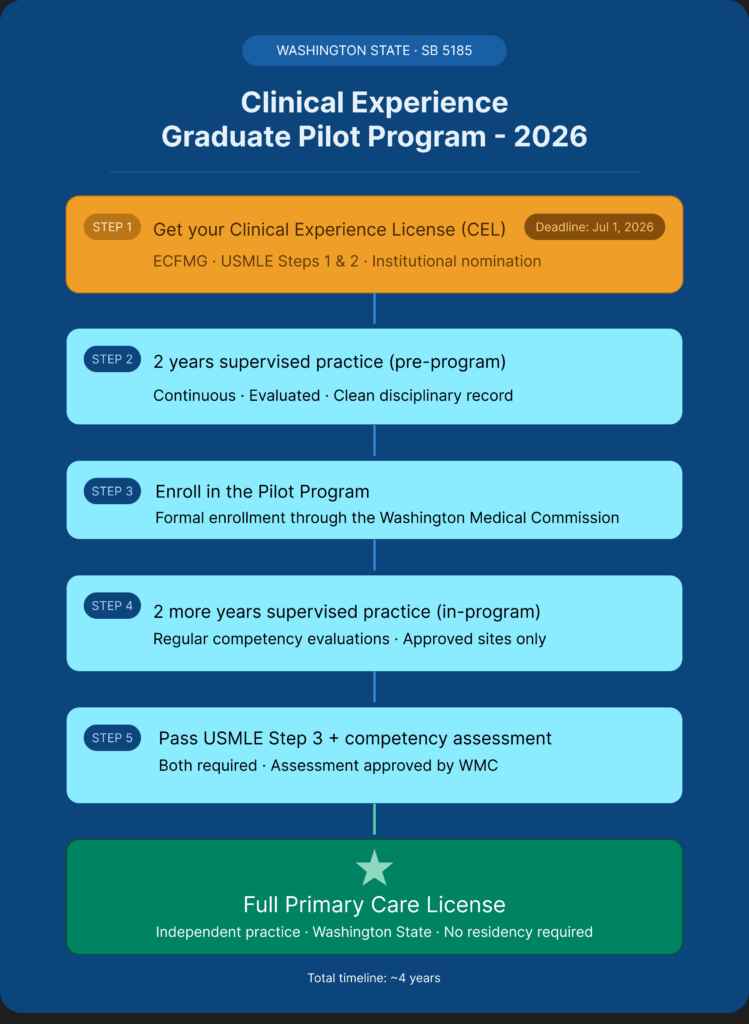
How the Pilot Program Works to get a Full Medical License in Washington for IMGs – Step by Step
Once you have your CEL and complete your pre-program requirements, here’s the full pathway:
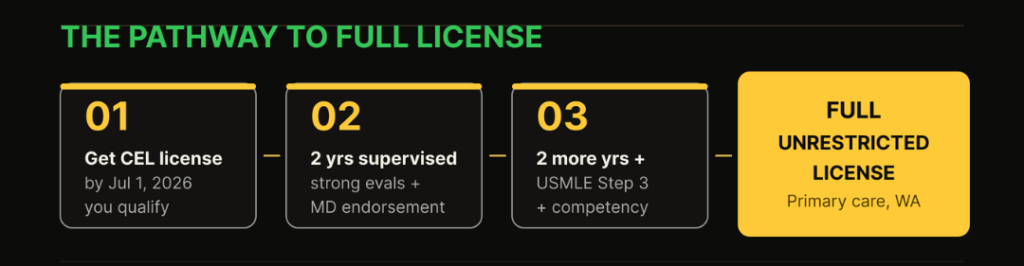
Step 1: Hold a CEL issued on or before July 1, 2026 This is your eligibility gate. No exceptions noted in the law.
Step 2: Two Years of Continuous Supervised Practice (Pre-Program) This phase has teeth. You need:
- Satisfactory evaluations from your supervising physician across all clinical assessment categories
- A written attestation from your supervising physician
- A written endorsement from the medical director of your practice site (if different from your supervisor)
- A completely clean disciplinary record, no active actions, no significant history
Step 3: Enroll in the Pilot Program Formal enrollment through the WMC once pre-program requirements are met.
Step 4: Two More Years of Supervised Practice (In-Program) Continued supervised patient care, regular competency evaluations, approved clinical settings only.
Step 5: Pass USMLE Step 3 and a Clinical Competency Assessment. Both are required. The competency assessment is approved by the WMC.
Step 6: Full Primary Care License Full, unrestricted medical license in Washington. Independent practice. Primary care.
One more thing: under SB 5185, the WMC is directed to engage with the American Board of Medical Specialties to explore a board certification process for pilot program participants. Nothing is locked in yet, but it signals this program is designed to produce fully credentialed physicians, not a secondary tier of provider.
Where You Can Practice During the Program
Approved practice sites:
- Hospitals
- Federally Qualified Health Centers (FQHCs)
- Government healthcare entities
- Private practices or physician employment groups with at least 10 full-time equivalent, board-certified physicians delivering in-person care in Washington
- Mental and behavioral health facilities (with WMC approval)
That behavioral health inclusion matters. It’s one of Washington’s most acute shortage areas, and if your background touches psychiatry or behavioral medicine, this opens a lane that didn’t exist before.
The Track Record That Got This Law Passed
Before you wonder whether this program will actually work, consider what already has.
Washington’s Clinical Experience License has been running for five years. In that time, approximately 50 physicians have practiced under it. Those 50 doctors have collectively served over 35,000 patients. In five years of operation, there have been zero reported patient safety incidents.
That’s not spin. That’s the data the legislature used to pass this bill by margins that rarely happen in healthcare legislation.
It’s also why the Washington State Medical Association, which originally opposed the bill, citing concerns about training variability and a “two-tiered” system, eventually switched to supporting the substitute version. The safety record made the argument that opponents couldn’t rebut.
That said, the concern about two-tiered medicine hasn’t fully gone away. Some in the medical community still believe U.S. residency provides training that can’t be replicated through supervised practice alone. The WMC’s annual reports to the legislature through 2035 will be the evidence that either cements this program or limits it. The first cohort of participants matters more than they might realize.
Why This Matters for IMGs
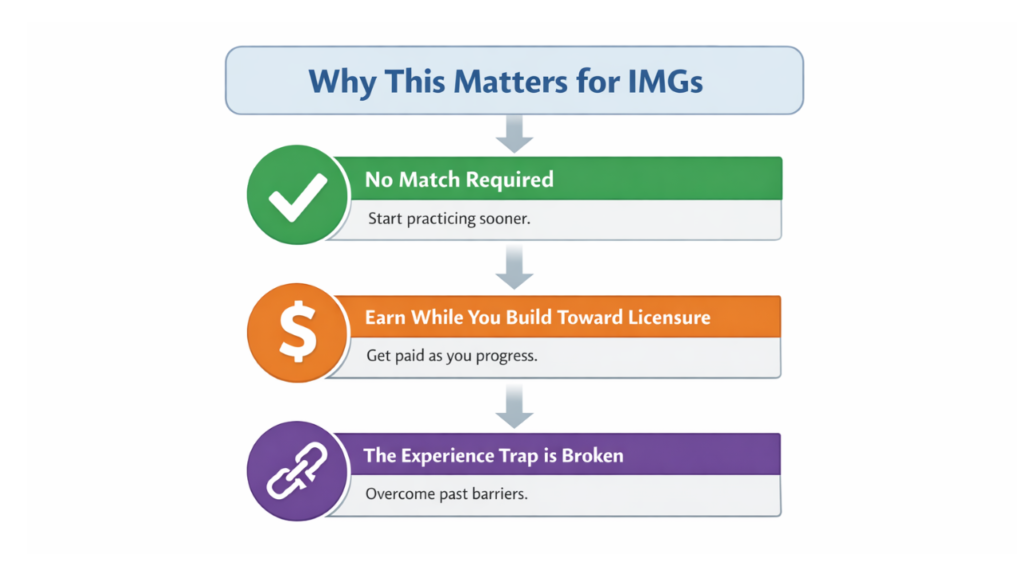
- No match required. The match is a brutal, opaque, and increasingly difficult system that filters out qualified physicians for reasons that have nothing to do with clinical competence. This pathway removes it entirely from the equation.
- You earn while you build toward licensure. Because CEL holders are recognized as full-scope physicians for billing and employment purposes, you’re not surviving on a training stipend. You’re working, earning, and accumulating clinical experience that directly counts toward your license.
- The experience trap is broken. The old loop: no residency means no license, no license means no U.S. experience, no U.S. experience means no match. SB 5185 cuts that loop at the root.
- The shortage works in your favor. Washington built this law specifically to address rural and primary care shortages. The state needs physicians in places that have trouble attracting them. IMGs willing to practice in underserved communities aren’t just eligible, they’re exactly who this program was designed for.
There’s Also an Exceptional Qualification Waiver
Most IMGs won’t need this, but it exists and it’s worth knowing about.
If you have a recognized body of work in research, medical excellence, or employment, and you can secure endorsements from national or international experts in your specialty, you can apply to the WMC for an exceptional qualification waiver. This can excuse certain standard licensure requirements entirely.
For a senior physician, an academic, or someone with a documented record in their field, this is a parallel route to Washington licensure that doesn’t require going through the CEL or the pilot program at all. It’s not widely discussed. Look into it if it might apply to you.
Already Licensed in Another U.S. State? Check the IMLCC First
If you’ve already achieved full medical licensure in another U.S. state, the pilot program may not be your fastest route into Washington.
The Interstate Medical Licensure Compact (IMLCC) allows physicians licensed in one member state to obtain expedited licensure in other member states without going through the full application process. Washington participates. If you hold a full license elsewhere in the U.S., check whether you qualify for the compact route, it could get you practicing in Washington significantly faster than the pilot program timeline.
Specialty Scope
Primary care only. The law does not include other specialties at this stage.
Residency vs. New Washington IMG Pathway
| Feature | Traditional Residency | New Washington IMG Pathway |
|---|---|---|
| Duration | 3–7 years | 4 years total |
| Match Required | Yes | No |
| Competition | Extremely high | Limited entry |
| Income During Training | Low | Earn while practicing |
| Flexibility | Low | Moderate |
| Specialty Options | Broad | Primary care |
Who This Is Actually Built For
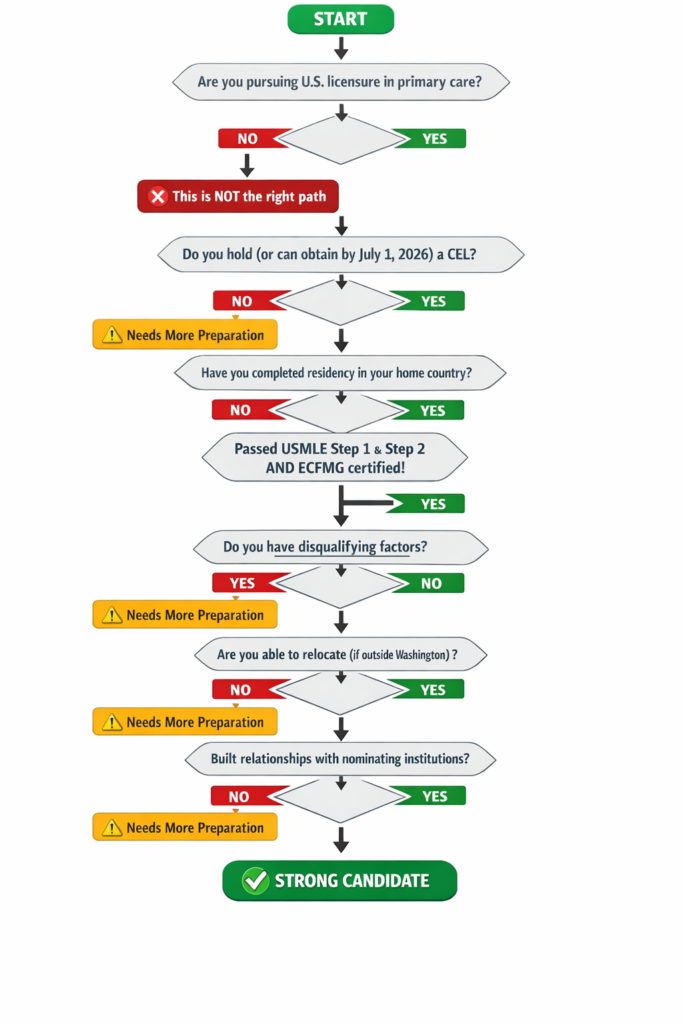
You’re a strong candidate if:
- You hold a CEL or can realistically obtain one before July 1, 2026 for current cycle.
- You completed residency in your home country and want U.S. licensure
- You didn’t match and have been building supervised clinical hours in Washington
- You’re outside Washington but can relocate, the state residency requirement no longer applies
You need more preparation if:
- You haven’t cleared USMLE Steps 1 and 2 yet
- You don’t have ECFMG certification
- You need to build relationships with potential nominating institutions
This isn’t the right path if:
- Your goal is a specialty outside primary care
- You have active or significant disciplinary history
- You already hold a full license in another U.S. state – check the IMLCC first
Visa & Work Authorization for the CEL & Pilot Program- What You Need to Know
The WMC issues the license. Federal immigration law determines whether you can use it. These are two separate systems.
| Status / Visa | Works for CEL? | Key Notes |
|---|---|---|
| Green Card / U.S. Citizen / Asylum / Refugee | ✅ Yes | No sponsorship needed. Apply directly. |
| H-1B (employer-sponsored) | ✅ Yes — primary route for most foreign nationals | CEL creates a physician employment role, which qualifies. Your nominating institution sponsors the petition. Cap-exempt sites (hospitals, FQHCs, government) can file year-round — no lottery. Private practices are cap-subject. Step 3 (required for the pilot program) also strengthens the H-1B case. |
| TN Visa (Canadian / Mexican nationals) | ✅ Yes — if qualifying | Physicians are a TN-eligible category. Simpler and faster than H-1B. |
| H-4 EAD or other dependent EAD | ✅ Possibly | If your dependent status includes work authorization, CEL practice may be covered. Verify with an attorney. |
| O-1 (extraordinary ability) | ✅ Yes — if qualifying | Relevant for IMGs pursuing the exceptional qualification waiver simultaneously. |
| No current U.S. status (outside the U.S.) | ❌ Not without sponsorship first | You need H-1B or TN sponsorship from a Washington employer before CEL practice can begin. |
Will Other States Follow?
Washington’s own legislative record notes that similar pathways exist in other states. This isn’t framed as unprecedented in the bill itself, it’s framed as a logical extension of what other states have started. What makes Washington’s version significant is the structure: a defined entry point, a defined timeline, mandatory annual reporting, and a 2035 sunset that forces a real legislative reckoning.
If the data over the next few years supports expansion, the pressure on other states to act will build. The physicians who complete this program early become the evidence base for that argument.
Frequently Asked Questions on the New Pathway to Full Medical License in Washington for IMGs
Can IMGs really practice in the U.S. without residency now?
Yes, in Washington, under SB 5185 signed March 23, 2026. The pilot program creates a supervised clinical pathway to full licensure without traditional residency.
What do I need to get a Clinical Experience License?
ECFMG certification, USMLE Steps 1 and 2, a background check, an approved practice agreement, and a nomination from an eligible institution. You no longer need to be a Washington state resident first.
Is USMLE Step 3 required?
Not for the CEL, but yes, it’s required to complete the pilot program and receive your full license.
How competitive is finding a supervisor?
More competitive than people expect. Each supervising physician can oversee a maximum of two CEL holders at once. Start building those relationships early. Don’t assume availability.
Is this available in other states?
Not in this form. Washington’s is one of the most structured alternatives to residency currently in U.S. law.
What can I practice under this license?
Primary care only.
What if I have a disciplinary history?
Active or significant disciplinary history as determined by the WMC disqualifies you from the pilot program. This is assessed case by case.
I have a strong research or academic background. Is there another route?
Possibly. The WMC’s exceptional qualification waiver may apply if you have a recognized body of work and endorsements from experts in your specialty. Worth investigating separately.
Is this easier than residency?
Honestly, it’s different, not easier. The match pressure is gone, but four years of supervised performance, satisfactory evaluations, attestations, Step 3, and a competency assessment is a real commitment. What it removes is the part that had nothing to do with your ability to practice medicine: the lottery of the match.
Do I need a visa to practice under the CEL?
You need U.S. work authorization, either through permanent residency, citizenship, or an appropriate visa. The CEL itself doesn’t grant work authorization. For most foreign national IMGs, the H-1B (employer-sponsored) is the most viable visa for CEL practice, particularly at cap-exempt sites like hospitals and FQHCs. The J-1 visa is designed for ACGME residency and fellowship programs and is generally not applicable to the CEL pathway. Confirm your specific situation with an immigration attorney before applying.
What if i don’t get CEL in time. Will new cohorts open after by July 1, 2026?
Not automatically, but it’s structurally expected. The current law serves one cohort only.

Here’s Where You Actually Stand
If you’ve been grinding through this system for years, passing exams, collecting experience, trying to make yourself matchable, and nothing has moved, this law is the most concrete opening that has appeared in a long time.
It’s not magic. Four years is four years. The supervisor search is real work. Primary care may not be where you imagined landing. And the July 1, 2026 CEL deadline means the window to enter this pathway is closing faster than the program’s 2035 end date suggests.
But here’s what’s different now: the path is defined. The requirements are clear. The data supports it. And for the first time, the U.S. medical system has a state that said, formally, legislatively, with a 89–4 House vote — that your years of training and your willingness to serve patients in underserved communities is enough to earn you a license.
The practical next step is simple: find out whether you can get a CEL before July 1, 2026. Everything else follows from that.
Also feel free to check out Internationally-Trained Physician Employee (ITPE) License of North Carolina: A Clear and Promising 2026 Pathway for International Medical Graduates
Sources & References
Official Washington State Legislative Documents
- SB 5185 Bill Summary — Washington State Legislature
- SSB 5185 Enrolled Bill (Full Text) — Senate Passed Legislature
- House Bill Report — SSB 5185 As Passed House
- Senate Bill Report — SSB 5185 As Amended by House
- SSB 5185 First Substitute Bill Text
- Final Senate Bill Report — SSB 5185
Bill Tracking
Washington Medical Commission (WMC)
Federal Immigration & Visa
- USCIS — H-1B Specialty Occupations
- USCIS — H-1B Cap Exemptions
- ECFMG — Exchange Visitor Sponsorship Program (J-1)
- Conrad 30 Waiver Program — HRSA
- TN Visa — Physicians (USMCA)
- Interstate Medical Licensure Compact — IMLCC
ECFMG & USMLE
- ECFMG Certification — Official Requirements
- USMLE — Steps Overview
- USMLE Step 3 — Overview and Eligibility
American Board of Medical Specialties

Ready to Apply? Let Medvily Guide You!
Medvily offers a complete suite of services including:
- Tutoring / Mentoring
- Clinical Electives
- Observerships & Externships
- Clinical Research
- Residency Application Support
- Mock Interviews & IV Prep
- Medical Licensing Support
Disclaimer: All trademarks referenced herein are the property of their respective owners. Medvily disclaims any affiliation, sponsorship, or endorsement by such trademark owners or their affiliated companies. The information provided is for general informational purposes only.