Learn the complete Residency Application Fees 2027 breakdown, including ERAS fees, NRMP registration, IMG expenses, and Match costs for US MDs and DOs. Use our ERAS fee calculator to estimate your total residency application budget and avoid unexpected expenses.
Table of Contents
For the 2027 residency Match cycle, medical students and graduates are facing one of the most expensive application environments in recent years. Between ERAS application fees, NRMP registration, transcript transmission charges, and IMG-specific costs, residency applications can quickly become a major financial burden, especially for applicants applying broadly across multiple specialties or states.
This guide provides a comprehensive, authority-focused breakdown of 2027 ERAS application fees, IMG-specific costs, NRMP registration fees, and realistic budgeting strategies for residency applicants.
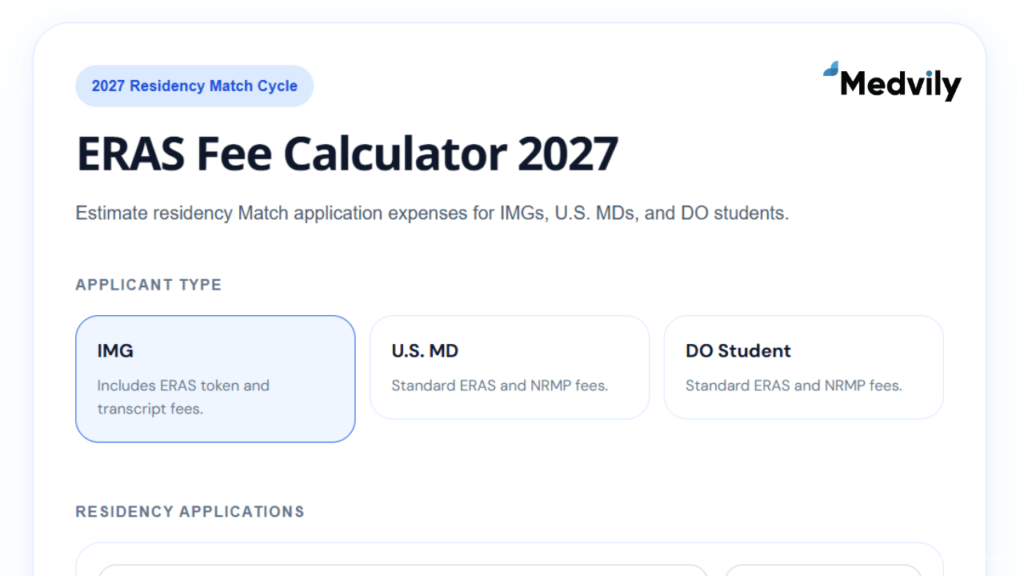
Calculate your ERAS expenses instantly using our ERAS Fee Calculator
What Is ERAS?
The Electronic Residency Application Service (ERAS) is one of the centralized application platform used by residency applicants in the United States. Through ERAS, applicants submit all core application materials to residency programs participating in the Match process. Nearly all major residency specialties participate in ERAS.
2027 ERAS Application Fees
The 2027 ERAS cycle uses a tiered pricing structure based on the number of residency programs an applicant applies to. Application costs increase substantially once applicants exceed 30 programs.
Official ERAS Fee Structure for 2027
| Number of Programs | Fee |
|---|---|
| First 30 Programs | $11 per program |
| Every Program After 30 | $30 per program |
This structure creates a significant financial escalation for applicants using broad application strategies.
Example: ERAS Fee Calculation
An IMG applying to 50 residency programs would pay:
First 30 Programs
30 × $11 = $330
Additional 20 Programs
20 × $30 = $600
Total ERAS Application Fees
$930
Importantly, this amount only reflects ERAS application submission costs. It does not include:
- NRMP registration fees
- ERAS token costs
- USMLE transcript transmission
- Interview-related expenses
- Visa processing
- Application advising services
As a result, actual residency Match expenses are often significantly higher than applicants initially anticipate.
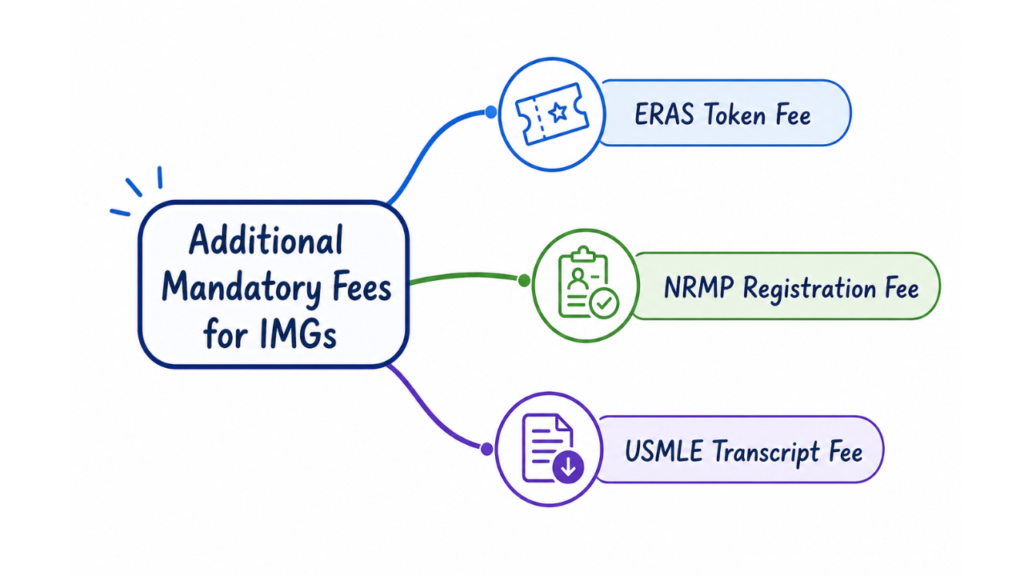
Additional Mandatory Fees for IMGs
International Medical Graduates generally face higher residency application costs because they must apply through ECFMG and pay several additional mandatory fees.
1. ERAS Token Fee
For the 2027 Match cycle:
- ERAS Token Fee: $185
The ERAS token is required for IMGs to access the ERAS platform through ECFMG. Without it, applicants cannot begin the residency application process.
2. USMLE Transcript Fee
Applicants must authorize ERAS to transmit their USMLE transcript to residency programs.
- USMLE Transcript Fee: $70
This is generally charged once per Match cycle.
3. NRMP Registration Fee
Applicants participating in the Match must also register separately with the National Resident Matching Program (NRMP).
For the 2027 cycle:
- NRMP Registration Fee: $85
This fee applies to:
- IMGs
- U.S. MD applicants
- DO applicants
Total Fixed Residency Application Costs by Applicant Type
International Medical Graduates (IMGs)
| Fee Type | Cost |
|---|---|
| ERAS Token | $185 |
| USMLE Transcript | $70 |
| NRMP Registration | $85 |
Total Fixed Fees: $340
These costs apply before ERAS application submission fees are even added.
U.S. MD Applicants
| Fee Type | Cost |
|---|---|
| NRMP Registration | $85 |
Total Fixed Fees: $85
DO Applicants
| Fee Type | Cost |
|---|---|
| NRMP Registration | $85 |
Total Fixed Fees: $85
Estimated Total Residency Application Costs for 2027
IMG Applicants
| Programs Applied | Estimated Total Cost |
|---|---|
| 20 Programs | ~$560 |
| 30 Programs | ~$670 |
| 50 Programs | ~$1,270 |
| 75 Programs | ~$2,020 |
| 100 Programs | ~$2,770 |
U.S. MD and DO Applicants
| Programs Applied | Estimated Total Cost |
|---|---|
| 20 Programs | ~$305 |
| 30 Programs | ~$415 |
| 50 Programs | ~$1,015 |
| 75 Programs | ~$1,765 |
| 100 Programs | ~$2,515 |
These estimates exclude interview travel, away rotations, visa processing, relocation, and residency preparation services, all of which can significantly increase total Match-season spending.
Why Residency Application Costs Have Increased
Residency application costs have risen dramatically over recent Match cycles due to increasing competition and aggressive application behavior.
Broad Application Strategies
Applicants now routinely apply to substantially larger numbers of programs to maximize interview opportunities.
This trend is particularly common in competitive specialties such as:
- Dermatology
- Orthopaedic Surgery
- Neurosurgery
- Plastic Surgery
- ENT
- Interventional Radiology
However, even traditionally IMG-friendly specialties like Internal Medicine and Pediatrics frequently see applicants submitting 50–100 applications.
Increased Competition for IMGs
International Medical Graduates often apply to more programs because of:
- Visa sponsorship limitations
- Program filtering criteria
- Lower interview conversion rates
- Geographic flexibility requirements
Some IMGs now apply to:
- 100+
- 150+
- even 200+ residency programs
At those levels, ERAS fees alone can cost several thousand dollars.
Supplemental Residency Costs
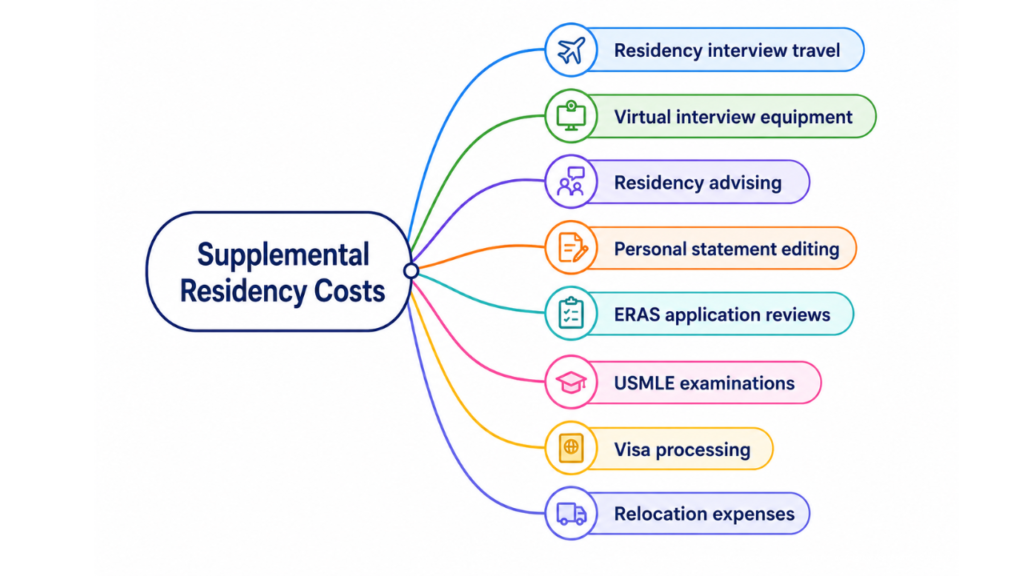
ERAS fees represent only one portion of total residency application expenses. Additional costs may include:
- Residency interview travel
- Virtual interview equipment
- Residency advising
- Personal statement editing
- ERAS application reviews
- USMLE examinations
- Visa processing
- Relocation expenses
For many applicants, especially IMGs, the overall Match process has become a major financial undertaking.
Should Applicants Apply to More Residency Programs?
One of the most frequently asked residency questions is:
Does applying to more programs improve Match chances?
The answer depends on several variables, including:
- Specialty competitiveness
- Visa status
- Board scores
- Research experience
- Clinical experience
- Geographic flexibility
- Application red flags
While broader application strategies may improve interview opportunities, there is often a point of diminishing returns.
For example:
- Applying strategically to 30 carefully selected programs may outperform blindly applying to 120 programs.
- Strong signaling and program targeting often matter more than raw application volume.
Applicants should focus on:
- Program fit
- IMG friendliness
- Historical interview patterns
- Visa sponsorship policies
- Geographic strategy
rather than simply maximizing application counts.
Common Residency Application Mistakes
- Underestimating Match costs. Many applicants budget only for ERAS submission fees and overlook additional expenses such as NRMP registration, transcript transmission fees, interview costs, advising services, and relocation expenses. This frequently creates financial stress later in the Match season.
- Applying without strategy. Mass-applying without proper research can waste thousands of dollars. Applicants should identify realistic programs, backup specialties, IMG-friendly institutions, and visa-sponsoring programs before submitting applications.
- Waiting until the last minute. Delayed preparation often results in weak personal statements, rushed ERAS applications, poor program selection, and unnecessary overspending. Early planning remains one of the strongest predictors of an efficient and financially sustainable Match season.
How to Budget for the 2027 Match Cycle
Start Saving Early
Applicants should ideally begin budgeting 6–12 months before ERAS applications open.
Build a Strategic Program List
Programs should generally be categorized into:
- Reach
- Target
- Safe
This reduces unnecessary applications and helps optimize spending.
Track Every Residency Expense
Applicants should estimate:
- ERAS application costs
- Fixed Match fees
- Interview expenses
- Relocation costs
before the residency application season begins.
FAQs
When do ERAS application fees usually need to be paid?
ERAS application fees are paid at the time applicants submit residency applications to programs. Once applications are certified and submitted, most fees are non-refundable.
Are residency application fees refundable if I withdraw applications?
No. ERAS application fees are generally non-refundable, even if you later withdraw applications, change specialties, or do not receive interviews.
Do visa-requiring IMGs usually apply to more residency programs?
Yes. Many visa-requiring IMGs apply to a larger number of programs because not all residency programs sponsor visas, which increases overall application costs significantly.
When Does ERAS Open for the 2027 Match Cycle?
ERAS for the 2027 residency Match cycle is expected to open in June 2026, allowing applicants to start preparing and submitting residency applications, documents, and letters of recommendation before programs begin reviewing applications in September 2026.
Which Residency Specialties Commonly Do Not Fully Participate in ERAS?
Some residency pathways or specialties may use separate match systems, early matches, or institution-specific applications, including: Ophthalmology, Urology and Military Medicine. These specialties may use separate matching services such as the San Francisco Match or the American Urological Association Match instead of the standard NRMP process.
Final Thoughts
The 2027 residency Match cycle continues the national trend toward rising application costs and increasingly aggressive application strategies.
For many applicants, particularly International Medical Graduates, the residency application process now represents a significant financial investment. Although ERAS fees may initially appear manageable, costs increase rapidly once applicants exceed 30 residency applications.
Understanding the fee structure early allows applicants to:
- Budget realistically
- Avoid unnecessary spending
- Apply strategically
- Reduce financial stress during Match season
Successful residency applicants increasingly distinguish themselves not by applying to the highest number of programs, but by building targeted, data-driven application strategies focused on program fit, competitiveness, and long-term career goals.
Feel free to check out New Residency Programs for Match 2027 and ERAS 2027 Worksheet Download

Ready to Apply? Let Medvily Guide You!
Medvily offers a complete suite of services including:
- Tutoring / Mentoring
- Clinical Electives
- Observerships & Externships
- Clinical Research
- Residency Application Support
- Mock Interviews & IV Prep
- Medical Licensing Support
Disclaimer: All trademarks referenced herein are the property of their respective owners. Medvily disclaims any affiliation, sponsorship, or endorsement by such trademark owners or their affiliated companies. The information provided is for general informational purposes only.