
The UK Medical Training Prioritisation Act became law on March 5, 2026, requiring NHS training programs to prioritize UK graduates and doctors with NHS experience. For international medical graduates planning residency in the UK, the pathway remains open but competition and strategy for securing training posts may change significantly.
Table of Contents
UK Medical Training Prioritisation Act: What Happened and Why It Matters
The UK Medical Training Prioritisation Act officially became law on March 5, 2026, after receiving Royal Assent from the UK government.
This legislation introduces a framework that allows the NHS to prioritize certain groups when allocating postgraduate medical training posts.
For international medical graduates (IMGs), the news triggered immediate concern.
Many doctors started asking questions such as:
- Is the UK residency pathway closing?
- Will IMGs still be able to get specialty training?
- Does this affect PLAB and GMC registration?
The reality is more nuanced than many headlines suggest.
The UK Medical Training Prioritisation Act does not close the door for international doctors. However, it does change the competitive landscape for postgraduate medical training in the UK.
Understanding these changes is essential for any IMG planning a residency pathway in developed countries, particularly within the NHS.

What the UK Medical Training Prioritisation Act Actually Does
The UK Medical Training Prioritisation Act introduces a legal requirement for NHS training authorities to prioritize certain applicants when allocating training posts.
In simple terms, when training programs distribute positions, priority groups may be considered first.
The main groups expected to receive prioritization include:
- Graduates of UK medical schools
- Doctors with significant NHS clinical experience
- Certain additional priority groups depending on the program
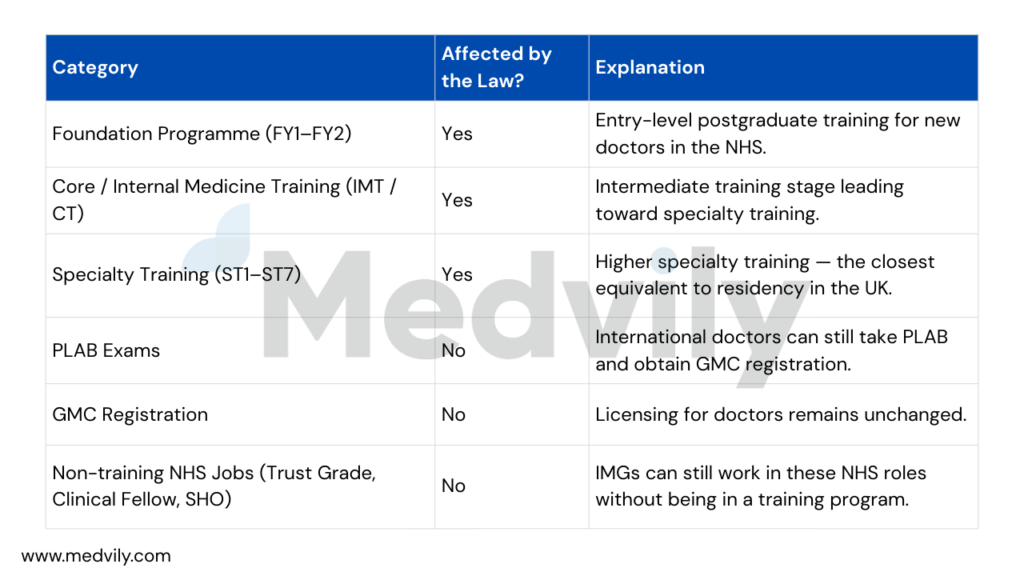
This prioritization applies specifically to NHS postgraduate medical training programs, which function as the UK equivalent of residency.
Examples include:
- Foundation Programme (FY1 / FY2)
- Internal Medicine Training (IMT)
- Core Surgical Training
- General Practice training
- Specialty Training (ST1–ST7)
These programs form the structured training pathway for doctors who want to become consultants or specialists in the UK.
Priority Order of Doctors (UK Medical Training Prioritisation Act 2026)
Below is a simplified priority hierarchy based on the legislation and policy briefings.
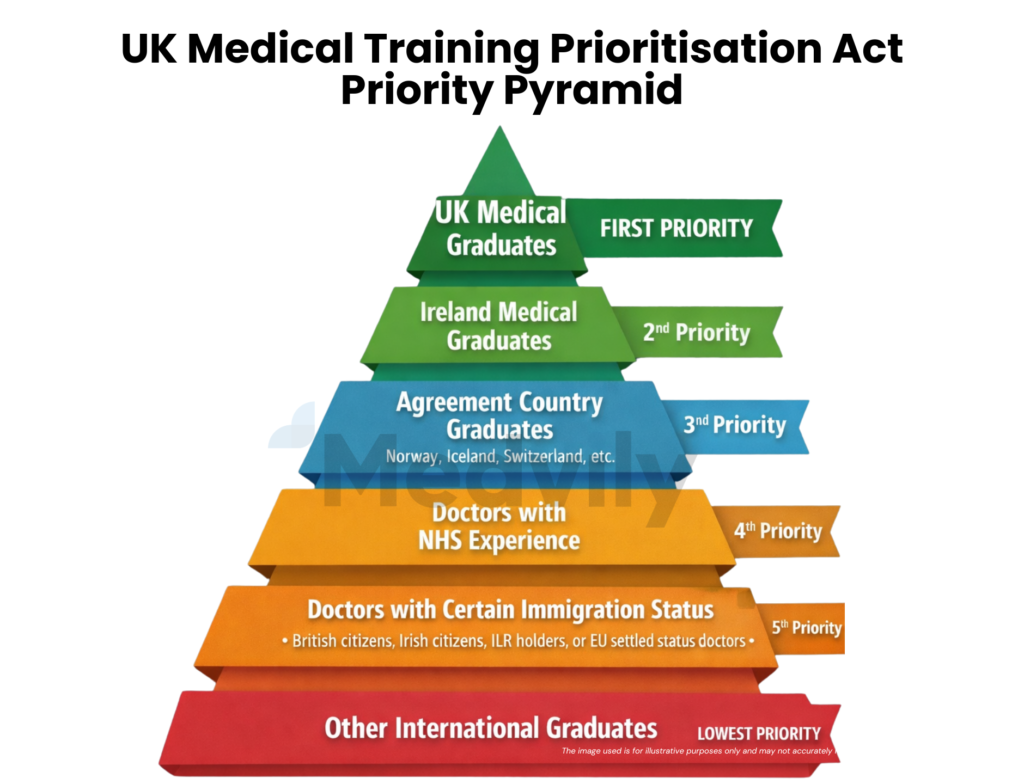
This graphic is a simplified educational illustration of the prioritisation framework introduced under the UK Medical Training (Prioritisation) Act 2026. It is intended for informational purposes only and does not represent official recruitment guidance or legally binding priority tiers. Actual eligibility, applicant prioritisation, and recruitment decisions for UK Foundation and Specialty Training programmes are determined by the relevant regulatory bodies, including NHS England and national recruitment offices, based on current regulations, recruitment policies, and individual applicant circumstances. While reasonable efforts have been made to ensure accuracy, the information presented here may not reflect all regulatory details, updates, or exceptions. Applicants should consult official sources and recruitment guidance for the most up-to-date and authoritative information.
Why the UK Government Introduced This Law
To understand the UK Medical Training Prioritisation Act, it is important to understand the context behind it.
Over the last decade, competition for NHS training posts has increased significantly.
Several factors contributed to this situation.
1. Increase in UK Medical School Graduates
The UK government has expanded medical school intake.
More UK medical students are graduating each year.
However, the number of available training posts has not increased at the same rate.
This created a training bottleneck.
2. Growing Number of Applicants
In recent years, NHS training programs have seen a dramatic rise in applications.
Many of these applicants include international doctors seeking postgraduate training in the UK.
This increased competition has made it harder for some UK graduates to secure training positions.
3. Workforce Planning Concerns
Medical organizations raised concerns that if UK graduates cannot access training opportunities, it could disrupt the long-term workforce pipeline.
The UK Medical Training Prioritisation Act aims to ensure that UK-trained doctors have a clearer pathway into specialty training.
Does the UK Medical Training Prioritisation Act Affect Residency for IMGs?
For international doctors, the biggest concern is whether the law blocks their access to UK training.
The short answer is no.
However, it may change the order in which applicants are considered.
The UK Medical Training Prioritisation Act primarily affects how training posts are allocated when competition is high.
International doctors can still:
- Apply for NHS training programs
- Obtain GMC registration
- Work in NHS hospitals
- Build clinical portfolios
- Apply for specialty training
The pathway remains open, but competition dynamics may shift.
UK Residency vs NHS Non-Training Jobs for IMGs
One critical detail often misunderstood is that the UK Medical Training Prioritisation Act affects training posts, not general NHS employment.
Many IMGs first enter the UK healthcare system through non-training roles.
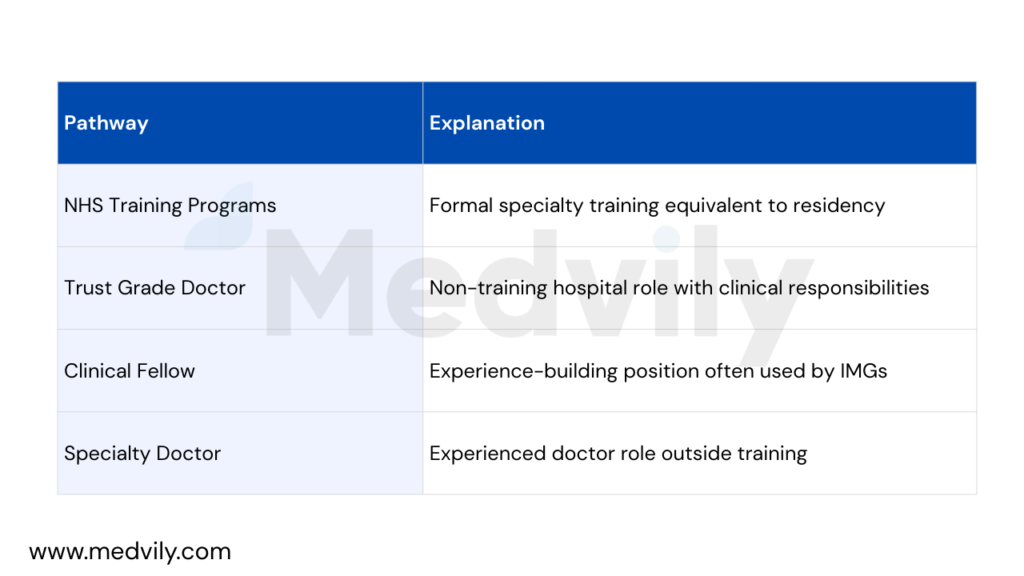
These non-training jobs allow international doctors to:
- Gain NHS clinical experience
- Build strong references
- Develop portfolios
- Prepare for training applications
For many IMGs, this pathway remains one of the most realistic routes into UK specialty training.
Timeline of the UK Medical Training Prioritisation Act
Understanding the timeline helps clarify how quickly the changes may affect applicants.
March 5, 2026
The bill receives Royal Assent and becomes the UK Medical Training Prioritisation Act.
2026 Recruitment Cycle
Prioritization is expected to occur primarily during the offer and allocation stage.
Applicants may still be interviewed and ranked.
However, priority groups could receive offers first.
2027 Recruitment Cycle and Beyond
The prioritization framework may expand to earlier stages such as:
- Shortlisting
- Interview invitations
- Ranking systems
These changes could affect how applicants progress through the selection process.

Can IMGs Still Get UK Residency After the Medical Training Prioritisation Act?
This is one of the most common questions international doctors are asking.
The answer is yes, but the strategy may need to evolve.
The UK remains one of the most IMG-friendly healthcare systems in the developed world.
International doctors still make up a large proportion of the NHS workforce.
However, the UK Medical Training Prioritisation Act means that IMGs may need stronger applications and better planning.
Success may increasingly depend on:
- NHS clinical experience
- Strong portfolios
- Consultant references
- Strategic specialty selection
Brutal Reality Check for IMGs
There is a lot of misinformation circulating about the UK Medical Training Prioritisation Act.
Here are some realities that many headlines do not explain clearly.
The UK Pathway Is Not Closed
International doctors are still essential to the NHS workforce.
Hospitals across the UK rely heavily on international medical graduates.
Competition Was Already Increasing
Even before the law passed, many specialties were becoming more competitive.
The new policy simply formalizes prioritization for certain applicants.
NHS Experience Will Become More Valuable
Doctors who already have NHS experience may remain competitive because the system values familiarity with NHS practice.
What Programs Don’t Tell You
One important insight often overlooked is that the NHS still faces significant staffing shortages.
International doctors fill many essential roles across the healthcare system.
Because of this, completely restricting IMG entry into training programs would be difficult.
Instead, the likely outcome is a more structured pathway where international doctors first gain NHS experience before entering formal training.
Strategy for IMGs After the New Law
If you are an international medical graduate planning to pursue medical residency in developed countries, strategic planning is critical.
Here are practical steps to consider.
1. Focus on Entering the NHS Workforce
Securing an NHS job is often the first step.
Positions such as clinical fellow or trust grade doctor can provide valuable experience.
2. Build a Strong Portfolio
Training programs often evaluate applicants using portfolio scoring.
Important components include:
- Clinical audits
- Quality improvement projects
- Teaching experience
- Research publications
- Conference presentations
3. Choose Specialties Strategically
Some specialties have extremely high competition ratios.
Being flexible with specialty choice can increase chances of entering training earlier.
4. Develop Professional Networks
Working within NHS hospitals helps doctors build relationships with consultants who can provide strong references.

Real IMG Scenario
Consider a typical international doctor pursuing UK training.
A doctor completes PLAB and obtains GMC registration.
They then secure a Junior Clinical Fellow position in an NHS hospital.
During two years of work, they:
- Participate in clinical audits
- Assist with teaching medical students
- Gain strong consultant references
- Learn NHS clinical protocols
When applying for specialty training later, they now have significant NHS experience and a competitive portfolio.
Even under the UK Medical Training Prioritisation Act, such candidates may remain strong applicants.
Common Mistakes IMGs Make
When major policy changes occur, misinformation spreads quickly.
Avoid these common mistakes.
Mistake 1: Assuming the UK Pathway Is Closed
The law does not ban IMGs from training.
Mistake 2: Panicking and Changing Plans Immediately
Policy changes often take several years to fully affect recruitment systems.
Mistake 3: Ignoring Portfolio Development
Strong portfolios remain one of the most important factors in training applications.
Quick Checklist for IMGs
✔ Understand the UK Medical Training Prioritisation Act
✔ Monitor NHS recruitment changes
✔ Gain NHS clinical experience
✔ Build a strong training portfolio
✔ Stay flexible about specialty choices
✔ Seek mentorship from experienced NHS doctors
FAQ
Does the UK Medical Training Prioritisation Act affect PLAB?
No. The UK Medical Training Prioritisation Act does not change PLAB exams or GMC registration requirements.
Can IMGs still work in the NHS?
Yes. The law does not affect non-training NHS jobs such as trust grade doctor or clinical fellow roles.
Will it become impossible for IMGs to enter UK training?
No. However, competition may increase, making strategy and preparation more important.
Does this law apply to all specialties?
The framework allows prioritization across NHS training programs, but the exact implementation may vary between specialties.
When will the law fully impact recruitment?
Initial implementation begins in the 2026 recruitment cycle, with broader changes expected in 2027 and beyond.

Conclusion
The UK Medical Training Prioritisation Act represents an important policy shift in how NHS postgraduate medical training posts are allocated.
The law aims to ensure that UK medical graduates receive priority access to training opportunities.
For international medical graduates, the pathway to UK specialty training is still open—but the competitive landscape is evolving.
IMGs who build strong portfolios, gain NHS experience, and plan strategically will continue to have opportunities within the UK healthcare system.
Understanding the implications of the UK Medical Training Prioritisation Act is the first step toward navigating this changing environment successfully.
Ready to Apply? Let Medvily Guide You!
Medvily offers a complete suite of services including:
- Tutoring/Mentoring
- Clinical Electives
- Observerships & Externships
- Clinical Research
- Residency Application Support
- Mock Interviews & IV Prep
- Medical Licensing Support
📩 Email: contact@medvily.com
🌐 Website: www.medvily.com
Disclaimer: All trademarks referenced herein are the property of their respective owners. Medvily disclaims any affiliation, sponsorship, or endorsement by such trademark owners or their affiliated companies. The information provided is for general informational purposes only and
Written by
Dr. Pradeep
Physician | Author | Global Healthcare Career Decision Strategist
10+ years advising doctors, nurses, and allied health professionals on international licensing, training, and career pathways
Expertise across USA, UK, Canada, Australia, Germany, Ireland, New Zealand, and the Middle East (UAE, Saudi Arabia, Qatar)