
Published: June 25, 2026
Last Updated: June 25, 2026
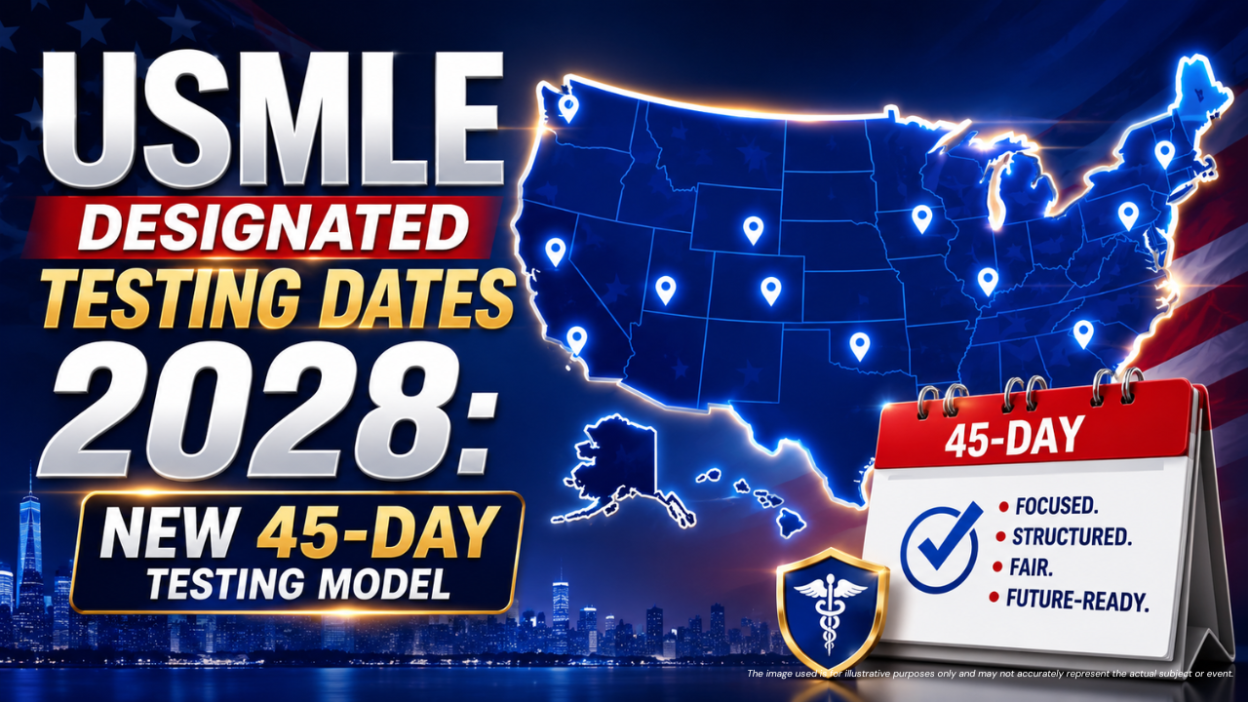
USMLE designated testing dates 2028 mark one of the biggest changes to exam scheduling in recent years. Starting in 2028, the USMLE will shift to a new 45-day designated testing model, replacing the current on-demand system. While this change may improve scheduling efficiency, it could also affect flexibility and exam planning for applicants worldwide.
Table of Contents
The United States Medical Licensing Examination (USMLE) is making one of its biggest operational changes in years. Starting January 1, 2028, the exam moves away from year-round availability to a fixed schedule called USMLE designated testing dates 2028.
Under this model, USMLE exams will only be offered on 45 designated testing days per year across all levels. The on-demand scheduling system most candidates have relied on is going away.
If you’re planning to take a Step exam in or after 2028, here’s what you need to know:
- What are USMLE designated testing dates?
- Why is USMLE ending on-demand testing?
- How does this affect medical students and IMGs?
- Could this delay your residency application?
What Are USMLE Designated Testing Dates 2028?
USMLE designated testing dates are pre-announced exam days; a fixed calendar that replaces the current flexible scheduling model.
Right now, candidates can book exams across most of the year at Prometric centers, based on seat availability. You pick a date when you feel ready.
Starting in 2028, that’s no longer how it works.
Candidates will choose from a set list of approved dates. These are called Designated Testing Dates (DTD).
The era of USMLE on-demand testing ending is no longer a rumor, it’s official.
USMLE Limited Testing Days 2028: The 45-Day Rule
USMLE put this plainly in the announcement:
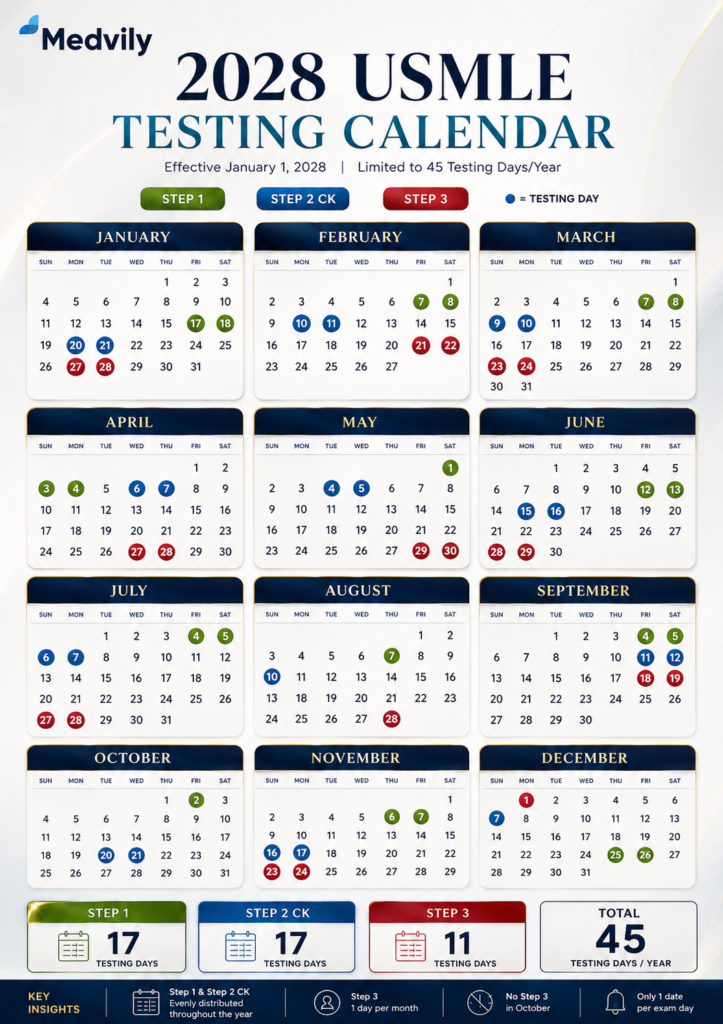
“USMLE exams will be offered on only 45 testing days per year beginning in 2028.“
This covers all three Steps combined, every administration across the entire licensing sequence fits within those 45 total days annually.
Currently, testing runs across hundreds of days a year. Going to 45 is a sharp cut.
The 45-day total is expected to stay consistent year to year, but specific calendar dates may shift.
Why Is USMLE Switching to Designated Testing Dates?
The stated reason is exam security.
Licensing exams globally have faced growing problems with:

- Question recall and memory-based sharing
- Unauthorized content exposure
- Test security breaches
- Unequal access to leaked material
- Threats to exam fairness
Fewer testing days means a smaller window for exam content to be recalled, circulated, and exploited.
The goal is to protect:
- Assessment integrity
- Score reliability
- Candidate fairness
- Public confidence in physician licensure
That’s the rationale. Whether 45 days is the right number to achieve it is a separate conversation, but that’s the official reasoning.
USMLE Exam Schedule Changes 2028: What Is Actually Changing?
The USMLE exam schedule changes 2028 go beyond just fewer dates. Several practical things shift:
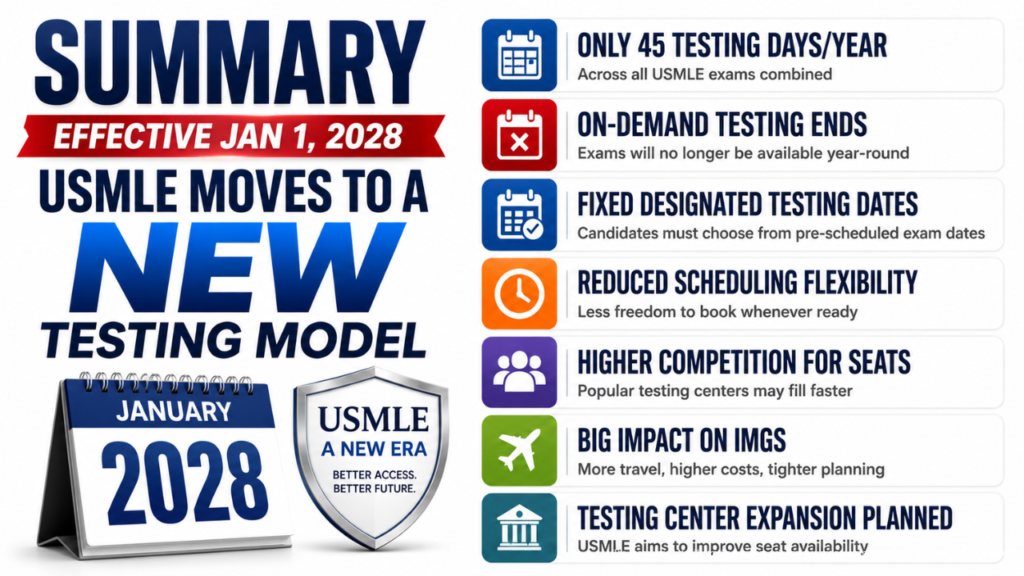
1. Reduced Scheduling Flexibility
No more picking from broad testing windows. Planning happens around fixed dates.
2. Increased Competition for Seats
Fewer testing days means more candidates competing for the same slots, especially in regions. Popular testing locations will fill faster.
3. Earlier Registration Pressure
Candidates who wait may not get their preferred center or date. Early registration becomes more important.
4. More Strategic Planning
Study schedules will need to work backward from fixed dates rather than forward from readiness. Instead of “I’ll book when I’m ready,” the question becomes “Am I ready for this date?”
For candidates who’ve always used readiness as their scheduling cue, that’s a harder adjustment than it sounds.
How USMLE Testing Is Changing in 2028 for Medical Students
For U.S. medical students, the transition may be more manageable, but it’s not frictionless.
Medical school already runs on structured timelines:
- Pre-clinical milestones
- Clerkship rotations
- Graduation requirements
- Residency application cycles
Most schools provide scheduling guidance, which helps. But fixed testing dates can still create problems if:
- A student needs to reschedule
- Illness disrupts timing
- Academic delays push things back
- A leave of absence changes the plan
The USMLE designated testing dates impact on medical students will depend largely on how much flexibility their institution can build around the fixed calendar.
USMLE Designated Testing Dates Impact on IMGs
IMGs are likely to feel this change most sharply.
The reasons are practical:
- Visa complications
- International travel logistics
- Fewer local testing centers
- Currency and payment barriers
- Delayed document processing
- Less predictable personal timelines
Scheduling flexibility has historically been one of the few things working in IMGs’ favor.
Under the new model, the USMLE designated testing dates impact on IMGs could mean:

Higher Travel Burden
If local seats fill quickly, candidates may need to travel to another city or country.
Greater Financial Risk
Missing a designated testing date could push exam completion back by weeks or months, not just days.
Residency Application Delays
A late testing date can affect ERAS readiness, score reporting timing, and interview eligibility. For competitive specialties, timing matters.
Will USMLE Designated Testing Dates Affect Residency Timeline?
Possibly, yes.
Residency applications run on fixed annual calendars. A delayed Step score can affect:
- When an application is complete
- Score release timing relative to program review
- Interview invitation windows
A missed designated testing date doesn’t just cost a few weeks, it could push score release into a later part of the application season.
That’s a real risk for anyone targeting competitive programs or trying to match in their first cycle.
The exact impact depends on how the testing calendar is distributed across the year, how quickly scores are released, and where ERAS deadlines fall. For now, the safest approach is to stay well ahead of scheduling.
USMLE Testing Center Expansion 2028
USMLE has acknowledged the access concerns that come with fewer testing days.
As part of the transition, there are plans for USMLE testing center expansion 2028, including:
- Additional testing center capacity
- Better geographic seat distribution
- Seats reserved exclusively for USMLE candidates
- Improved access for international candidates
The idea is that fewer testing days doesn’t have to mean fewer available seats, just more concentrated ones.
Whether that pans out in practice, especially for international candidates, will become clearer as the 2028 calendar firms up.
USMLE Designated Testing Dates Community Sessions 2026
USMLE announced community engagement sessions in July and August 2026 to walk candidates through the transition.
These sessions are expected to cover:
- Policy rationale
- Scheduling logistics
- Candidate questions
- Operational specifics
- Future calendar updates
Interest in USMLE designated testing dates community sessions 2026 is rising as candidates look for early clarity on seat availability, rescheduling rules, emergency accommodations, and international access.
Details will come through official USMLE communications, worth monitoring.
Official USMLE Designated Testing Dates Calendar 2028
The official USMLE designated testing dates calendar 2028 has been released and confirms the 45 testing days per year structure.
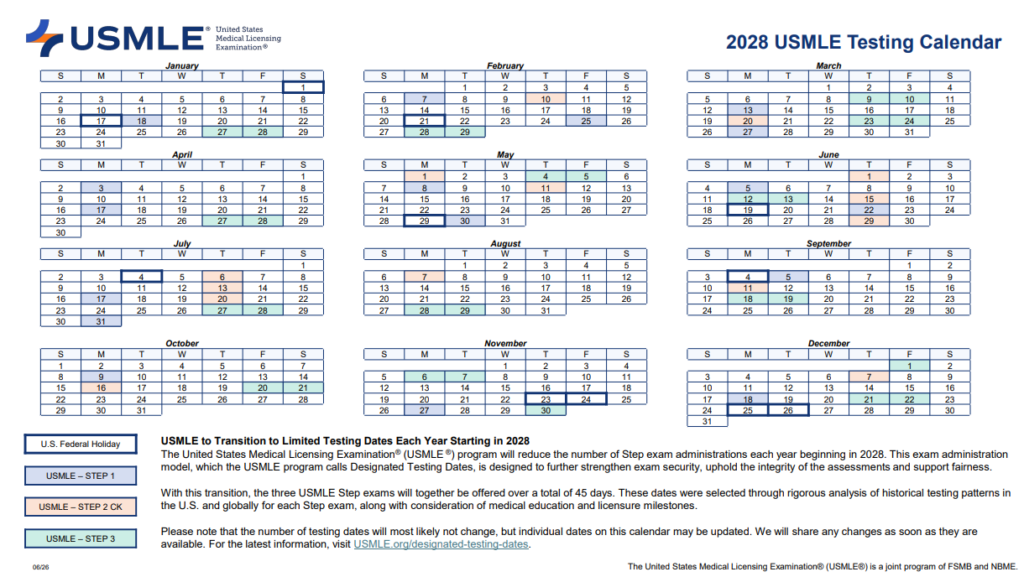
It shows how those days are distributed across all three Steps throughout the year.
Individual dates may be adjusted in future releases, so checking official announcements regularly is a good habit.
What Should Candidates Do Now?
The policy starts in 2028, but planning now is the right call.
- Stay current with official USMLE announcements and
USMLE Designated Testing Dates Information Hub - Build earlier timelines into your exam planning
- Add buffer time to your prep schedule
- Don’t assume the flexibility you have today will carry forward
If you’re testing before 2028, this doesn’t affect you directly. If your exam timeline extends into 2028 or beyond, this deserves serious attention.
FAQs
Does the USMLE 45-day limit apply globally, or are international testing centers treated separately?
The 45 designated testing days apply to the USMLE program globally, USMLE has not indicated that international centers will operate on a separate calendar. However, how seat allocation is distributed across domestic and international Prometric locations within those 45 days has not been detailed. This is one of the open questions expected to be clarified through official communications before 2028.
Will score reporting timelines change under the designated testing dates model?
No. USMLE has confirmed that score reporting will remain on the same schedule, results will still be released 2–4 weeks after the exam date. The shift to designated testing dates does not affect how quickly scores are processed or reported.
Will the registration process change?
The core registration process stays the same. However, specifics like eligibility period length and rescheduling rules may be adjusted to fit the designated testing dates model. USMLE has said those details are still being finalized and will be shared before the 2028 transition.
Do eligibility requirements change under the new model?
No. Eligibility requirements for all three Step exams remain unchanged.
Final Thoughts
45 testing days per year. All three Steps. Starting 2028.
That’s the change. USMLE says it’s about security and fairness, and the reasoning is defensible, fewer testing windows means less exposure of exam content. But it also puts more pressure on candidates to get scheduling right the first time.
For IMGs, a missed date isn’t just inconvenient. Depending on where it falls in the year, it can set back a residency application by an entire cycle.
Start planning earlier than you think you need to.
Check out our USMLE Cost Calculator: Instantly calculate your total USMLE cost including exam fees, ECFMG charges, travel, preparation resources, and hidden expenses — updated for 2026.

Reviewed by: Medvily Verified Residency Experts
Ready to Apply? Let Medvily Guide You!
Medvily offers a complete suite of services including:
- Tutoring/Mentoring
- Clinical Electives
- Observerships & Externships
- Clinical Research
- Residency Application Support
- Mock Interviews & IV Prep
- Medical Licensing Support
📩 Email: contact@medvily.com
🌐 Website: www.medvily.com
Disclaimer: All trademarks referenced herein are the property of their respective owners. Medvily disclaims any affiliation, sponsorship, or endorsement by such trademark owners or their affiliated companies. The information provided is for general informational purposes only and