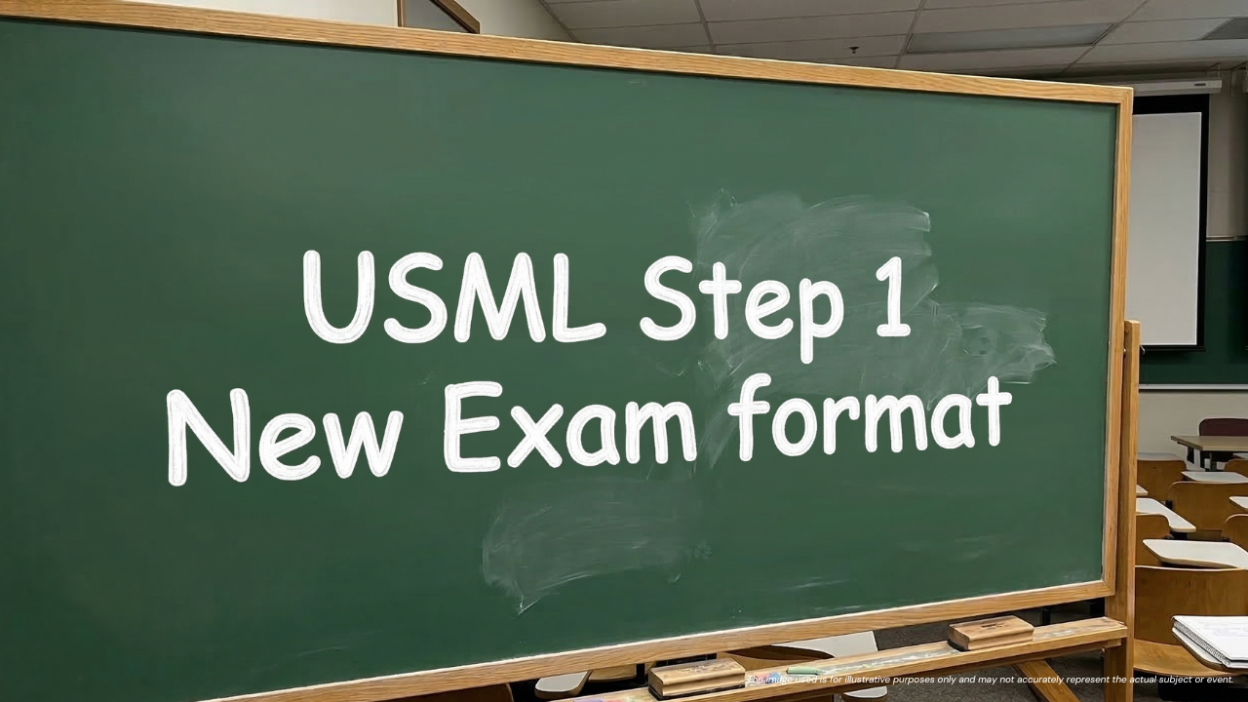
The USMLE Step 1 new exam format takes effect on May 14, 2026. Learn how the new 14-block structure works, what remains the same, and how IMGs should adjust their preparation strategy.
Table of Contents
If you’re preparing for Step 1 and your test date falls after May 14, 2026, something is changing about how you’ll sit the exam.
Not what you’re tested on. The science stays the same.
What’s changing is how the questions are delivered to you; the block structure, the session length, the pacing of the entire day.
The USMLE program, run jointly by the United States Medical Licensing Examination and the National Board of Medical Examiners, is rolling out new test delivery software. Anyone testing from May 14 onward will encounter a different exam structure than what Step 1 has used for years.
The short version: the exam is being split into more, shorter pieces. That’s the whole update.
What’s actually changing
The current Step 1 format runs 7 blocks, each with 40 questions and a 60-minute time limit.
That’s roughly an hour of continuous focus, seven times over, across an exam day that totals about 8 hours.
Starting May 14, the same exam gets divided into 14 blocks instead. Each block has 20 questions and runs 30 minutes.
280 questions total. Same content. Same pass/fail scoring. Just divided differently.
Current Exam Format vs
USMLE Step 1 New Exam Format
| Feature | Current format | New format (May 14 2026)+ |
|---|---|---|
| Total questions | 280 | 280 |
| Number of blocks | 7 | 14 |
| Questions per block | 40 | 20 |
| Time per block | 60 minutes | 30 minutes |
| Total exam length | ~8 hours | ~8 hours |
The syllabus doesn’t change. Pathophysiology, pharmacology, microbiology, biochemistry, all of it stays identical.
The NBME has been clear: the update is structural, not substantive.
Why they’re changing it
Step 1 is one of the longer single-day exams in medical training.
Eight hours of continuous testing creates real cognitive fatigue. Most test-takers know exactly what that feels like; somewhere around question 30 of a long block, attention starts sliding. You’re still answering, but you’re not reasoning as cleanly as you were at question 5.
Shortening blocks to 20 questions and 30 minutes creates more stopping points. You finish a block, take a breath, reset, go again.
There’s also a practical side. The testing software is being modernized. Medical licensing exams globally have been shifting toward more modular digital platforms, and this update brings Step 1 in line with that direction; better navigation, better accessibility, better stability.
The block restructure and the software upgrade are happening together.
What this actually means on test day
The total workload is unchanged, but the rhythm of the day is different.
- You’ll transition between blocks more often. With 14 sessions instead of 7, you’re resetting your mental state twice as frequently. Some people find this disruptive at first. Others find it easier to stay sharp when sessions are shorter.
Worth knowing which type you are before test day — not after.
- Fatigue within blocks should be less of a problem. The phenomenon of burning out in the back half of a long block becomes less likely when each block is only 20 questions. That’s roughly 30 minutes of sustained focus at a stretch. Most people handle that better than 60.
- Break strategy becomes more deliberate. The total break time available during the exam isn’t changing, so you still have to manage hydration, food, and mental recovery within the same window. With more blocks, you’ll need to decide when to pause and when to push through. No universal answer here but you should have a plan going in, not a vague intention.
- Flagging strategy shifts too. In a 40-question block, flagging 8 to 12 questions and circling back is common practice. With 20 questions, that same approach gets risky, reviewing half a block at the end eats into 30 minutes quickly. Flag only genuinely uncertain questions. Make a call on everything else. Keep moving.
How to adjust your preparation to the USMLE Step 1 New Exam Format
If your exam is after May 14, a few changes to your practice structure are worth making.
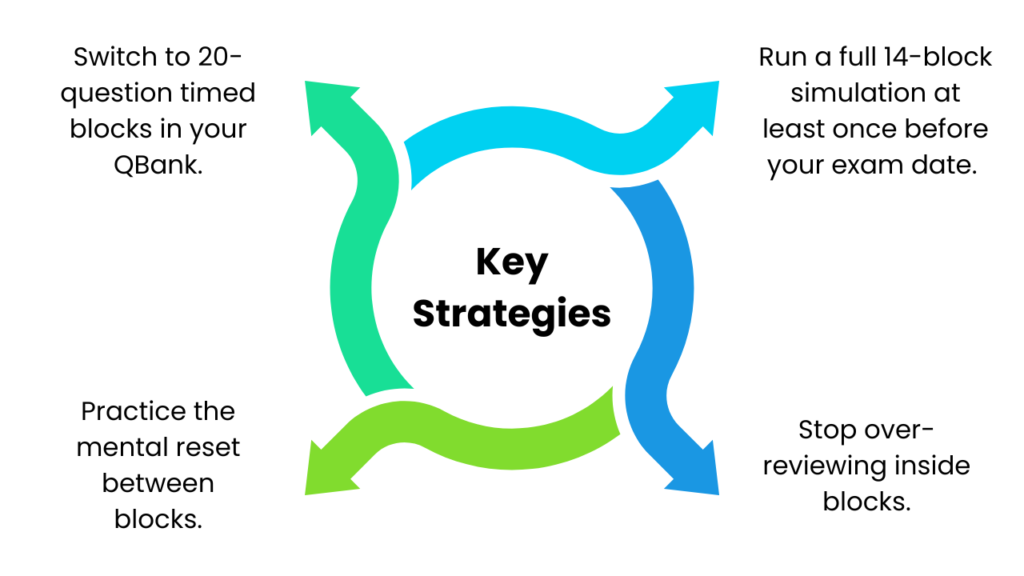
- Switch to 20-question timed blocks in your QBank. Most platforms let you customize block length. If you’ve been running 40-question sessions because that matched the old format, change it now. Practicing in the format you’ll actually test in is basic preparation hygiene.
- Practice the mental reset between blocks. Finish a timed block, pause 30 to 60 seconds, start the next one. This sounds almost too simple to bother with, but the transition between blocks is a real skill. You’re carrying the emotional residue of whatever just happened into the next session. Training yourself to drop it quickly matters.
- Run a full 14-block simulation at least once before your exam date. Build it out properly: 14 timed blocks, realistic breaks, the full 8-hour commitment. The goal isn’t to exhaust yourself — it’s to know what the late blocks feel like when you’re genuinely tired.
- Stop over-reviewing inside blocks. With 30 minutes for 20 questions, spending four or five minutes wrestling with a single stem can derail the rest of the block. Trust your first instinct more than you’re probably used to.
Common Mistakes Test Takers Are Making After the USMLE Announcement
Since the USMLE Step 1 new exam format for 2026 was announced, student forums have been full of reactions; most of them more panicked than the situation warrants. The exam is still 280 questions, still pass/fail, still testing the same clinical reasoning. The only real change is block structure: 14 blocks of 20 questions at 30 minutes each, instead of the old 7-block setup.
But that hasn’t stopped some students from making decisions they’ll probably regret.
Common mistakes students are currently making after the USMLE Step 1 new exam format announcement.
- Rescheduling for the wrong reasons. Some students rush to test earlier to avoid the new interface or delay their exam assuming smaller blocks mean an easier test. The content, difficulty, and scoring remain unchanged. Disrupting your study timeline over a UI change can harm your preparation.
- Treating the format like a new exam. The exam itself has not changed. You still need to interpret clinical vignettes, apply biomedical science, and recognize disease patterns. Spending weeks analyzing the block structure wastes time that should go toward core subjects.
- Not adjusting timing practice. One practical adjustment is pacing. If you only practice 40-question blocks, you may not adapt to the new exam rhythm. Incorporating timed 20-question blocks helps you become comfortable with the pacing without changing what you study.
- Assuming shorter blocks mean an easier exam. The question difficulty and scoring remain the same. While fatigue might be slightly easier to manage, the exam is not easier. Students who make this assumption often neglect challenging topics.
- Skipping a break strategy. More blocks do not automatically mean better recovery. Without a planned break schedule for hydration and mental resets, fatigue can accumulate and affect performance in the later blocks.
- Spending more time debating than studying. Every USMLE update generates speculation online. Students who focus on question banks and spaced repetition consistently outperform those who spend weeks analyzing rumors and forum discussions.
USMLE Step 1 preparation checklist for the new 2026 format
Use this before your exam date. Not the night before — weeks before.
QBank setup
Simulation practice
Test-day mental prep
In the weeks before
What you don’t need to do
- You don’t need to relearn any content because of this format change
- You don’t need to buy new prep materials
- You don’t need to reschedule your exam just to avoid the new interface
If I were an IMG sitting Step 1 after May 14
- Switch my QBank to 20-question timed blocks (30 minutes) immediately.
- Train fast decision-making and avoid overanalyzing long question stems.
- Practice a mental reset between blocks so each block feels like a fresh start.
- Run at least one full 14-block simulation weeks before the exam.
- Plan your break timing in advance instead of deciding on exam day.
- Use the shorter blocks to recover quickly after a difficult section.
- Ignore panic in forums — the science and difficulty of USMLE Step 1 hasn’t changed.
- Keep the bigger goal in mind: Step 1 pass → strong Step 2 CK score → US clinical experience → competitive residency application.
This section is for international medical graduates specifically — because the format change lands differently for IMGs than it does for US MD students.
If I were an IMG preparing for Step 1 after May 14, 2026 when the USMLE Step 1 new exam format comes into effect, my first move wouldn’t be to panic about the new interface.
It would be to change how I practice.
The science tested on Step 1 hasn’t moved. Same pathophysiology, same pharmacology, same clinical reasoning under pressure. What’s different is the shape of the exam day; fourteen 30-minute sprints instead of seven 60-minute slogs.
That shift matters more than most people think. Here’s how I’d approach it.
1. Train in 20-question blocks from day one
This is the most obvious adjustment, and also the most skipped.
Most IMGs spend months grinding 40-question blocks because that’s what every forum post from 2023 recommends. The new format doesn’t work that way.
I’d switch immediately:
- 20-question timed blocks only
- 30-minute timer, no extensions
- Start the next block after a short reset, not a long break
Format familiarity is underrated. By exam day, 20 questions in 30 minutes should feel completely automatic not unfamiliar.
2. Practice the mental reset, deliberately
Under the new format, you reset your focus 14 times in a single day instead of 7.
That’s not trivial. Each reset is a chance to either shake off a bad block or carry its stress into the next one.
I’d train this specifically:
- Finish a block
- Close the review screen
- Take 30 to 60 seconds — breathe, let it go
- Open the next block and start
The goal is to treat each block as a completely separate event. What happened in block 6 is irrelevant to block 7. Training that mental cut takes repetition.
3. Build decision speed, not just knowledge
Many IMGs come from educational systems that reward deep analysis and careful memorization. That’s genuinely useful for learning medicine.
It can hurt you on Step 1.
With only 20 questions per block, one or two overthought stems can eat into your review time badly. I’d actively train myself to:
- Spot the key diagnostic clue in the first read
- Avoid rereading long stems more than once
- Flag and move, don’t sit on a question
- Trust the first clinical instinct more often than feels comfortable
Step 1 is a pattern recognition exam. The faster you recognize patterns, the better you do.
4. Simulate full exam days earlier than you think you need to
This is where most IMGs leave performance on the table.
Step 1 is still an 8-hour exam. Shorter blocks don’t change the total duration. What they change is the rhythm; and rhythm is something you have to train, not just understand.
I’d run a full 14-block simulation at least 6 to 8 weeks before my exam date, not 2 weeks before. That simulation would include:
- All 14 timed blocks
- Planned breaks at realistic intervals
- Real food and hydration, not just water
- No pausing or cheating the timer
One full simulation tells you more about your actual exam readiness than weeks of standard QBank sessions.
5. Use the shorter blocks to recover faster mid-exam
This one is genuinely underappreciated.
Under the old 40-question format, a rough block could drag you down for an entire hour. By question 35, you might still be rattled by something that went wrong at question 10.
With 20-question blocks, that window closes faster. A bad block ends in 30 minutes. You reset. You move on.
I’d lean into that actively:
- Treat each block as a fresh mini-exam
- Once a block ends, those questions don’t exist anymore
- Focus only on what’s in front of you right now
IMGs who struggle with exam anxiety often perform better in shorter sessions. This format change may actually work in your favor.
6. Plan your breaks before exam day, not during it
Most students think about break strategy loosely. That’s a mistake.
With 14 blocks, the temptation is to take small breaks frequently, which sounds reasonable until you’ve burned through all your break time by block 9 and you’re exhausted for the final stretch.
I’d map this out in advance. One way it could look:
- Short break after block 3
- Short break after block 6
- Longer break (lunch) after block 9
- Final short break before block 12
Test it during your full simulations. Adjust based on where your fatigue actually hits, not where you assume it will.
7. Don’t let IMG communities talk you into rescheduling
This needs to be said directly.
Every time the USMLE changes anything, online communities generate a lot of noise about it. Forums fill up with speculation about whether the new format is harder, easier, or worth avoiding.
Most of that noise isn’t useful.
The facts are simple:
- 280 questions, same as before
- Same scientific content
- Same pass/fail scoring
- Same difficulty level
The format change affects pacing, not knowledge. If your preparation is solid, the interface doesn’t matter. If your preparation isn’t solid, a familiar interface doesn’t fix it.
8. Keep the bigger picture in mind
Step 1 is one exam in a longer journey.
As an IMG, residency competitiveness depends on a combination of things:
- Step 1 pass
- Step 2 CK score
- US clinical experience
- Letters of recommendation
- A well-constructed ERAS application
The new block format is a logistical change in a much larger career strategy. Treat it that way — adjust your preparation, practice in the right format, and move forward.
The exam hasn’t gotten harder. You just need to train for a slightly different shape of the same day.
Who this affects — and who it doesn’t
If you’re testing before May 14, 2026, none of this applies. You’ll sit the current 7-block format.
If you’re testing on or after May 14, you’ll see the new structure.
Does the new format make the exam easier?
Probably not in any meaningful sense.
The questions are the same. The pass standard is the same. The knowledge required doesn’t change. Shorter blocks don’t fix a weak foundation in pathology.
What the new format may do is reduce the performance gap between your early blocks and your late ones. A consistent frustration Step 1 test-takers report is that their accuracy drops as the day goes on, not because they don’t know the material, but because fatigue degrades how carefully they read stems.
If shorter blocks reduce that dropout, your late-day performance might more accurately reflect what you actually know.
That’s not a minor thing. But it’s not a free pass either.
FAQs on the USMLE Step 1 New Exam Format
Is there a change in the syllabus for the USMLE Step 1 Exam New Format?
No. No change as of today
Does pass/fail scoring change?
No.
Will question difficulty change on the USMLE Step 1 New Exam Format?
The USMLE hasn’t announced any change to difficulty.
Do I need a completely new study strategy?
No. Adjust your block length, practice the reset, run a full simulation. That’s it.
What if I’ve already been using 40-question blocks?
Switch now. Four weeks of 20-question practice is enough to make the new format feel natural.
Should I reschedule to test before May 14?
Only if your preparation is genuinely ready before then. Not to avoid the interface change.

The bottom line
Step 1 on May 14, 2026 is the same exam with a different structure.
Same questions. Same science. Same scoring. The blocks are shorter and there are more of them.
If you’ve ever burned out in the back half of a long block, you’ll probably appreciate it. If you’ve struggled with pacing, 14 shorter sessions give you a cleaner frame to work within.
And if the format change is making you anxious, that’s understandable, but it’s also a distraction. The exam doesn’t care how you feel about the interface. It just asks whether you know the material.
Prepare well. Practice in the right format. Show up.
This article is for informational purposes based on publicly available USMLE format announcements. Always verify current policies directly at usmle.org and ecfmg.org before your exam date.
Check out USMLE Step 3 Software Updated (March 2026): New Exam Interface
Also feel free to check our USMLE Cost Calculator & YOG: Risk Calculator

Ready to Apply? Let Medvily Guide You!
Medvily offers a complete suite of services including:
- Tutoring / Mentoring
- Clinical Electives
- Observerships & Externships
- Clinical Research
- Residency Application Support
- Mock Interviews & IV Prep
- Medical Licensing Support
Disclaimer: All trademarks referenced herein are the property of their respective owners. Medvily disclaims any affiliation, sponsorship, or endorsement by such trademark owners or their affiliated companies. The information provided is for general informational purposes only.