

YOG for Residency plays a critical role in how residency programs screen applications. Calculated as Match Year minus Graduation Year, it can trigger automated filters at 3-, 5-, or 7-year thresholds. This article explains how YOG impacts IMGs, how it interacts with USMLE scores and clinical continuity, and what strategies can offset higher graduation gaps to remain competitive in the Match.
Table of Contents
When international medical graduates begin planning their U.S. training pathway, one variable silently shapes their competitiveness: YOG for residency. While USMLE scores, U.S. clinical experience, and letters of recommendation are visible metrics, year of graduation operates as a structural filter within many residency programs.
Understanding how YOG for residency functions in program screening, automated filtering systems, and application review can prevent avoidable rejections and allow for strategic positioning within the Match process.
This article breaks down the operational realities behind YOG, how residency programs use it, and what international medical graduates must do at different graduation intervals.
What Is YOG in the Residency Application Context?
YOG stands for Year of Graduation. In the residency process, YOG refers to the year printed on your final medical degree certificate — not the year you passed exams, not internship completion unless reflected on the diploma, and not ECFMG certification date.
For residency programs, YOG for residency is calculated as:
YOG = Match Year – Graduation Year
If you graduated in 2020 and apply for the 2027 Match:
2027 – 2020 = 7 years since graduation.
This metric becomes part of automated filtering logic in many program management systems.
Important note: Some programs do consider the YOG as below:
YOG =
Match Year – Year of Submitting Applications to the Programs
If you graduated in 2020 and apply for the 2027 Match, for which application are submitted in September 2026 then
2026 – 2020 = 6 years since graduation.
Calculate Your YOG Instantly
Before reading further, calculate your YOG for residency and see your risk level for the upcoming Match cycle.
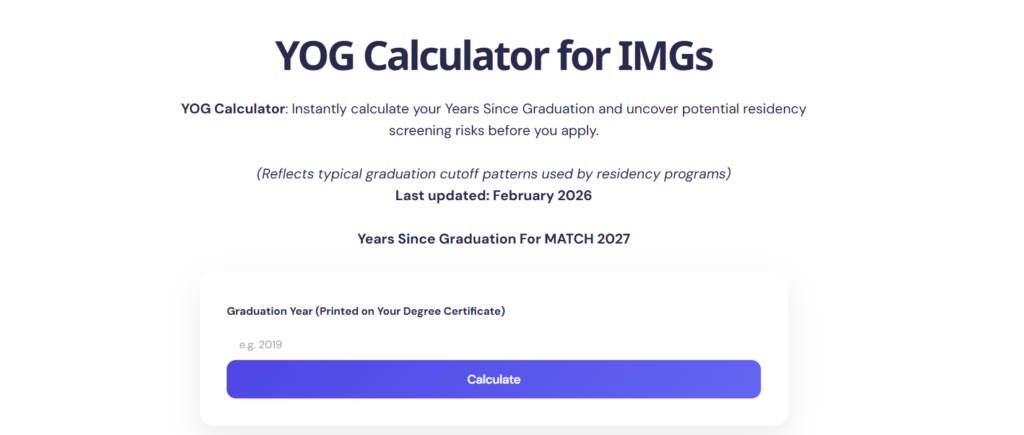
Click here to Use the free YOG Calculator for IMGs
Why Residency Programs Care About YOG
Residency programs receive thousands of applications per cycle. Automated filtering systems help narrow the pool before manual review begins. YOG functions as:
- A proxy for clinical recency
- A signal of training continuity
- A risk management tool
- A screening efficiency parameter
While YOG alone does not determine acceptance, YOG for residency influences whether an application is reviewed at all.
Programs often apply:
- 3-year preferred recency
- 5-year soft cutoff
- 7-year hard filter
These are not universal rules, but patterns observed across multiple specialties.

How YOG Filters Work in Practice
Many programs use ERAS-integrated screening tools. When YOG exceeds a predefined threshold:
- Applications may be automatically hidden
- Review priority may decrease
- Manual review may require justification
This does not mean older graduates cannot match. It means that higher YOG requires compensatory strengths.
Understanding how YOG for residency interacts with Step scores, U.S. clinical experience, and research output is critical.
YOG and International Medical Graduates
For IMGs, YOG carries additional implications:
- Visa-requiring applicants face compounded screening
- Community programs may apply stricter graduation windows
- Academic programs may prioritize continuous training
The strategic mistake many IMGs make is assuming USMLE performance alone offsets graduation gaps. In reality, programs evaluate the total risk profile.
A 250 Step 2 CK score does not automatically neutralize a 9-year YOG. It improves competitiveness, but structured continuity remains essential.

YOG Risk Stratification by Years Since Graduation
0–3 Years Since Graduation
Low structural risk.
Applicants in this window experience minimal YOG-related filtering. Programs evaluate:
- USMLE scores
- Clinical performance
- Letters
- Specialty alignment
For these candidates, YOG for residency is rarely a limiting factor.
Strategic priority: maximize score performance and secure recent U.S. clinical experience.
4–5 Years Since Graduation
Moderate structural exposure.
Some programs begin applying graduation filters within this interval. Competitive specialties may prefer recent graduates, though many programs remain accessible.
Strategic priority:
- Maintain active clinical involvement
- Avoid unexplained CV gaps
- Obtain recent U.S. letters
- Demonstrate ongoing engagement
Here, YOG for residency becomes a contextual variable rather than a barrier.
6–7 Years Since Graduation
Elevated filtering probability.
This range intersects with common 5-year cutoffs used by certain programs. Manual review becomes more selective.
Strategic priority:
- Demonstrate continuous medical practice
- Complete recent U.S. clinical experience
- Provide clear narrative explanation
- Target programs without strict graduation filters
Applicants in this category must approach YOG for residency as a strategic planning variable.
8+ Years Since Graduation
High structural filter risk.
Many programs apply 7-year thresholds. Automated filtering increases significantly.
However, matching remains possible with:
- Strong USMLE performance
- Active clinical employment
- Research productivity
- Clear career trajectory explanation
- Strategic program targeting
At this stage, YOG for residency demands deliberate application design rather than broad application volume.
Specialties and YOG Sensitivity
Different specialties show varying sensitivity to graduation timelines.
More YOG-sensitive specialties:
- Dermatology
- Orthopedic Surgery
- Plastic Surgery
- Radiology
Moderately sensitive specialties:
- Internal Medicine
- Pediatrics
- Neurology
Lower relative sensitivity (program dependent):
- Family Medicine
- Psychiatry
- Pathology
These are trends, not absolutes. Program-specific review remains essential.

YOG and USMLE Scores: Which Matters More?
Applicants often ask whether a high Step score overrides graduation years.
The reality:
- USMLE score influences ranking.
- YOG influences initial screening.
If an application is filtered out due to graduation criteria, score becomes irrelevant.
Therefore, optimizing YOG for residency strategy includes:
- Timely application planning
- Avoiding unnecessary delay
- Maintaining active engagement
The Hidden Variable: Clinical Continuity
Programs evaluate not only how many years since graduation have passed, but what occurred during that time.
Strong continuity signals:
- Active hospital employment
- Research involvement
- Specialty-consistent practice
- U.S. clinical rotations
- Academic appointments
Weak continuity signals:
- Unexplained gaps
- Career switching without narrative
- Non-clinical inactivity
Applicants must frame their profile beyond raw YOG calculation.

The Strategic Role of Timing
Match timing directly influences YOG.
Applying earlier reduces graduation gap.
Delaying application increases structural exposure.
Candidates sometimes delay for:
- Score improvement
- Research publication
- Visa planning
Delays must be weighed against the impact on YOG for residency.
A one-year delay may convert a 4-year YOG into a 5-year YOG, crossing program filters.
How to Offset Higher YOG
If your YOG exceeds five years, strategic reinforcement becomes essential:
- Maintain clinical engagement.
- Obtain recent U.S. letters of recommendation.
- Demonstrate academic productivity.
- Craft a cohesive personal statement explaining progression.
- Apply strategically rather than broadly.
- Network where possible through observerships or conferences.
Residency programs seek reliability, not perfection. A well-explained trajectory reduces perceived risk.
YOG and Data-Driven Application Planning
Modern residency advising increasingly relies on analytics. Understanding aggregate graduation trends helps applicants benchmark themselves.
If most applicants applying in a cycle have 2–5 years since graduation, candidates at 8+ years must differentiate intentionally.
Tracking YOG for residency in conjunction with specialty trends allows for data-informed decisions rather than reactive application behavior.
The Psychological Component
Applicants often view YOG as a fixed disadvantage. In reality, programs assess patterns, not isolated variables.
Graduation year does not equal capability. It reflects recency.
Applicants who maintain skill, demonstrate clinical maturity, and show clear specialty commitment remain competitive across graduation ranges.
Frequently Asked Questions (FAQs)
Does internship year count separately in YOG calculation for residency?
No. YOG is based on the official degree award year printed on your final medical diploma. For most international medical graduates, especially from countries where internship is integrated into the medical curriculum, the degree is awarded only after completion of internship. Therefore, internship is not added separately — it is already included in the graduation year.
Does repeating a USMLE exam affect YOG for residency applications?
No. Retaking a USMLE exam does not change your YOG. Year of graduation is fixed and independent of USMLE performance. However, extended delays due to repeated attempts may indirectly increase the number of years since graduation, which can influence program perception.
Do fellowship programs consider YOG the same way residency programs do?
Fellowship programs typically focus more on residency completion date rather than medical school graduation year. While some fellowship programs may review overall training timeline, YOG is generally less emphasized compared to board scores, research productivity, and residency performance.
If I completed postgraduate training in my home country, does that reset my YOG for U.S. residency?
No. Completing postgraduate training abroad does not reset your medical school graduation year. Your YOG remains tied to your original degree award date. However, advanced clinical experience or specialty training may strengthen your application and mitigate concerns related to older graduation timelines.
Does changing specialty affect YOG for residency applications?
No. Changing your intended specialty does not change your Year of Graduation. YOG remains fixed based on your medical degree date. However, switching specialties may require a stronger narrative explanation, especially if several years have passed since graduation without consistent specialty-focused clinical activity.
Does taking a research gap year after medical school increase YOG for residency?
Yes. Any year spent in research after medical school still counts toward your total years since graduation. YOG is calculated strictly from the date on your medical degree certificate, regardless of whether you were doing research, clinical work, or preparing for exams during that time.
However, a structured research year can strengthen your application and help offset concerns related to increasing YOG, especially if it results in publications, presentations, or academic mentorship.
Final Perspective
YOG for residency is neither a myth nor a disqualifier. It is a structural variable embedded within program screening systems.
Understanding how year of graduation interacts with:
allows international medical graduates to move from uncertainty to strategy.
Residency selection is not a single-variable equation. It is a composite risk assessment. Graduation year is one component — important, but manageable with planning.
Candidates who approach YOG analytically rather than emotionally position themselves more effectively for long-term success.
Ready to Apply? Let Medvily Guide You!
Medvily offers a complete suite of services including:
- Tutoring/Mentoring
- Clinical Electives
- Observerships & Externships
- Clinical Research
- Residency Application Support
- Mock Interviews & IV Prep
- Medical Licensing Support
📩 Email: contact@medvily.com
🌐 Website: www.medvily.com
Disclaimer: All trademarks referenced herein are the property of their respective owners. Medvily disclaims any affiliation, sponsorship, or endorsement by such trademark owners or their affiliated companies. The information provided is for general informational purposes only and