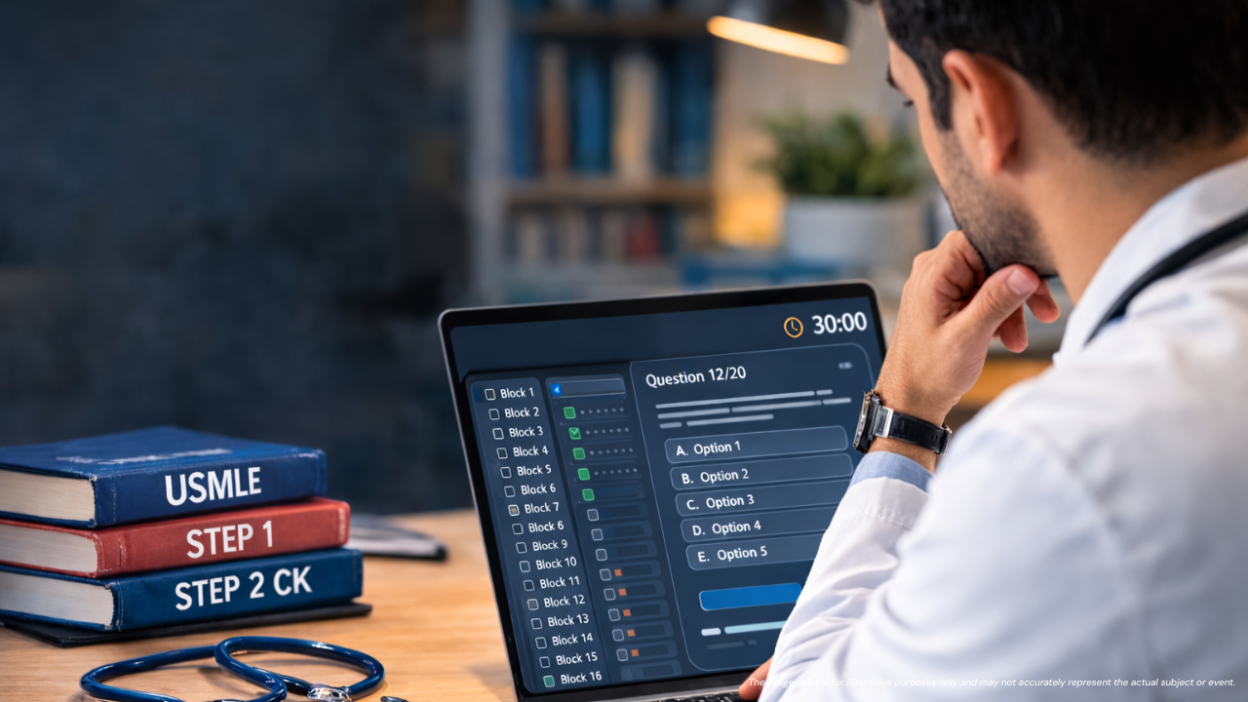
USMLE Step 1 & Step 2 CK format change 2026 explained for IMGs. New 20-question blocks, break strategy, common mistakes & a full exam-day prep checklist.
Table of Contents
The USMLE Step 1 format change 2026 and USMLE Step 2 CK format change 2026 are now official, and if you’re an international medical graduate, this affects you more than most prep articles are letting on. Not because the content is changing, but because you’re already navigating a system that wasn’t designed with you in mind.
The testing center might be in a city you’re visiting for the first time. The clinical vignettes are written for a North American patient context you’ve never practiced in. You’re often self-studying without a structured curriculum, piecing together prep resources from Reddit threads and WhatsApp groups. And you’re doing all of this while managing visa timelines, ECFMG paperwork, and the constant low-grade anxiety of not knowing whether any of it will actually land you a residency spot.
So when the USMLE announces a format change effective May 2026, it deserves more than a quick infographic scroll. This is what the change actually means for IMGs, and what you need to do about it before exam day.
What’s announced: USMLE Step 1 format change and Step 2 CK format change 2026
The numbers first, because the specifics matter.
USMLE Step 1 — New format effective May 14, 2026
| Exam Feature | Before | New Format (2026) |
|---|---|---|
| Total Questions | 280 | 280 |
| Total Blocks | 7 | 14 |
| Questions per Block | 40 | 20 |
| Time per Block | 60 minutes | 30 minutes |
| Total Exam Length | ~8 hours | ~8 hours |
USMLE Step 2 CK — New format effective May 7, 2026
| Exam Feature | Before | New Format (2026) |
|---|---|---|
| Total Questions | 316 | 316 |
| Total Blocks | 8 | 16 |
| Questions per Block | 38–40 | 18–20 |
| Time per Block | 60 minutes | 30 minutes |
| Total Exam Length | ~9 hours | ~9 hours |
The question count stays the same. The total time stays the same. What changes is the structure of the day: twice the number of blocks, each running 30 minutes instead of 60.
For Step 2 CK, that means 16 blocks across roughly 9 hours. For Step 1, 14 blocks across roughly 8 hours.
Why this change hits IMGs differently
American medical students have been practicing timed blocks since year one. For most IMGs, that structured practice only starts when you decide to apply for US residency. You’re building stamina from scratch while learning content at the same time.
The USMLE Step 1 format change and USMLE Step 2 CK format change for 2026 don’t change the content. But they make exam-day execution harder in ways that hit IMGs first. Here’s why:
- Warm-up window shrinks. With 40-question blocks, the first four or five questions gave you time to settle into the vignette style and stop second-guessing clinical terms. With 20-question blocks you’re already 25% through before that calibration even closes. For IMGs reading in a second or third language, those early questions aren’t throwaway warm-up anymore.
- Transitions double. Step 1 goes from 7 to 14 block transitions. Step 2 CK goes from 8 to 16. Every transition means stopping, submitting, leaving your station, and restarting from zero. Each one costs mental energy and the new format asks you to do it twice as often across an already long exam day.
- Breaks need a real plan. In the old format you could bank unused block time and add it to your break later. The new 30-minute blocks change that calculation entirely. You can no longer wing your breaks mid-exam. You need a written schedule with specific block numbers and break lengths decided before you walk into the testing center.
- Language fatigue hits earlier and harder. Reading dense clinical vignettes in a second or third language takes more cognitive effort per question than it does for native English speakers. That baseline fatigue builds across the day. With more frequent transitions in the new format, there’s less recovery time between blocks before that fatigue starts affecting your answer quality.
What has not changed
Step 1 is still pass/fail. That changed in January 2022, and this format update doesn’t reverse it. If you sat Step 1 before the scoring change and got a strong three-digit score, it no longer counts the way it once did for residency screening. If you haven’t sat it yet, pass is the only target. Period.
For IMG residency applicants, this is worth sitting with. The thing that used to give IMGs a fighting chance against lower research output or fewer US clinical experiences, a 260 on Step 1, is gone. You can’t compensate with Step 1 score anymore.
Step 2 CK still reports a three-digit score. Program directors still use it. For most IMGs applying to US residency, Step 2 CK is now the most important number on your ERAS application. A score above 250 puts you in serious contention at competitive programs. The 240–249 range is workable for many specialties. Below 230, you’re applying into a much narrower field regardless of your clinical experience or research.
The USMLE 2026 format change doesn’t shift those thresholds. It just means you need to arrive on Step 2 CK exam day ready to perform across 16 blocks, not 8.
The content blueprints haven’t changed either. The organ systems, pathophysiology, pharmacology, and clinical reasoning being tested are the same. Shorter blocks don’t mean different topics.
How IMGs should actually prepare for the new format
Most candidates will read about this change, acknowledge it, and continue doing 40-question timed blocks on UWorld until exam day. That’s the wrong adaptation.
Here’s what the preparation adjustment actually looks like for IMGs:
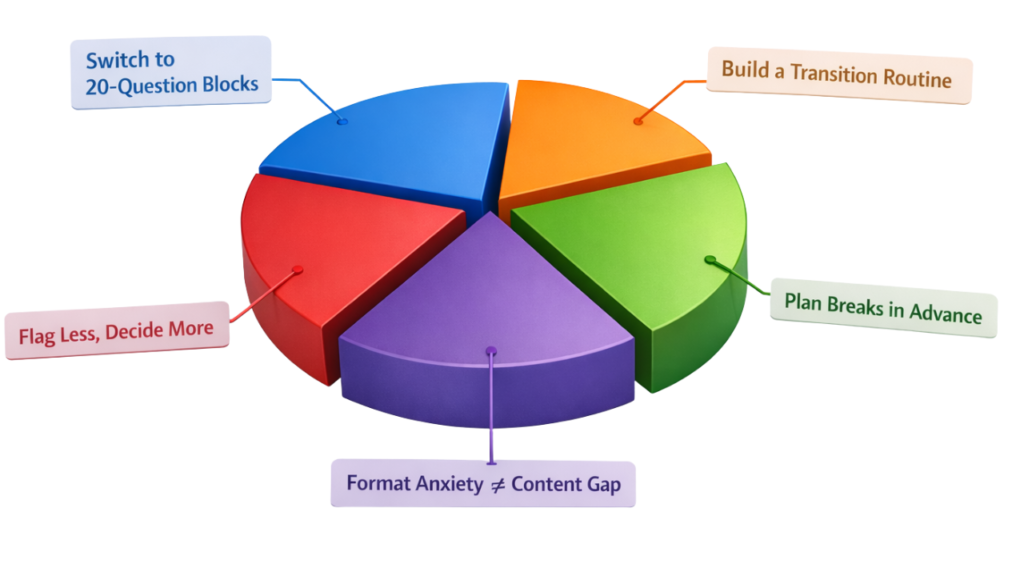
1. Switch your qbank to 20-question blocks now
If you’re within four months of your USMLE Step 1 or Step 2 CK exam date, start practicing in 20-question blocks immediately. Not occasionally, as your default. Your Qbanks may allow custom block lengths. Use them.
The goal isn’t just correct answers. It’s training yourself to reach focus and speed within the first three or four questions instead of the first eight or ten. That’s a different cognitive skill, and it takes repetition to build.
2. Build a deliberate transition routine
Between each practice block, do exactly what you’ll do in the real exam: stop, step away from your desk or close your laptop, take 60 to 90 seconds to decompress, then come back in fresh. Make the transition a routine, not an interruption.
IMGs often underestimate how much carry-over anxiety from a hard block bleeds into the next one. Questions 1 through 5 of your next block shouldn’t be decided by questions 18 through 20 of your previous one.
3. Plan your breaks before exam day, not during it
In the new USMLE format, with 14 blocks for Step 1 and 16 for Step 2 CK, you need a break strategy written down before you walk into the testing center. A practical approach for most IMGs: short micro-breaks of two to three minutes every two blocks, with one longer break of eight to ten minutes at the midpoint of the exam.
If English fatigue is a real factor for you, and be honest with yourself about this, err toward more frequent short breaks rather than fewer longer ones. Ten hours of sustained second-language reading depletes you faster than most candidates plan for.
4. Flag less, decide more
With 40-question blocks, flagging six or seven questions and reviewing them at the end was a reasonable strategy. With 20-question blocks and only 30 minutes, the review window shrinks. If you flag more than three or four questions per block, you’re setting yourself up for a rushed review under time pressure.
Tighten your decision-making threshold. If you’re between two answers and you’ve spent more than 60 seconds, commit and move on. Flag only the cases where you genuinely don’t have enough information to decide.
5. Don’t mistake format anxiety for content gaps
Some IMGs will read about the new USMLE Step 1 and Step 2 CK format and spiral into re-studying content. That’s displacement anxiety. If you’re already in your final six weeks of prep, the content work is largely done. The remaining preparation should be execution: practicing the rhythm of shorter blocks, refining your stamina strategy, and making sure exam-day logistics like test center location, accommodation, and travel are handled well in advance.
The residency application picture for IMGs in 2026
The USMLE format change lands at a complicated moment for IMG residency applicants. Match rates for IMGs have been under pressure for several years. The number of international graduates applying to US residency programs continues to increase while unfilled spots in competitive specialties remain limited.
In that environment, Step 2 CK score matters more than ever as a screening filter. ERAS caps aside, a strong Step 2 CK number is one of the few things an IMG can control and put directly in front of a program director.
ECFMG certification requirements, OET scores for some programs, the J-1 versus H-1B visa decision, and letters of recommendation from US-based physicians all remain unchanged. The format change is one piece of a larger puzzle, but it’s a piece that arrives in May 2026 whether you’ve prepared for it or not.
Common mistakes IMGs make with the USMLE Step 1 format change and Step 2 CK format change 2026
Most of the prep mistakes IMGs make around the new USMLE format aren’t about effort. They’re about misdirected effort. Here are the ones that will actually hurt your score.
Common Mistakes When Preparing for the New USMLE formatt
- Treating the update as a content change. Some IMGs assume a “new format” means the exam content is shifting. It isn’t. The USMLE blueprints remain identical. Step 1 still focuses on basic science mechanisms and Step 2 CK still tests clinical decision-making across outpatient, inpatient, and emergency settings. Restudying organ systems because of a format change wastes valuable time that should be spent on execution practice.
- Switching to 20-question blocks at the last minute. Many candidates panic after hearing about the format change and overhaul their practice approach two weeks before the exam. The final stretch should focus on consolidation and confidence, not experimentation. If you want to adapt to 20-question blocks, start early rather than right before test day.
- Skipping breaks to save time. Some IMGs power through multiple blocks without breaks. With the increased number of blocks in the new format, this strategy quickly leads to mental fatigue. Short breaks help reset your focus and prevent decision fatigue during later blocks.
- Over-flagging questions because blocks feel shorter. Shorter blocks do not mean more time per question. The pacing remains about 90 seconds per question. Flagging too many questions leaves little time for review. Limit yourself to two or three flagged questions per block.
- Not practicing the transition between blocks. Many candidates simulate full practice tests but ignore the transition moments between blocks. These short resets are where anxiety can spike. Practicing a quick mental reset routine helps maintain focus throughout the exam.
- Ignoring exam-day logistics. Many IMGs travel long distances to take the USMLE. Arriving tired or jet-lagged can hurt performance. Plan accommodation near the testing center, arrive a day early, and treat logistics with the same seriousness as your study plan.
If I were an IMG sitting the USMLE in 2026
Let me be direct. If I were an international medical graduate scheduled for USMLE Step 1 or Step 2 CK on or after May 2026, this is exactly how I’d approach the next few months.
- I’d confirm my exam date against the format rollout immediately. If I were scheduled for Step 2 CK before May 7 or Step 1 before May 14, I’d weigh whether that timing still made sense for my readiness level. If I’m close to ready, sitting before the format change removes one variable from exam day. If I’m not close to ready, I’d rather face the new format fully prepared than rush into the old one underprepared.
- I’d switch to 20-question practice blocks this week. Not next week. Not after I finish my current UWorld pass. This week. I’d go into settings, set every block to 20 questions, and stop doing 40-question practice sessions entirely. The discomfort of adapting to a shorter rhythm is the point. I want that adjustment to happen in practice, not on exam day.
- I’d design a written break schedule and follow it in every practice session. My actual break plan for Step 2 CK would look something like: two-minute break after every two blocks, one eight-minute break after block 8. I’d write it down and follow it consistently. By exam day, it wouldn’t feel like a strategy; it would feel like a habit.
- I’d be honest about my English reading stamina and build around it. If I know reading clinical vignettes in English tires me out more than reading in my native language, I wouldn’t pretend otherwise and hope for the best. I’d schedule more frequent micro-breaks and practice pacing myself so the back half of the exam doesn’t feel like reading through fog.
- I’d stop adding new resources in the final six weeks. This is the one IMGs struggle with most. There’s always another Anki deck, another First Aid chapter, another Pathoma video. At some point, new content adds anxiety faster than it adds knowledge. Six weeks out, I’m reviewing what I already know, drilling weak spots, and doing timed practice, not starting new resources.
- I’d visit or research the testing center location before exam day. Where is it? How long does it take to get there at 7am on a Tuesday? Where do I park or catch a bus? Is there food nearby for the lunch break? None of this is dramatic. It’s removing decision fatigue from a day when I need all my cognitive resources for 316 questions.
- I’d treat Step 1 as the foundation and Step 2 CK as the score. Since Step 1 is pass/fail, my preparation goal is to pass confidently, not to chase a number. The time and energy I’d otherwise spend chasing a Step 1 score goes entirely toward building a strong Step 2 CK result, because that’s the number residency programs actually see.
Your IMG USMLE 2026 format change checklist
Use this before your exam date. Check off each item when it’s done, not when you plan to do it.
6+ months out
3–6 months out
4–8 weeks out
1–2 weeks out
Exam day
Frequently asked questions on USMLE Step 1 format change & USMLE Step 2 CK format change
Does the format change affect the passing score for Step 1?
No. The pass/fail threshold for USMLE Step 1 has not been announced as changing.
If my exam is scheduled before those dates, do I get the old format?
Yes. Any exam sitting before the respective effective dates uses the existing block structure.
Has the content or syllabus for USMLE Step 1 changed alongside the format change?
No. The Step 1 content blueprint remains the same.
Has USMLE Step 2 CK content changed with the new format?
No. Step 2 CK still tests the same clinical reasoning across medicine, surgery, pediatrics, obstetrics, gynecology, and psychiatry. The question style, vignette length, and subject distribution are unchanged. Only the block structure is different.
I’m an IMG who graduated more than 5 years ago. Does this affect my prep differently?
The format change applies to everyone equally. But if you’ve been out of clinical practice for several years, the Step 2 CK content load is already heavier for you. Make sure your prep timeline accounts for that before factoring in the new format.
Bottom line
The USMLE Step 1 format and Step 2 CK format change in May 2026 is real, specific, and close enough that your prep window is now.
Shorter 30-minute blocks mean faster calibration required, more transitions to manage, and a break strategy that needs to be planned rather than improvised. None of that makes the exam harder on content. But walking in unprepared for the new rhythm, after months of 40-question block practice, will cost you questions you already knew the answers to.
For IMGs especially, exam-day execution has always been the hidden variable. You can know the material cold and still underperform if the test format catches you off-guard. The IMGs who adapt their practice to 20-question blocks now will enter the new format with the right stamina and pace already built in. The ones who don’t will spend the first third of their exam figuring out a rhythm they should have practiced months earlier.
The dates are fixed. May 7 and May 14, 2026 aren’t moving.
This article is for informational purposes based on publicly available USMLE format announcements. Always verify current policies directly at usmle.org and ecfmg.org before your exam date.
Check out USMLE Step 3 Software Updated (March 2026): New Exam Interface
Also feel free to check our USMLE Cost Calculator & YOG: Risk Calculator

Ready to Apply? Let Medvily Guide You!
Medvily offers a complete suite of services including:
- Tutoring / Mentoring
- Clinical Electives
- Observerships & Externships
- Clinical Research
- Residency Application Support
- Mock Interviews & IV Prep
- Medical Licensing Support
Disclaimer: All trademarks referenced herein are the property of their respective owners. Medvily disclaims any affiliation, sponsorship, or endorsement by such trademark owners or their affiliated companies. The information provided is for general informational purposes only.