

Last Updated: February 26, 2026
USCE for IMGs is one of the most powerful factors in securing U.S. residency. This guide explains what counts as meaningful clinical experience, how different types of USCE work, how to secure strong letters of recommendation, and how to strategically strengthen your Match application.
Table of Contents
USCE for IMGs: What You Really Need to Know
If you are an international medical student or an international medical graduate (IMG), you have likely heard this over and over:
“You need U.S. clinical experience.”
But what exactly does that mean?
And more importantly:
How much is enough?
What type matters most?
Does a externship make a real difference?
Is a subinternship better?
Let’s break this down clearly and strategically.
Because USCE for IMGs is not just about checking a box.
It can determine whether you receive interviews or get filtered out before anyone reads your personal statement.
Why USCE for IMGs Is So Critical in the Match Process
U.S. residency programs evaluate applicants based on trust.
And for Program Directors, the biggest unknown is this:
“Can this applicant function in the U.S. healthcare system?”
Strong USCE for IMGs helps answer that question.
It demonstrates:
- Familiarity with U.S. hospital workflow
- Experience with electronic medical records
- Understanding of patient communication standards
- Exposure to interdisciplinary team rounds
- Adaptation to American medical culture
When program directors review your ERAS application, U.S. clinical exposure reduces risk.
It makes you safer.
And in a competitive NRMP Match process, “safe” matters.
Types of USCE for IMGs (Ranked by Strategic Value)
Not all clinical experiences carry equal weight. Here’s how program directors typically view them.

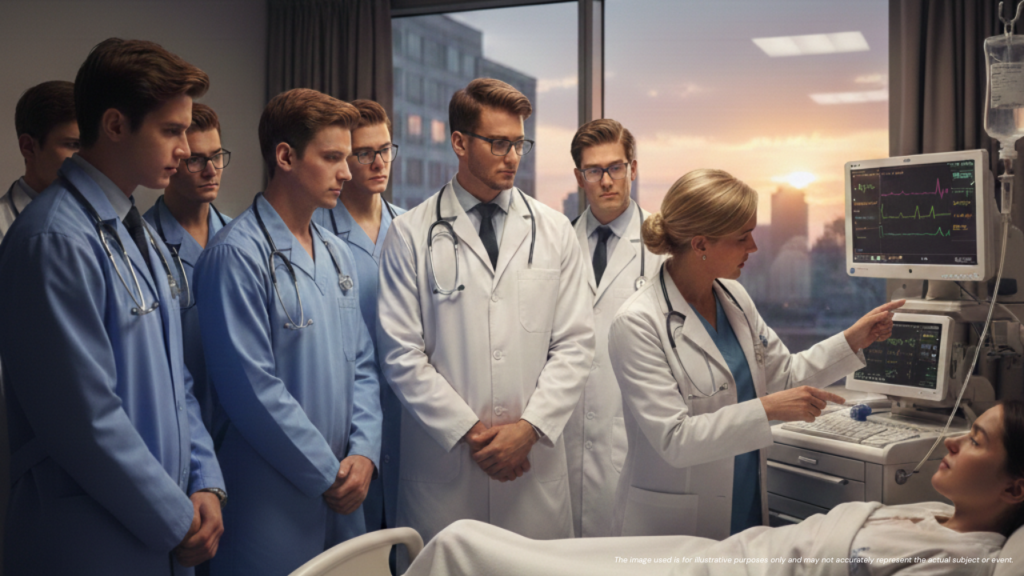
1. Subinternship (Highest Value)
It closely mirrors the responsibilities of a first-year resident.
What You Do in a Subinternship
- Carry your own patients
- Write progress notes
- Present during rounds
- Participate in care decisions
- Take call (sometimes)
This is not passive shadowing.
You function almost like an intern — under supervision.
✅ Pros of Subinternship
1. Highest Clinical Credibility
Programs see this as near-residency-level experience.
You carry patients.
You present on rounds.
You participate in care decisions.
That matters.
2. Strongest Letters of Recommendation
Because attendings directly observe your clinical reasoning, your LORs can be detailed and powerful.
Specific examples → stronger letters → more interviews.
3. Demonstrates Residency Readiness
Subinternships show that you can handle workload and responsibility in a U.S. system.
That reduces perceived risk in the Match process.
4. Often Done in Teaching Hospitals
If completed at a hospital with a residency program, your exposure is even more valuable.
❌ Cons of Subinternship
1. Limited Availability for Graduates
Most subinternships are restricted to students currently enrolled in medical school. If you’ve graduated, access becomes difficult.
2. Competitive Application Process
Top institutions require strong USMLE scores and documentation.
3. Performance Pressure Is High
This is essentially an audition. Poor performance can hurt more than help.
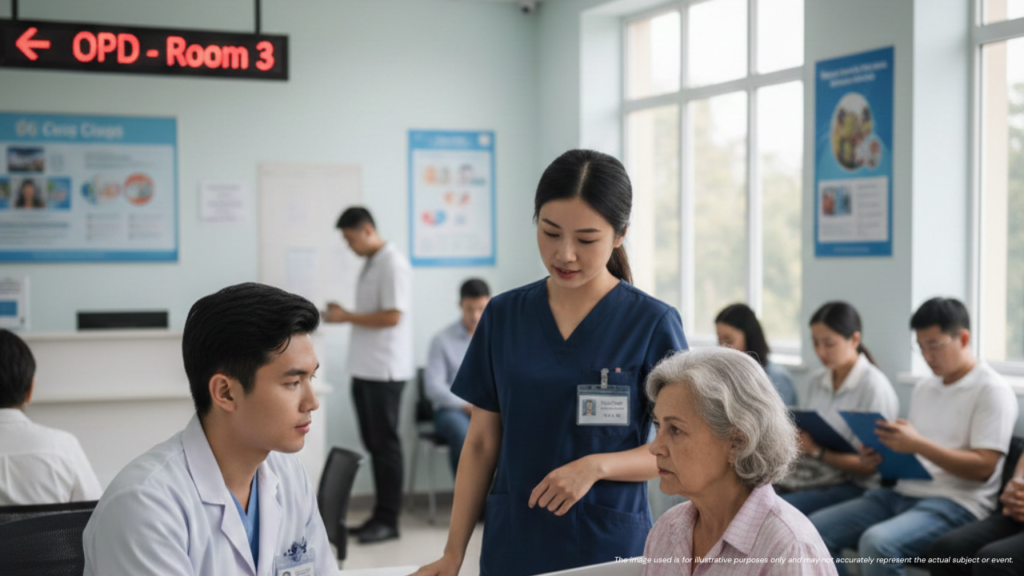
2. Externship (Extremely Valuable for Graduates)
Externships are often confused with observerships but they are very different.
An externship usually involves hands-on clinical participation, even for graduates.
This makes it particularly valuable for IMGs who have already completed medical school and cannot apply for student electives.
What Makes an Externship Valuable
- Direct patient interaction
- Performing physical exams
- Presenting cases to attendings
- Writing notes (depending on hospital policy)
- Potential for strong personalized LORs
For graduates, externships are often the most practical way to secure meaningful USCE for IMGs.
Inpatient vs Outpatient Externships
Inpatient externships tend to carry more weight because:
- They mirror residency workflow
- They involve multidisciplinary rounds
- They demonstrate stamina and adaptability
Outpatient externships are still useful but may offer less intense evaluation.
If possible, aim for at least one inpatient experience.
✅ Pros of Externship
1. Hands-On Experience for Graduates
This is one of the strongest forms of USCE for IMGs available after graduation as it is hands-on.
2. Strong LOR Potential
Because you actively participate, attendings can write detailed letters.
3. Flexible Access
More available to graduates compared to subinternships.
4. Inpatient Options Available
Inpatient externships mirror residency workflow closely.
❌ Cons of Externship
1. Variable Quality
Not all externships are equal.
Some are structured.
Others are loosely organized.
You must vet programs carefully.
2. Limited EMR Access
Some institutions restrict documentation privileges.

3. Clinical Electives (Highly valued for medical students)
Electives are typically available to final-year medical students. They are structured and often affiliated with residency programs.
Benefits
- Direct patient interaction
- Faculty evaluation
- Exposure to U.S. documentation standards
- Potential networking
For international medical students (not graduates), electives are often the best route to meaningful USCE.
✅ Pros of Electives
1. Strong Academic Structure
Usually affiliated with teaching hospitals.
2. Hands-On Participation
Students can engage in patient care.
3. Valuable Networking
You interact with faculty, residents, and coordinators.
4. Strong LOR Opportunities
Especially if completed in your intended specialty.
❌ Cons of Electives
1. Restricted to Current Students
Graduates cannot apply.
2. Application Complexity
Requires documentation, immunizations, transcripts, and sometimes Step 1 completion.
3. Competitive Slots
Top university electives fill quickly.
4. Cost
Some Electives have high tuition fees.
Observerships (Lower Value but Sometimes Necessary)
Observerships are common among IMGs who have already graduated.
But here’s the honest truth:
They are mostly shadowing.
You typically:
- Do not touch patients
- Do not write notes
- Do not enter orders
They are better than nothing.
But they are not equivalent to a externship.
Programs know the difference.
✅ Pros of Observership
1. Easy Access
Many private clinics and hospitals offer observerships.
2. Networking Opportunity
You build relationships with U.S. physicians.
3. Good Starting Point
For IMGs with zero U.S. exposure, this can open doors.
❌ Cons of Observership
1. No Hands-On Clinical Work
You usually do not examine patients. Programs know this.
2. Weak LOR Potential
Letters may be generic due to limited direct observation.
3. Lower Residency Impact
Observership alone rarely makes an application competitive.
4. Limited Evaluation of Clinical Skill
It does not demonstrate your ability to function as a resident.
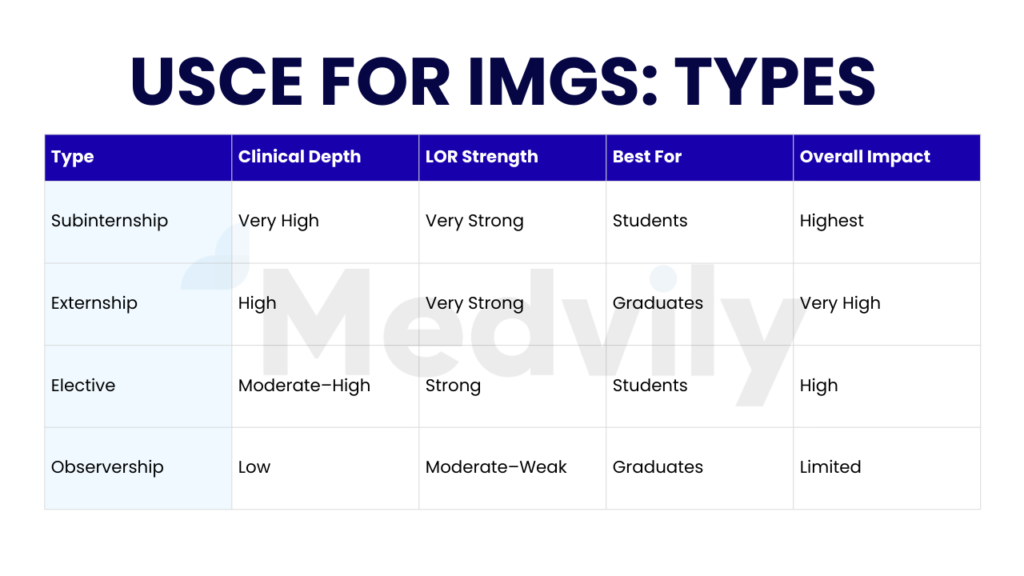
Quick Comparison Summary
How Much USCE for IMGs Is Enough?
This is where many IMGs panic.
Here’s a realistic benchmark:
- Minimum competitive range: 3 months
- Strong profile: 4–6 months
- Highly competitive specialties: 6+ months
However, quality beats quantity.
Three months of strong subinternship experience with powerful LORs is better than six months of passive observerships.
Access our USCE Calculator to know the minimum months of USCE required for each specialty. (Based on the data of matched candidates)
The Real Purpose of USCE for IMGs: Letters of Recommendation
The true value of USCE for IMGs lies in the Letters of Recommendation.
Strong U.S. LORs should:
- Be written by attending physicians
- Reference direct clinical involvement
- Describe patient interactions
- Comment on teamwork and professionalism
- Compare you favorably to U.S. trainees
- Highly Personalized
Generic letters weaken your application.
Strong letters dramatically increase interview chances.
Before finishing a rotation, ask directly:
“Do you feel comfortable writing me a strong letter of recommendation?”
Clarity prevents disappointment.
When Should IMGs Do USCE?
Timing matters.
Ideal Timeline
- During final year (for students)
- Within 1–2 years before applying to residency
- After USMLE Step 1
Programs prefer recent clinical experience.
If you graduated 5 years ago and your last USCE was 4 years ago — that is a red flag.
How to Strategically Combine USCE Types?
Here’s a smarter approach:
For Current Students:
- 1 subinternship
- 1–2 electives
- All in your intended specialty
For Graduates:
- At least 1 inpatient externship
- At least 2 OPD based Externship
- Optional observership for networking
- Secure 3-4 strong LORs
This combination strengthens your profile dramatically.

Visa and USCE: What IMGs Should Know
This is where confusion often happens.
Let’s clarify two separate issues:
Visa Status for Doing USCE
Many IMGs complete USCE while on:
- B1/B2 visitor visas
- Dependent visas (such as H-4)
- Other legally permitted non-immigrant statuses
Observerships are commonly done on B1/B2 visas.
Some externships are also done under B1/B2, depending on institutional policy and the structure of the experience.
Each hospital sets its own rules.
It is your responsibility to confirm that:
- The institution permits your visa category
- The activity complies with immigration regulations
- You are not receiving unauthorized employment compensation
USCE itself does not automatically require a J-1 or H-1B visa.
Those visas are typically related to residency training, not pre-residency clinical exposure.
Common Mistakes IMGs Make with USCE
1. Only Doing Observerships
Shadowing alone rarely demonstrates readiness.
2. Misaligned Specialty Exposure
Your clinical experience should match your intended specialty.
3. Not Treating Rotations as Auditions
Every day matters.
Show initiative.
Volunteer for presentations.
Ask for feedback.
4. Not Asking for Strong LORs
You must ask clearly:
“Do you feel comfortable writing me a strong letter of recommendation?”
If they hesitate, that’s your answer.
Does Research Compensate for Weak USCE?
Short answer: No.
Research publications help. But residency is clinical training.
If you lack meaningful USCE, research alone rarely compensates.
Best scenario:
- Strong Step 2 CK
- 3–4 months hands-on USCE
- 2–3 strong U.S. LORs
- Some research
That combination is powerful.

Case Comparison: Two IMG Profiles
Applicant A
- Step 1 Pass
- Step 2 CK: 250
- 6 months observership
- Generic LORs
Applicant B
- Step 1 Pass
- Step 2 CK: 240
- 2 months OPD externship & 1 month Inpatient externship
- 3 strong LORs (OPD & IPD experience combined)
Who is perceived as residency-ready?
Often, Applicant B.
Programs value clinical proof over passive presence.
If I Were Starting Again as an IMG (Student)
Here’s the strategic approach I would follow:
- Complete USMLE Step 1 early
- Aim for 245+ on Step 2 CK
- Secure at least one inpatient subinternship & 2 Clinical Electives
- Obtain 3 strong U.S. LORs
- Ensure USCE is recent
- Align all experiences with one specialty
If I Were Starting Again as an IMG (Graduate)
Here’s the strategic approach I would follow:
- Complete USMLE Step 1 early
- Aim for 250+ on Step 2 CK
- Secure at least one inpatient externship & 2 OPD externships
- Obtain 3 strong U.S. LORs
- Ensure USCE is recent
- Align all experiences with one specialty
Coherence strengthens your narrative.
Residency programs value consistency.
Quick USCE Strategy Checklist
- □ Minimum 3 months hands-on experience
- □ At least one inpatient rotation
- □ Specialty-aligned experience
- □ 2–3 U.S. LORs
- □ Recent (within 1–2 years)
- □ Preferably at hospital with residency training.
FAQs
Is observership enough for matching into residency?
Rarely by itself. It should supplement not replace hands-on experience.
Can I match without USCE?
Extremely difficult. Especially if you require visa sponsorship.
Is a subinternship mandatory?
Not officially. But it significantly strengthens your application.
Should USCE match my intended specialty?
Yes. Alignment strengthens your application narrative.
Is externship better than observership?
Yes. Externships involve hands-on clinical work and carry more weight.
How recent should USCE be?
Ideally within 1–2 years of applying to residency.

Conclusion: USCE for IMGs Is a Strategic Investment
USCE for IMGs is not just a resume entry.
It is proof of clinical readiness within the U.S. system.
It strengthens your ERAS application.
It supports strong Letters of Recommendation.
It builds credibility during the Match process.
Whether completed through externships, subinternships, or electives, meaningful USCE for IMGs can significantly influence interview outcomes.
Be strategic.
Confirm visa compliance.
Prioritize hands-on exposure.
And treat every clinical experience as preparation for residency success.
Feel to check out our YOG Residency Risk Calculator and USMLE Cost Calculator for free.
Ready to Apply? Let Medvily Guide You!
Medvily offers a complete suite of services including:
- Tutoring/Mentoring
- Clinical Electives
- Observerships & Externships
- Clinical Research
- Residency Application Support
- Mock Interviews & IV Prep
- Medical Licensing Support
📩 Email: contact@medvily.com
🌐 Website: www.medvily.com
Disclaimer: All trademarks referenced herein are the property of their respective owners. Medvily disclaims any affiliation, sponsorship, or endorsement by such trademark owners or their affiliated companies. The information provided is for general informational purposes only and


[…] Read more about USCE for IMGs: The Ultimate Guide to Secure Residency Success (2026) […]