The Harvard ASID track is one of the most competitive advanced standing programs for internationally trained dentists seeking a U.S. DMD degree. This guide explains eligibility, admissions strategy, curriculum, interviews, costs, visa realities, and a practical checklist to maximize your chances of acceptance
Table of Contents
What Is the Harvard ASID Track?
The Harvard ASID track (Advanced Standing International Dentists DMD Track) is a pathway at Harvard School of Dental Medicine that allows internationally trained dentists to earn a U.S. Doctor of Dental Medicine (DMD) degree.
Instead of repeating four full years of dental school, selected candidates enter directly into Year 2 of Harvard’s DMD program.
That means:
- You complete approximately 29 months of training
- You graduate with the same DMD degree as traditional students
- You become eligible for U.S. dental licensure (subject to state requirements)
For globally trained dentists whether from Europe, the Middle East, Africa, Asia, Latin America, or Australia, the Harvard ASID track represents a direct route into the U.S. dental system through one of the world’s most respected institutions.
Program at a Glance: Harvard ASID Track
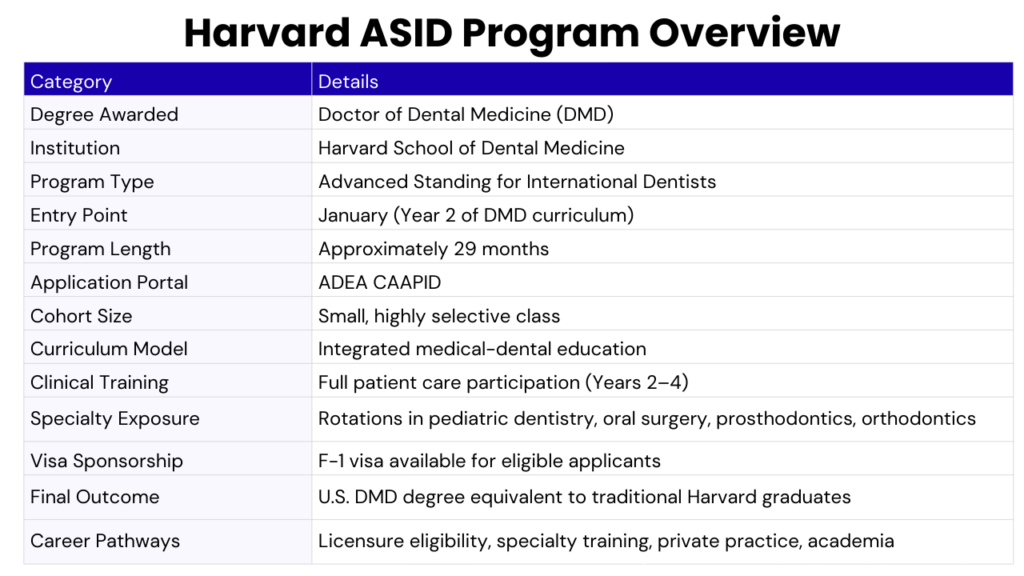
The Harvard ASID track offers internationally trained dentists a structured pathway to earn a U.S. DMD degree through advanced standing entry into Year 2 at Harvard School of Dental Medicine.
Below is a clear snapshot of the program structure.
Why the Harvard ASID Track Matters Globally
Let’s address the big question:
Why choose the Harvard ASID track over other advanced standing programs?
Because reputation matters.
Harvard’s name carries international recognition across:
- Private practice
- Academic dentistry
- Specialty training
- Research careers
- Global health leadership
More importantly, the program integrates oral health with systemic medicine, a model that aligns with modern interdisciplinary care worldwide.
For internationally trained dentists who want:
- Long-term U.S. practice
- Specialty residency placement
- Academic careers
- Global leadership roles
The Harvard ASID track offers leverage that few programs can match.
Program Structure of the Harvard ASID Track
Students admitted into the Harvard ASID track begin in January and join the second-year DMD class.
Year 2: Medical-Dental Integration
This year focuses on:
- Oral-systemic disease connections
- Diagnosis and treatment planning
- Foundational clinical exposure
- Integration with Harvard’s medical curriculum
Harvard’s model emphasizes understanding dentistry within the broader context of whole-body health.
You are not just trained as a procedural dentist.
You are trained as a healthcare thinker.
Years 3 & 4: Advanced Clinical Immersion
In the final years, students in the Harvard ASID track:
- Provide comprehensive patient care
- Rotate through specialties (pediatric dentistry, prosthodontics, oral surgery, orthodontics)
- Participate in case-based learning
- Strengthen treatment planning skills
By graduation, you are functioning at the same clinical level as any Harvard DMD graduate.

Eligibility Requirements for the Harvard ASID Track
To apply for the Harvard ASID track, candidates must:
- Hold a dental degree equivalent to a U.S. DDS/DMD
- Complete credential evaluation (WES or ECE)
- Pass the INBDE (Integrated National Board Dental Examination)
- Submit TOEFL scores (minimum requirements apply)
- Apply through ADEA CAAPID
Strong academic performance is expected.
But academics alone are not enough.
Harvard looks for leadership, research involvement, global perspective, and intellectual maturity.
Application Requirements
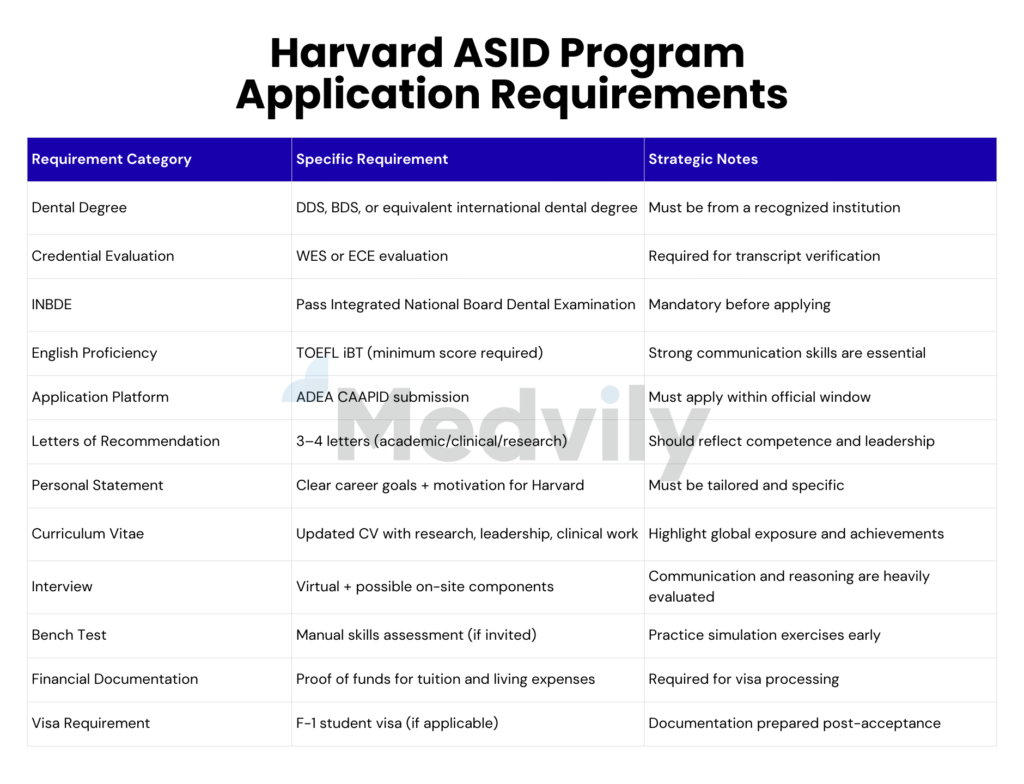
Admission into the Harvard ASID program requires more than eligibility. Every component must demonstrate readiness for rigorous academic and clinical training.
Below is a structured table to simplify preparation.
Application Strategy: How to Be Competitive
The Harvard ASID Program is extremely selective. Each cohort is small.
Here is how strong applicants differentiate themselves:
1. INBDE Performance
While pass/fail, strong foundational understanding matters. Your interview performance often reveals your conceptual depth.
2. Research Experience
Harvard values scholarly engagement. Publications are not mandatory, but research exposure strengthens your narrative.
3. U.S. Clinical Exposure
Observerships or shadowing in U.S. dental settings show:
- Familiarity with infection control standards
- Understanding of patient communication norms
- Awareness of ethical and legal structures
4. Strong Letters of Recommendation
Letters should describe:
- Clinical competence
- Professional integrity
- Intellectual curiosity
- Leadership potential
Generic letters weaken your application.

The Interview Process
If selected, candidates may go through:
- Virtual interviews
- Behavioral and scenario-based discussions
- Bench skills assessment
- Interaction with current students
This stage evaluates more than manual skills.
Harvard assesses:
- Communication clarity
- Ethical reasoning
- Adaptability
- Confidence under pressure
Many internationally trained dentists underestimate this step.
Preparation matters.
Mock interviews significantly improve outcomes.

Visa Sponsorship and Global Applicants
The program accepts international applicants requiring visas.
Typically:
- F-1 student visas are issued
- Documentation support is provided upon acceptance
However:
- Financial proof is required
- Tuition and living expenses in Boston are substantial
International applicants must plan funding carefully.
Tuition and Financial Reality
Let’s be honest.
The Harvard ASID track is expensive. Check out the tuition fees here.
Costs include:
- Tuition and fees
- Instruments and supplies
- Health insurance
- Living expenses in Boston
Boston is one of the highest-cost cities in the U.S.
Financial planning is essential.
Some students explore:
- Private loans
- International lenders
- Family sponsorship
- Institutional financial aid
This is an investment decision.
You must evaluate long-term return carefully.
Brutal Reality Check
Here is what many applicants don’t consider.
Getting into the Harvard ASID Program is only the first step.
After graduation, you still must:
- Complete regional clinical licensing exams
- Meet state board requirements
- Possibly complete a residency (depending on state)
Licensure rules vary across states.
Research early.
Plan strategically.

Common Mistakes International Dentists Make
When applying to the program, applicants often:
- Apply without U.S. exposure
- Submit weak personal statements
- Underprepare for bench exams
- Ignore interview coaching
- Fail to articulate long-term goals
Harvard is not selecting just a clinician.
They are selecting a future leader.
Your story matters.
What Makes a Strong Personal Statement?
For the Harvard ASID Program, your statement must:
- Explain why U.S. dentistry
- Explain why Harvard specifically
- Show intellectual maturity
- Demonstrate resilience
- Present a clear career trajectory
Avoid:
- Generic admiration
- Emotional overdramatization
- Copy-paste narratives
Be precise.
Be strategic.
Be reflective.
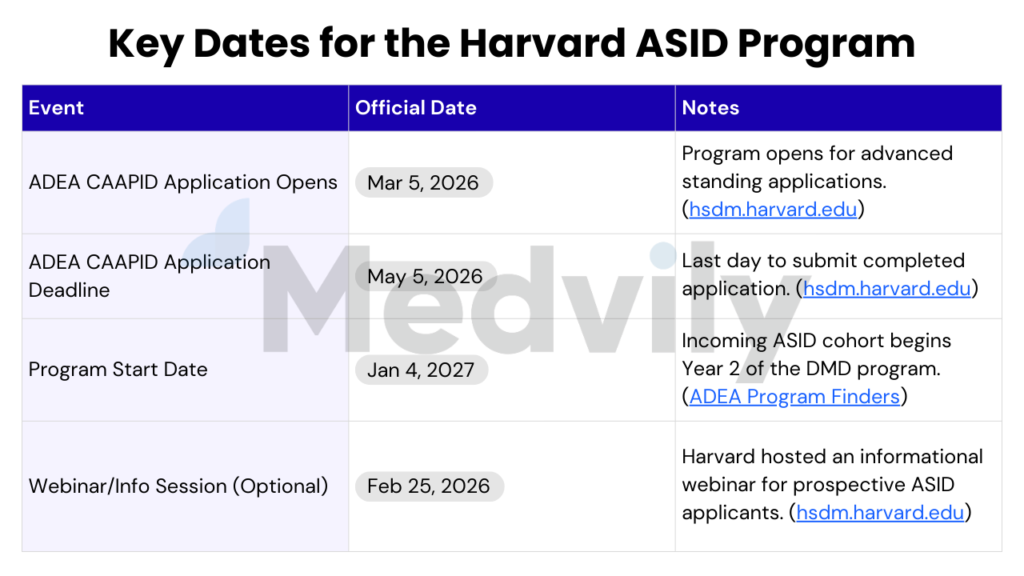
Key Dates
The Harvard ASID Program follows a specific annual application schedule. These dates (from official Harvard/CAAPID sources) are the most up-to-date timeline for applicants targeting the January 2027 start term.
Checklist for the Harvard ASID Track
Here is your structured checklist section, optimized for clarity and action.
Academic Preparation
- Dental degree verified (WES/ECE completed)
- INBDE passed
- TOEFL score meets minimum requirement
- Academic transcripts translated and uploaded
Application Materials
- CAAPID application submitted
- Personal statement tailored to Harvard
- CV updated with leadership and research
- 3–4 strong letters of recommendation secured
Clinical & Professional Strengthening
- U.S. observership completed
- Infection control knowledge reviewed
- HIPAA and patient communication understanding demonstrated
Interview & Bench Preparation
- Mock interviews completed
- Ethical scenarios practiced
- Bench test manual dexterity rehearsed
- Communication clarity refined
Financial & Visa Planning
- Tuition and cost of attendance reviewed
- Proof of funds prepared
- Visa documentation ready
This checklist transforms uncertainty into action.
FAQs About the Harvard ASID Track
How competitive is the Harvard ASID track?
Extremely competitive. Small class sizes and high global demand make acceptance rates low.
Can older graduates apply?
Yes. However, recent academic engagement strengthens applications.
Does the Harvard ASID track guarantee licensure?
No. It qualifies you for licensure eligibility, but state requirements must still be fulfilled.
Is U.S. clinical experience required?
Not always mandatory, but strongly recommended.
Is the INBDE required for the Harvard ASID track?
Yes. The INBDE (Integrated National Board Dental Examination) is required for admission into the Harvard ASID track. Applicants must pass the INBDE before applying through CAAPID.
Does the Harvard ASID track prefer applicants with specialty training from their home country?
Specialty training (such as orthodontics, prosthodontics, oral surgery, etc.) is not required. However, it can strengthen your profile if it demonstrates advanced clinical exposure, academic productivity, or leadership experience. That said, specialty credentials alone will not compensate for weak communication or poor interview performance.

Final Thoughts on the Harvard ASID Track
The Harvard ASID track is not just an academic bridge.
It is a strategic career accelerator for internationally trained dentists who want credibility, mobility, and long-term impact in U.S. dentistry.
But it demands:
- Preparation
- Financial planning
- Intellectual depth
- Emotional resilience
If you approach the Harvard ASID track strategically — not emotionally — your chances improve dramatically.
For global dentists willing to prepare early and execute precisely, this pathway can redefine your professional trajectory.
Plan wisely.
Act early.
Compete strategically.
Ready to Apply? Let Medvily Guide You!
Medvily offers a complete suite of services including:
- Tutoring/Mentoring
- Clinical Electives
- Observerships & Externships
- Clinical Research
- Residency Application Support
- Mock Interviews & IV Prep
- Medical Licensing Support
📩 Email: contact@medvily.com
🌐 Website: www.medvily.com
Disclaimer: All trademarks referenced herein are the property of their respective owners. Medvily disclaims any affiliation, sponsorship, or endorsement by such trademark owners or their affiliated companies. The information provided is for general informational purposes only and