Starting July 1, 2026, Indiana allows foreign-trained dentists to become licensed dental hygienists. Learn eligibility, exams, costs, and visa options.
Updated March 20, 2026
Table of Contents
Intro
If you trained as a dentist outside the United States with your degree in hand, your skills real, but your path forward unclear; Indiana just opened a door you probably didn’t know existed.
As of July 1, 2026, Indiana House Bill 1254 lets foreign-trained dentists apply for dental hygienist licensure in the state. Not a watered-down certificate. An actual dental hygienist license. One that lets you work, earn, and build your career in the U.S. while you figure out the longer road to full dental licensure.
This isn’t a rumor. It’s law.
And if you’re a foreign-trained dentist sitting on years of clinical experience, trying to make sense of what comes next in America, this might be one of the most practical pieces of news you’ll read this year.
Let’s break it all down.
What Exactly Is the new Indiana HB 1254 law?
Indiana House Bill 1254 is a state law that creates a new licensure pathway specifically for internationally trained dentists who want to work as licensed dental hygienists in Indiana.
Key points
Allows internationally trained dentists to:
- Apply for a Dental Hygienist License
- Practice under U.S. standards without repeating full dental school
- Enter the workforce significantly faster
HB 1254 allows foreign-trained dentists to apply for dental hygienist licensure in Indiana without completing a U.S. DDS program, provided they meet specific eligibility, exam, and regulatory requirements.
Why This Law Is a Big Deal for Foreign-Trained Dentists
For years, international dentists faced a frustrating reality:
- Repeat 2–3 years of dental school in the U.S.
- Spend $150,000–$300,000+
- Compete for limited advanced standing seats
Now, Indiana just changed the game.
This law effectively creates:
- A “bridge pathway” into U.S. dentistry
- A financially viable alternative to DDS
- A stepping stone toward full licensure later
Why This Actually Matters for Indiana
Here’s the thing about the dental hygienist shortage in the U.S. that doesn’t get talked about enough: it’s bad and getting worse. The Bureau of Labor Statistics projects continued job growth in dental hygiene well into the 2030s. Indiana, like many Midwestern states, has rural and underserved communities where access to basic dental care is genuinely difficult.
HB 1254 fixes that
When Does It Take Effect?
July 1, 2026.
That’s the official effective date. The Indiana Professional Licensing Agency (IPLA) is expected to begin accepting applications on or after that date. If you’re planning ahead, now is the time to gather your documents, get transcripts translated and evaluated, and look into exam prep, because once applications open, the early applicants will have an advantage in processing time.
What Is a Dental Hygienist, and How Is It Different From a Dentist?
Before you decide whether this pathway makes sense for you, it’s worth being clear on what a dental hygienist actually is, and what the role is not.
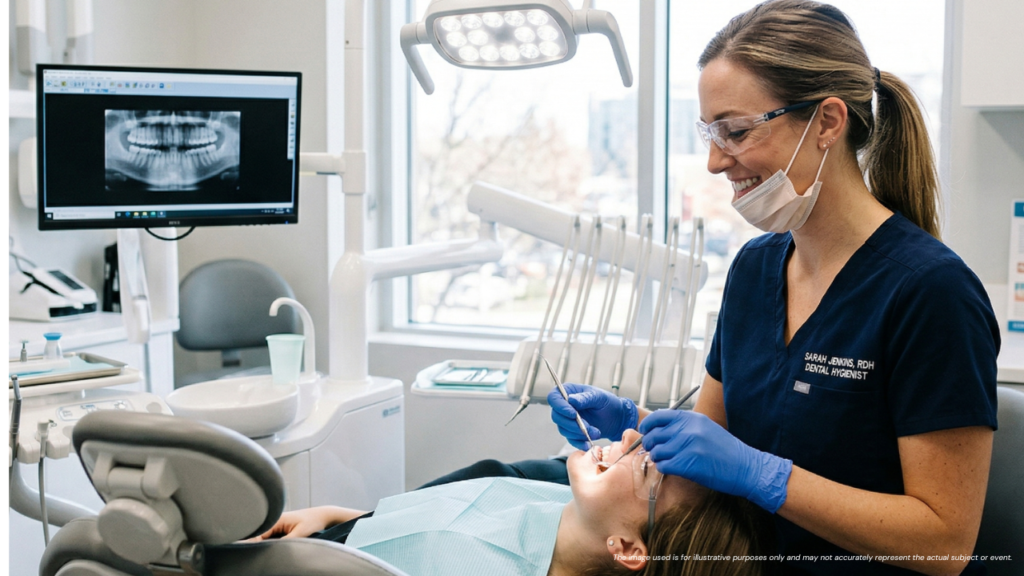
A dental hygienist is a licensed oral health professional who focuses on preventive care and patient education. The job exists in the space between “brush your teeth” advice and the restorative, surgical, and diagnostic work that dentists do. Hygienists are trained clinicians. They work chairside. They see patients every day. But their scope of practice is defined and limited by state law, and understanding those limits matters before you commit to this route.
In simple terms: a dental hygienist cleans teeth, assesses periodontal health, takes X-rays, and educates patients. A dentist diagnoses disease, prescribes treatment, performs surgery, places restorations, and manages complex cases.
What a Licensed Dental Hygienist in Indiana CAN Do
Indiana follows the American Dental Hygienists’ Association (ADHA) scope of practice model, with some state-specific provisions. As a licensed dental hygienist in Indiana, you may be authorized to:
- Perform oral health assessments — reviewing medical history, charting existing conditions, recording vital signs
- Complete periodontal assessments — probing pocket depths, measuring bone loss, evaluating gum health
- Scale and root plane — removing calculus, plaque, and biofilm from tooth surfaces above and below the gumline (this is the core clinical skill of the job)
- Polish teeth — coronal polishing to remove stain
- Take and interpret dental radiographs — full mouth X-rays, bitewings, periapicals, and panoramic films
- Apply preventive agents — fluoride varnish, pit-and-fissure sealants, and desensitizing agents
- Administer local anesthesia — Indiana allows dental hygienists to administer local anesthesia with appropriate additional training and certification
- Apply nitrous oxide/oxygen analgesia — with additional certification in Indiana
- Provide oral hygiene instruction — teaching patients brushing, flossing, diet counseling, and home care techniques
- Document findings and refer — flagging suspicious lesions, caries, or other conditions for dentist review and diagnosis
- Work in public health settings — schools, community health centers, mobile clinics, and nursing homes
Indiana also permits dental hygienists to work under general supervision in certain public health settings, meaning you don’t always need a dentist physically present in the office.
What a Licensed Dental Hygienist in Indiana CANNOT Do
This is the part that matters most for foreign-trained dentists coming from full clinical dental backgrounds. The scope of practice for a dental hygienist is real — but it is narrower than what you trained for. Here’s what falls outside it:
- Diagnose dental disease — only a licensed dentist can diagnose caries, periodontal disease, or any oral pathology. A hygienist can observe and document; a dentist must diagnose.
- Perform restorations — no fillings, no crowns, no inlays or onlays. Restorative dentistry is outside hygienist scope entirely.
- Extract teeth — surgical procedures of any kind are not within dental hygienist scope.
- Prescribe medications — hygienists cannot write prescriptions. Dentists prescribe; hygienists may apply in-office agents but cannot send a patient home with a prescription.
- Perform endodontic treatment — no root canals, pulp capping, or related procedures.
- Place implants or prosthetics — prosthetic and implant work is dentist territory.
- Administer IV sedation or general anesthesia — outside scope entirely. Nitrous oxide with certification is the ceiling.
- Practice independently without supervision structure — in most Indiana settings, you work under a dentist’s license. The model is collaborative, not independent practice (though Indiana has some expanded public health access provisions).
Who Is Eligible? (Expected Requirements)
This is where people get confused, so let’s be specific.
To be eligible under HB 1254, you generally need to meet all of the following:
1. Foreign dental degree You must have completed a full dental degree (DDS, DMD, BDS, MDS, or equivalent) from a dental school outside the United States. Partial degrees or dental assistant training don’t qualify.
2. Credential evaluation Your degree needs to be evaluated by an approved credential evaluation agency. The National Association of Credential Evaluation Services (NACES) members, such as ECE, WES, or Josef Silny — are commonly accepted. This step confirms your foreign degree is equivalent to a U.S. dental degree.
3. English proficiency If your dental education was not conducted in English, you’ll need to demonstrate English proficiency, typically through TOEFL or IELTS scores that meet Indiana’s threshold.
4. Required examinations (covered below)
5. Application to the Indiana State Board of Dentistry The dental hygienist license in Indiana is overseen by the Indiana State Board of Dentistry. You’ll submit your application through the Indiana Professional Licensing Agency portal.
6. Background check A criminal background check is required, as it is for all healthcare licensure in Indiana.
There is no requirement to have previously held a dental license in the U.S.; this pathway is designed for people who have not yet gone through the full U.S. dental licensing process.
What Exams Do You Need to Pass?
Here’s where it gets real. You can’t just show up with a foreign dental degree and get a hygienist license; you still need to prove clinical and theoretical competency according to Indiana’s standards.
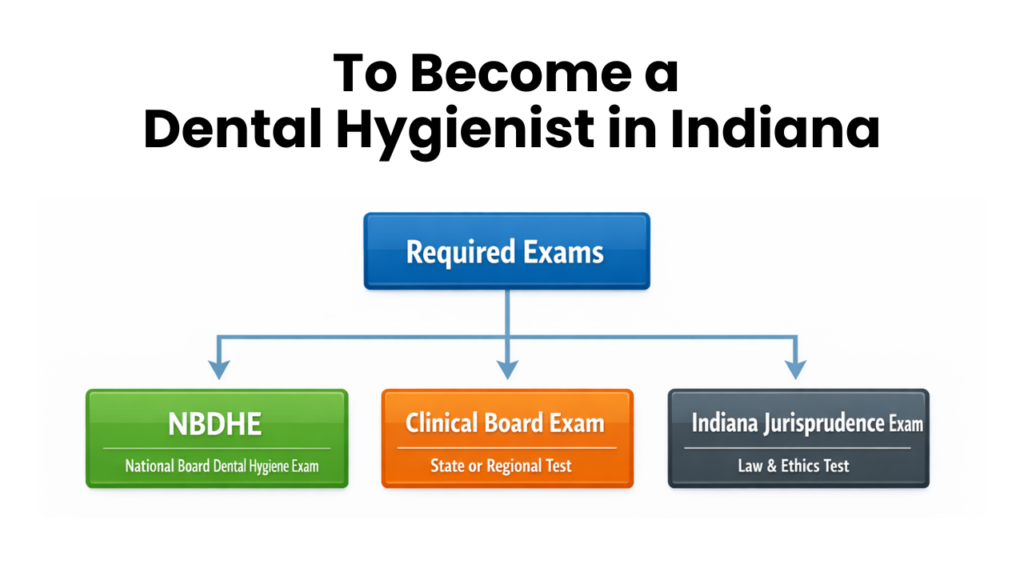
Under HB 1254, foreign-trained dentists applying for dental hygienist licensure will generally need to pass:
1. The NBDHE (National Board Dental Hygiene Examination)
This is the written component of the dental hygiene boards, administered by the Joint Commission on National Dental Examinations (JCNDE). It’s a 350-question computer-based test covering:
- Scientific basis for dental hygiene practice
- Provision of clinical dental hygiene services
- Community health and research principles
Most foreign-trained dentists find this manageable given their existing dental background. The content overlaps significantly with dental school coursework, oral pathology, pharmacology, periodontology, radiography, and patient management.
Testing windows: NBDHE is offered multiple times a year at Prometric test centers nationwide.
Pass rate: Nationally around 82–85% for first-time candidates.
2. A State or Regional Clinical Board Examination
In addition to the NBDHE, Indiana requires a clinical board examination. Indiana accepts results from major regional board testing agencies, including:
- CRDTS (Central Regional Dental Testing Service)
- WREB (Western Regional Examining Board)
- ADEX (American Dental Examining Board)
These clinical exams assess your hands-on ability to perform dental hygiene procedures on actual patients-scaling, root planing, radiographs, periodontal assessment. For a foreign-trained dentist, the technical skills are generally there. The adjustment is performing them under standardized, timed, U.S. board conditions.
3. Indiana Jurisprudence Exam
Some states require a separate jurisprudence exam covering state-specific dental law and ethics. Indiana may require this as part of the application process.
Important note: Eligibility criteria, exam requirements, and licensure processes may change and vary by individual case. Applicants should verify all details with the Indiana State Board of Dentistry and relevant authorities. This content is for informational purposes only and does not constitute legal or professional advice.
What Will It Cost? (Approximate Breakdown)
Nobody talks about this enough. Here’s an honest estimate of what the entire process might run you:
| Expense | Estimated Costs (USD) |
|---|---|
| Credential evaluation (WES, ECE, etc.) | $200 – $400 |
| TOEFL / IELTS (if required) | $220 – $250 |
| NBDHE exam fee | $475 |
| Regional clinical board exam | $1,000 – $1,800 |
| Board prep courses / study materials | $500 – $1,500 |
| Indiana license application fee | $50 – $150 |
| Background check | $30 – $75 |
| Document translation (if needed) | $100 – $500 |
| Total Estimated Range | $2,575 – $5,150 |
These are estimates based on current pricing from JCNDE, WES, and regional testing agencies. Costs will vary depending on your specific situation, how many exam attempts you need, and whether you’re already in the U.S. or still overseas.
Compare that $2,500–$5,000 investment to the $100,000+ cost of completing a U.S. advanced standing dental program. The math speaks for itself.
Visa Options for Foreign-Trained Dentists Pursuing This Pathway
This is arguably the most complicated piece of the puzzle, because your visa status determines whether you can legally work in the U.S. as a dental hygienist even after getting licensed.
Here’s a breakdown of the most relevant visa categories:
| Visa Type | Feasibility | Notes |
|---|---|---|
| H-1B | low | Dental hygienist may qualify. Requires proving the job needs a 4-year degree. |
| TN Visa (Canada/Mexico) | High | Consult immigration attorney; dentist category exists but hygienist is separate |
| F-1 OPT | High | OPT must relate to degree field; dental/health science graduates may qualify |
| Green Card | High | No restrictions. Full work authorization. |
| H-4 Visa (EAD) | High (if eligible) | Requires spouse on H-1B with approved I-140 |
| L-2 Visa (EAD) | Very High | Requires spouse on L-1 visa |
Important note: If your immigration status is more complicated, talk to an immigration attorney before you invest in exam prep. Getting licensed and then finding out you can’t legally work would be an expensive and demoralizing outcome.
So How Much Will You Actually Earn as a Dental Hygienist in Indiana?
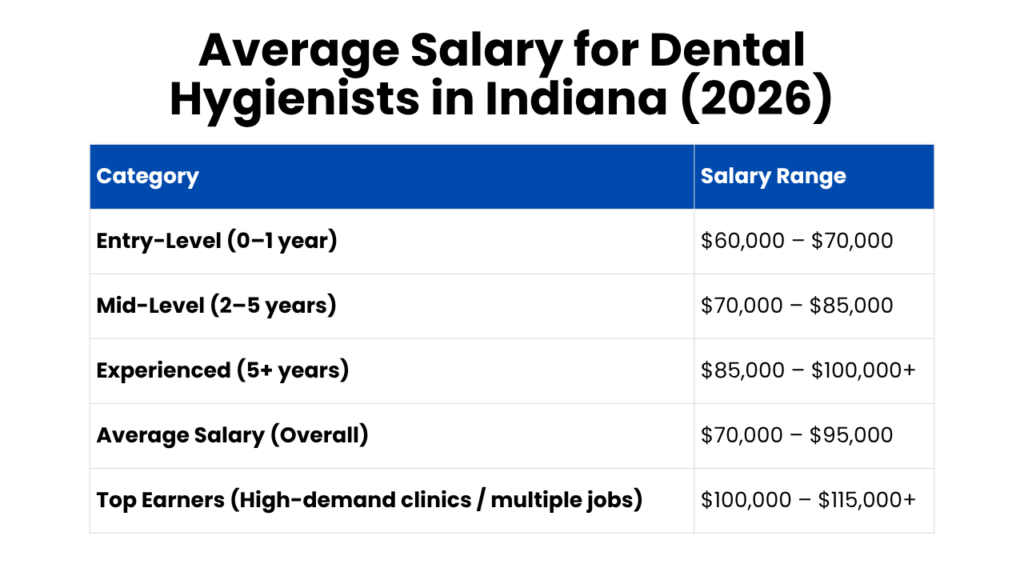
The average annual salary for a dental hygienist in Indiana runs around $60,000–$75,000 based on Bureau of Labor Statistics data, with higher wages in specialty practices or supervisory roles.
It’s not a dentist’s salary. But it’s real clinical work, real income, and a real foot in the door of U.S. healthcare.
How to Actually Apply: Step-by-Step
Once applications open after July 1, 2026, here’s the sequence most applicants will follow:
Step 1: Talk to an immigration attorney and confirm the visa type you need. Before anything else, before you pay for exams, before you send documents anywhere, sit down with a licensed U.S. immigration attorney and confirm that your current visa status permits you to work as a licensed dental hygienist in Indiana. Getting licensed and then discovering you can’t legally work is an expensive mistake that’s entirely avoidable. Your attorney can also advise on whether you need to change status, apply for an EAD, or take any other steps before you can start working after licensure.
Step 2: Get your foreign dental degree evaluated by a NACES-approved agency (WES, ECE, Josef Silny, etc.). Allow 4–8 weeks for processing.
Step 3: Take the TOEFL or IELTS if your dental education wasn’t in English. Scores are typically valid for 2 years.
Step 4: Register for and pass the NBDHE. You can do this while your credential evaluation is in progress.
Step 5: Schedule and pass a regional clinical board exam (CRDTS, WREB, or ADEX). These require patient cases, plan ahead.
Step 6: Submit your Indiana dental hygienist license application through the IPLA online portal. Include your credential evaluation report, exam score transcripts, background check, and application fee.
Step 7: Receive your license and begin your job search.
The whole process realistically takes 6 to 18 months depending on how quickly you move through exams and how long credential evaluation takes.long credential evaluation takes.
What are the strategic Advantages of This Pathway?
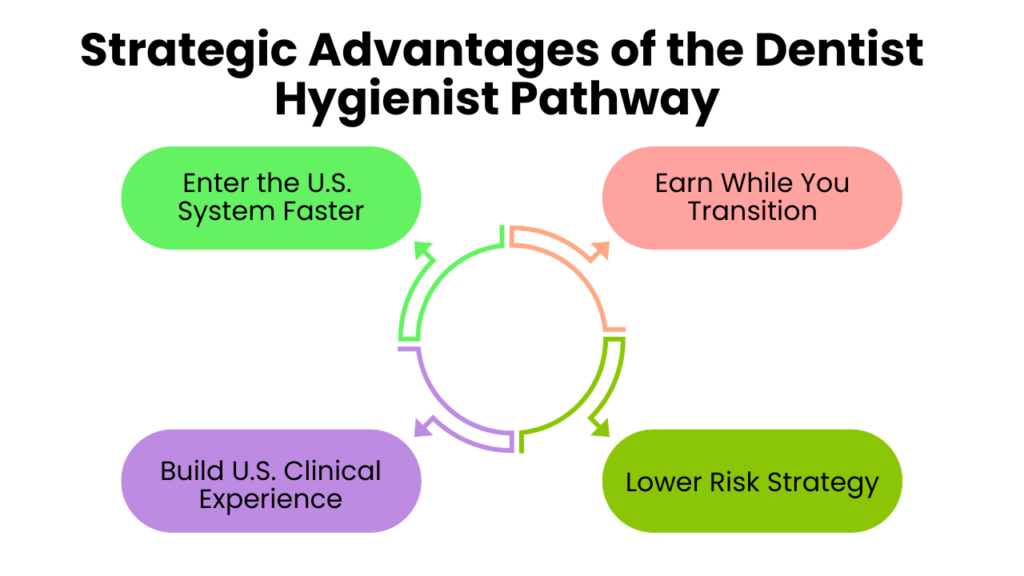
1. Enter the U.S. System Faster
Traditional route:
- 2–3 years for DDS admission
- Additional time for applications, interviews, and visa processing
Total delay: 3–5 years before earning
With Indiana’s pathway:
- You can realistically start working in 12–24 months
- Faster exam cycle compared to DDS
- No need to compete for limited advanced standing seats
Strategic Insight:
Early entry means:
- Earlier income
- Earlier U.S. exposure
- Faster long-term career progression
2. Earn While You Transition
Average dental hygienist salary:
$70,000 – $100,000/year
But the real advantage isn’t just the salary, it’s cash flow timing.
What This Enables:
- Cover living expenses without loans
- Support family (especially for candidates on dependent visas)
- Save $20K–$50K+ for future DDS applications
Reality Check:
Most DDS candidates:
- Take on $150K–$300K debt
- Delay income for years
This pathway flips that model:
Earn first → upgrade later
3. Build U.S. Clinical Experience (Your Biggest Asset)
This is where the real long-term advantage lies.
You gain:
- Hands-on patient interaction in the U.S. healthcare system
- Familiarity with infection control, documentation, and workflow
- Strong Letters of Recommendation (LORs)
- Networking with dentists and clinic owners
Why This Matters:
When applying later for:
- DDS programs
- Advanced standing
- Even job upgrades
U.S. experience makes you 10x more competitive
4. Lower Risk Strategy
Instead of putting all your time and money into one high-risk path:
DDS-only strategy = high cost + uncertain outcome
This pathway allows you to:
- Diversify your career entry
- Maintain financial stability
- Keep multiple options open
Smart Candidate Strategy
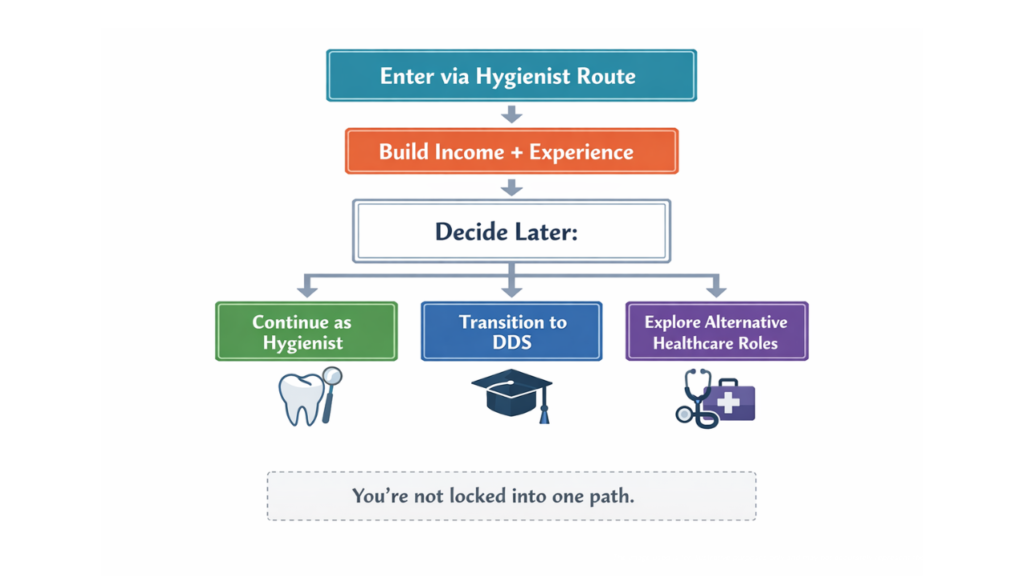
- Enter via hygienist route
- Build income + experience
- Decide later:
- Continue as hygienist
- Transition to DDS
- Explore alternative healthcare roles
You’re not locked into one path.
Who Should Seriously Consider This?
1. Recent International Dental Graduates (IDGs) with valid work authorization
- Avoid years of uncertainty waiting for DDS
- Start building U.S. experience early
Ideal for candidates who want momentum over delay
2. Financially Constrained Candidates
- Cannot afford $150K–$300K DDS programs
- Want a low-cost entry pathway ($3K–$6K)
This is one of the most affordable U.S. healthcare entry routes
3. Dentists Struggling with INBDE
- Difficulty clearing exams
- Burnout from repeated attempts
This provides:
- An alternative career route
- A way to stay within dentistry
4. Candidates Seeking U.S. Exposure First
- Want to understand the U.S. system before committing
- Prefer a step-by-step approach
Build:
- Clinical exposure
- Financial stability
- Professional network
before making bigger decisions.
FAQs on Dental hygienist Licensure in Indiana
Can foreign-trained dentists work as dental hygienists in the U.S.?
Yes, starting July 1, 2026, Indiana allows foreign-trained dentists to apply for dental hygienist licensure under HB 1254.
Do I need a U.S. DDS to apply?
No. This pathway eliminates the need for a U.S. DDS degree.
Can I eventually use this as a stepping stone to full dental licensure?
Yes. Working as a dental hygienist doesn’t close the path to dental licensure. You can continue preparing for the INBDE, apply to advanced standing programs, or pursue other routes in parallel.
When will IPLA start accepting applications?
Applications should open on or after July 1, 2026. Watch the Indiana Professional Licensing Agency website (pla.in.gov) for official guidance.
Does Indiana Recognize Dental Hygienist Licenses from Other States?
Yes, Indiana may recognize dental hygienist licenses from other U.S. states through licensure by endorsement, but applicants must meet specific requirements set by the Indiana State Board of Dentistry.
Final Word
Indiana HB 1254 is not a perfect solution to every problem a foreign-trained dentist faces in the United States. It doesn’t bypass immigration. It doesn’t eliminate the need for exams. It doesn’t hand you a dentist’s salary.
But it does something genuinely useful: it gives you a licensed clinical role to step into while you build your American career. For a lot of internationally trained dentists who’ve been grinding through an opaque and expensive system, that’s not a small thing.
If you qualify, July 1, 2026 is a date worth circling.
Feel free to check out Virginia Signals New Opportunities Through Alternative Licensing Pathways for Foreign-Trained Dentists (2026)
Feel free to check out Ultimate Guide to the Harvard ASID Track (Advanced Standing International Dentists DMD Track) 2026
Disclaimer: This article is for informational purposes only and does not constitute legal, immigration, or professional advice. Requirements for Indiana licensure under HB 1254, including eligibility, exams, and costs, may change and should be verified directly with the Indiana Professional Licensing Agency and the Indiana State Board of Dentistry. Visa information is general and not legal advice—individual eligibility depends on personal circumstances. No guarantee is made regarding licensure, employment, or outcomes. Always consult official authorities and qualified professionals before making decisions.

Ready to Apply? Let Medvily Guide You!
Medvily offers a complete suite of services including:
- Tutoring / Mentoring
- Clinical Electives
- Observerships & Externships
- Clinical Research
- Residency Application Support
- Mock Interviews & IV Prep
- Medical Licensing Support
Disclaimer: All trademarks referenced herein are the property of their respective owners. Medvily disclaims any affiliation, sponsorship, or endorsement by such trademark owners or their affiliated companies. The information provided is for general informational purposes only.