The ECFMG fee increase 2026, effective April 1, raises costs across key services including certification, credential verification, and EPIC services. While individual increases appear small, the total additional burden for International Medical Graduates can exceed $100, adding to an already expensive USMLE and residency pathway.
Table of Contents
Intro
Let me be direct with you: if you’re an IMG working through the USMLE pathway right now, you probably already feel the financial pressure. Exam fees, credential costs, USCE expenses, it adds up faster than most people expect.
So when ECFMG quietly announced a new round of fee changes effective April 1, 2026, it wasn’t exactly welcome news.
The individual increases don’t look dramatic on paper. Ten dollars here, twenty there. But if you’ve been through this process, you know that the USMLE pathway isn’t a single transaction, it’s a long chain of fees that compound across years. And for applicants converting from rupees, naira, or pesos? Even a $75 increase carries real weight.
Here’s everything you need to know about the ECFMG fee increase 2026 — what’s changing, what it costs you in total, and what you can actually do about it before April 1.
What ECFMG Is Actually Changing
The ECFMG certification cost for IMGs was already one of the more significant financial hurdles on the path to US residency. The new fee schedule pushes it higher across nearly every stage of the process.
Here’s the full comparison:
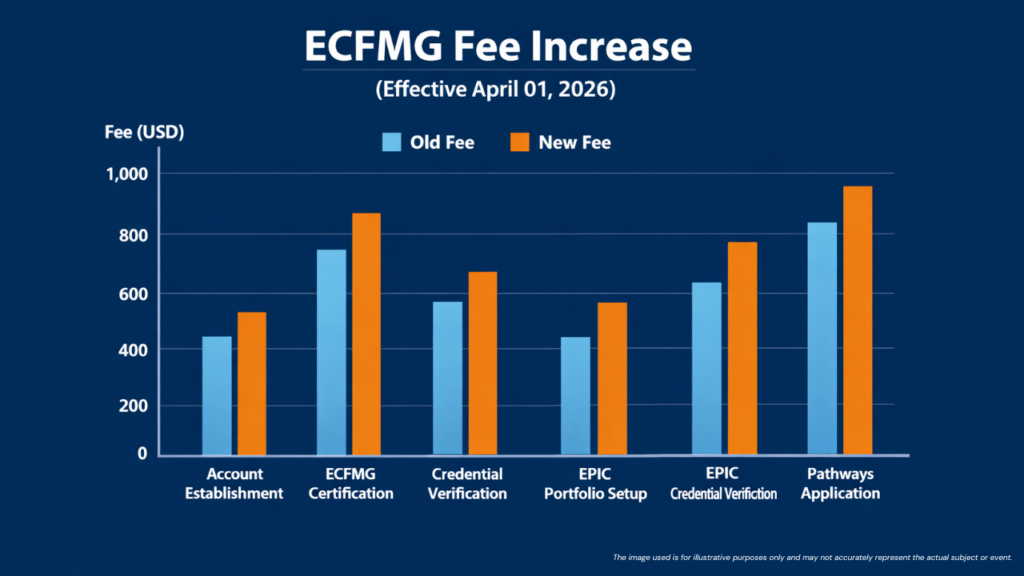
ECFMG Fee Changes 2026: Full Comparison Table
| Service | OLD Fee (USD) | NEW Fee (USD) |
|---|---|---|
| Account Establishment (ECFMG / MyIntealth) | $100 | $110 |
| Application for ECFMG Certification | $560 | $580 |
| Credential Verification (Diploma + Transcript) | $200 | $220 |
| Certification Verification Service (CVS) Report | $70 | $70 |
| EPIC Portfolio Establishment | $30 | $35 |
| EPIC Credential Verification | $100 | $110 |
| EPIC Report | $50 | $60 |
| Pathways Application | $925 | $945 |
| ERAS Token | $185 | $185 |
| Residency CAS Application Support | $185 | $185 |
Source: ECFMG Fee Increase April 01, 2026
Two things stand out when you look at this table carefully. First, the ERAS token and CVS report fees are staying flat, which suggests ECFMG isn’t raising everything uniformly, but targeting specific stages. Second, the Pathways application is already the single most expensive line item on this list, and it’s going up too. When high-ticket costs increase, even small percentage changes hurt more.
The Real Cost Math Nobody Talks About
If you add up the direct ECFMG fee increases for a typical applicant going through the full pathway, you’re looking at roughly $75 to $105 more than you’d have paid last year. That’s not nothing, but on its own it doesn’t sound catastrophic.
Here’s the part that matters though: this increase doesn’t exist in isolation.
The ECFMG certification cost for IMGs is just one layer of a much larger financial stack. When you fold in USMLE exam fees, the cost of US clinical experience, Research and ERAS application fees for residency, the total IMG cost for the USMLE pathway in 2026 can easily exceed $15,000 to $20,000 depending on how many programs you apply to and how many exam attempts you need.
The ECFMG fee increase 2026 doesn’t dramatically change that total. But it’s a signal. Costs across the pathway have been creeping upward for several years, and this update fits the pattern. Budget accordingly.

Why This Hits IMGs Harder Than the Dollar Amount Suggests
There’s an obvious point worth making plainly: the people most affected by these fee changes are usually the ones least positioned to absorb them without disruption.
IMGs applying from low- and middle-income countries aren’t just paying $945 for a Pathways application, they’re paying whatever the equivalent is in a currency that may have depreciated significantly against the dollar. They’re often doing this without access to US-based credit, without employer support, and sometimes without family income that can flex to cover unexpected expenses.
A $100 increase in total ECFMG costs can delay a timeline. It can mean choosing between submitting credentials this cycle or waiting. For applicants already running lean, “wait until you have more money” isn’t financial advice, it’s a year of your career.
None of that makes ECFMG‘s decision wrong, necessarily. Organizations have operational costs. The MyIntealth system wasn’t built for free. But understanding the real impact means looking past the percentage increase and thinking about who actually pays these fees and what they give up to do it.
What You Can Do Before April 1, 2026
If your timeline has any flexibility, here’s where to focus your energy in the next few weeks.
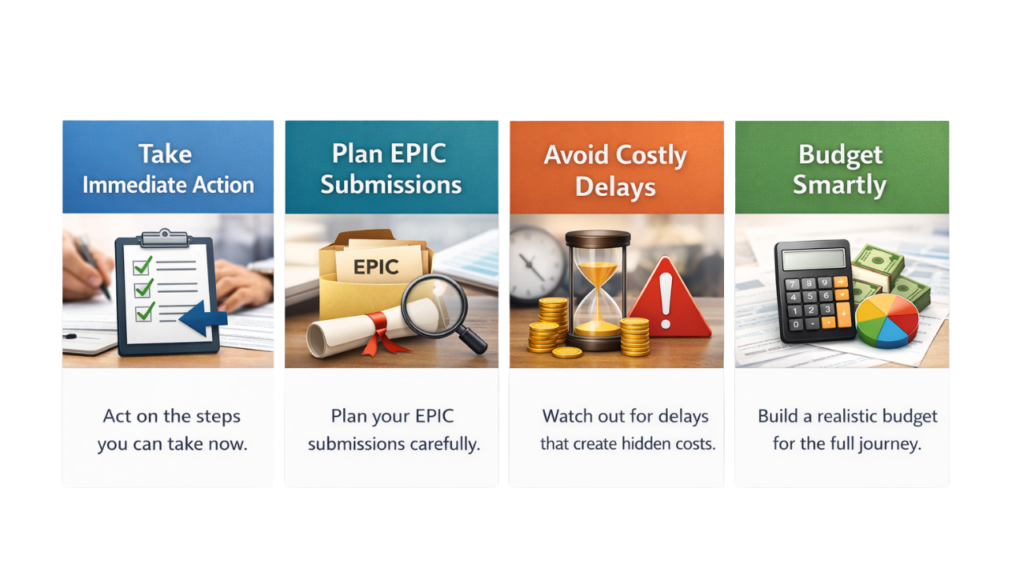
- Act on the steps you can take now. The most straightforward way to beat the ECFMG fee increase 2026 is to complete fee-bearing steps before April 1. If you haven’t opened your account yet, do it now, that’s $10 back in your pocket immediately. If your credentials are ready to submit, don’t wait. If you were planning to apply for Pathways this spring, move that up if you can. These aren’t dramatic savings individually, but combined they could keep $75 to $105 in your hands.
- Plan your EPIC submissions carefully. EPIC fees went up across the board, portfolio establishment, credential verification, and report fees all increased. The way to minimize damage here is to bundle everything you need into a single, complete submission rather than going back for additional reports later. Repeated requests cost more than getting it right the first time.
- Watch out for delays that create hidden costs. This one doesn’t get enough attention. Documents have expiration dates. If a credential verification lapses because your application sat incomplete for too long, you’re not just losing time, you may be paying verification fees again. Every delay in this process has a potential price tag attached to it. The ECFMG fee increase 2026 is visible; the cost of a lapsed document is invisible until it hits you.
- Build a realistic budget for the full journey. Most applicants underestimate their total costs because they budget exam by exam rather than planning the whole pathway at once. If you’re just entering the system, map out every fee-bearing step from account creation through ERAS submission, add a 15 to 20 percent buffer for things you can’t predict, and treat that number as your actual target. The total IMG cost for the USMLE pathway in 2026 is real money, plan for it like it is.
What the Trend Line Looks Like
It’s worth zooming out for a moment. The ECFMG fee increase 2026 isn’t happening in a vacuum.
USMLE exam fees have risen over the past several years. ERAS application fees, particularly for high-volume applicants going to competitive specialties, have grown substantially. The cost of competitive US clinical experience has increased as more IMGs pursue it and programs have raised their rates accordingly. And through all of this, match rates for IMGs in competitive specialties have not improved proportionally.
What this adds up to is a pathway that demands more money, more credentials, more preparation, and more strategic planning than it did five years ago. The ECFMG fee increase 2026 is a small part of that picture, but it’s a real part.
For applicants entering the system now, this is useful context. The question isn’t just “can I afford the fees this year” but “do I have a financial plan that accounts for how this process actually works over two or three years.” Applicants who treat financial planning as part of their residency strategy, not separate from it, tend to be better positioned when surprises come up.
A Note on What Hasn’t Changed
Not everything increased, and that matters for your planning too.
ERAS token fees remain at $185. The Certification Verification Service report is still $70. The Residency CAS Application Support fee is unchanged at $185. These are meaningful line items, and knowing they’re stable lets you budget them with confidence.
If I Were an IMG in 2026: My Exact Strategy (Checklist)
Pre–April 1 Action Checklist
Timeline Planning Checklist
Financial Planning Checklist
Cost Optimization Checklist
Competitive Strategy Checklist
Risk Prevention Checklist
Bottom Line Checklist
FAQ: ECFMG Fee Increase 2026
When do the new ECFMG fees take effect?
April 1, 2026.
Can I lock in old ECFMG fees if I’ve already started my application before April 1, 2026?
Yes, in most cases. If you’ve already initiated a fee-bearing step, such as account establishment or credential submission before April 1, 2026, that transaction is processed at the rate active at the time of payment. However, any new service you add after April 1 will be charged at the updated rate. If your application spans the deadline, audit exactly which steps remain incomplete and pay for them before the cutoff where possible.
Should I rush to apply before April 1?
If you’re genuinely close to being ready on any fee-bearing steps, account creation, credential submission, Pathways application, then yes, it makes sense to push those through before the deadline. Don’t manufacture urgency if you’re not ready, though. Submitting incomplete credentials to save $20 and then having to resubmit costs more than the fee increase would have
Is this part of a larger pattern of rising costs?
It appears to be. ECFMG fees, USMLE exam fees, and ERAS costs have all trended upward over the past several years. Whether this continues annually is unknown, but building some cost buffer into your long-term planning is reasonable.
Will the ECFMG fee increase affect current applicants or only new ones?
The new fees apply to all services paid on or after April 1, 2026, regardless of when you started your application. Even ongoing applicants will pay updated prices for pending steps.
Are USMLE exam fees also increasing with ECFMG fees?
No official announcement has linked this change to United States Medical Licensing Examination exam fee increases. However, historically, exam fees tend to rise periodically, so future changes are possible.
Can I pay ECFMG fees in advance to avoid the increase?
Yes, in some cases. If you complete and pay for specific services before April 1, 2026, you can lock in current pricing. However, unused or incomplete applications may not qualify.
Bottom Line
The ECFMG fee increase 2026 takes effect April 1. If you have steps you can complete before then, complete them. If you’re earlier in the process, build these numbers, and a buffer into your full pathway budget.
More than the specific dollar amounts, what this update reinforces is that the path to US residency as an IMG now requires financial planning that’s as careful as the clinical preparation. The applicants who treat it that way tend to move through the process without the scrambles and setbacks that derail timelines. That’s the actual strategic advantage in 2026.
Check out USMLE Step 3 Software Updated (March 2026): New Exam Interface
Also feel free to check our USMLE Cost Calculator & YOG Risk Calculator

Ready to Apply? Let Medvily Guide You!
Medvily offers a complete suite of services including:
- Tutoring / Mentoring
- Clinical Electives
- Observerships & Externships
- Clinical Research
- Residency Application Support
- Mock Interviews & IV Prep
- Medical Licensing Support
Disclaimer: All trademarks referenced herein are the property of their respective owners. Medvily disclaims any affiliation, sponsorship, or endorsement by such trademark owners or their affiliated companies. The information provided is for general informational purposes only.