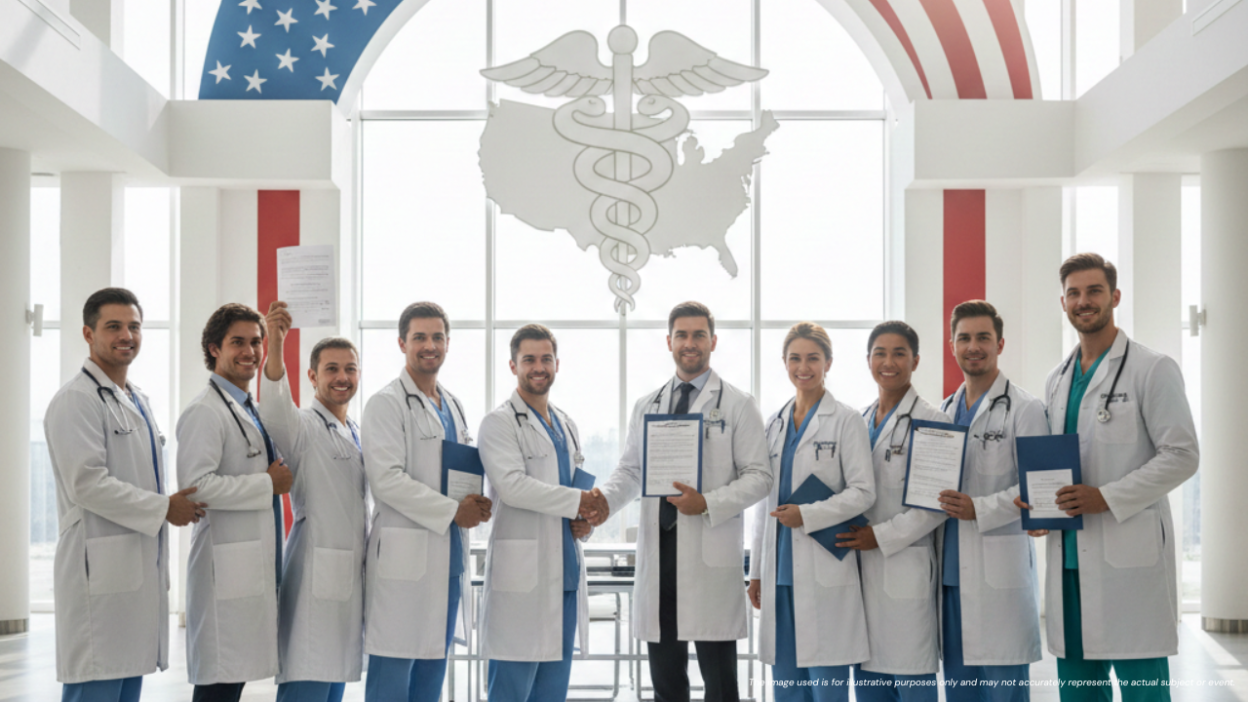
ABIM Pilot Pathway for IMGs. This is a competency-based guide explaining eligibility, required ACGME-accredited fellowship training, ECFMG certification, and the application process under Special Consideration – Pathway E for international medical graduates.
Updated March 29, 2026
Table of Contents
Introduction
The ABIM Pilot Pathway for IMGs represents one of the most significant policy shifts in recent years for internationally trained physicians seeking U.S. board certification in Internal Medicine. Officially categorized under Special Consideration – Pathway E, this pilot pathway offers a narrowly defined, competency-based alternative to the traditional requirement of completing a full U.S. ACGME-accredited internal medicine residency.
For many IMGs, particularly those who have already demonstrated clinical excellence by securing and completing an ACGME-accredited subspecialty fellowship in the United States—this pathway acknowledges prior training and real-world competence rather than duplicative residency repetition.
This article focuses exclusively and in depth on eligibility, clarifying exactly who qualifies, why ABIM considers them eligible, and where most IMG applications succeed or fail.
What Is the ABIM Pilot Pathway for IMGs?
The ABIM Pilot Pathway for IMGs is administered by the American Board of Internal Medicine as a time-limited pilot under its Special Consideration policies. It allows select IMGs—who trained in internal medicine outside the U.S. or Canada but later completed U.S.-based ACGME-accredited fellowship training—to apply for eligibility to sit for the ABIM Internal Medicine Certification Examination.
Importantly:
- This pathway does not waive standards
- It does not guarantee certification
- It does not replace U.S. residency for most IMGs
Instead, it applies only to a small, highly vetted subset of candidates who meet all eligibility criteria simultaneously.
Why ABIM created this pilot
ABIM’s public commentary and board materials show the pathway emerged from a recognition that some internationally trained physicians possess demonstrable competency through later U.S. fellowship training that may justify board eligibility without repeating full U.S. residencies. The pilot is structured to be carefully evaluative , ABIM will review outcomes and public comments before any permanent policy changes.

Who this helps (target audience)
- IMGs who completed internal medicine training outside the U.S./Canada and later secured an ACGME-accredited subspecialty fellowship in the U.S. as an “exceptionally qualified candidate” or as a graduate of an ACGME-International fellowship.
- Physicians with a valid ECFMG certificate and who can provide program attestation that fellowship training met ACGME standards and was completed satisfactorily.
Core Eligibility Framework (High-Level)
To be eligible under the ABIM Pilot Pathway (Pathway E), an IMG must satisfy four non-negotiable pillars:
- Completed Internal Medicine Residency Outside the U.S./Canada
- Completed an ACGME-Accredited ABIM Subspecialty Fellowship in the U.S.
- Hold Valid ECFMG Certification
- Meet ABIM Licensure and Professional Standing Requirements
Failure to meet any one of these pillars results in ineligibility.
Below is a detailed breakdown of each.
1. International Internal Medicine Residency Training (Mandatory)
Minimum Training Requirement
The applicant must have completed at least three years of formal internal medicine residency training outside the United States or Canada.
Key points:
- The training must be structured, continuous, and documented
- Rotations must reflect core internal medicine disciplines (inpatient medicine, outpatient continuity care, ICU exposure, subspecialty rotations)
- Internship alone or fragmented training does not qualify
Documentation Expectations
ABIM expects:
- Official residency completion certificates
- Institutional verification letters
- Clear start and end dates
- Evidence that training is equivalent in duration and scope to a standard IM residency
ABIM reserves the right to reject training that appears abbreviated, non-standard, or inadequately supervised.
2. ACGME-Accredited Fellowship in an ABIM-Certifying Subspecialty (Critical Criterion)
This is the cornerstone requirement of the pilot pathway.
Fellowship Type
The applicant must have completed an ACGME-accredited subspecialty fellowship in the United States in a discipline for which ABIM offers subspecialty certification, such as:
- Cardiology
- Gastroenterology
- Pulmonary & Critical Care
- Hematology-Oncology
- Endocrinology
- Infectious Diseases
- Nephrology
- Rheumatology
Non-ABIM subspecialties do not qualify.
How IMGs Typically Enter These Fellowships
Eligible candidates usually enter fellowship through one of the following mechanisms:
- Exceptionally Qualified Candidate (EQC) pathway
- Graduation from an ACGME-International accredited residency
- Institutional sponsorship based on demonstrated competence
Merely holding a fellowship position is not sufficient—the fellowship must be:
- Fully ACGME-accredited
- Successfully completed
- Properly evaluated and attested
Program Director Attestation
The fellowship Program Director must:
- Confirm satisfactory completion
- Attest to clinical competence
- Submit formal evaluations through ABIM’s FasTrack Clinical Competence Evaluation System
Without Program Director cooperation, the application cannot proceed.
3. Valid ECFMG Certification (Non-Negotiable)
All IMG applicants must hold an active and valid ECFMG certificate at the time of application and examination.
This includes:
- Primary source verification of medical school credentials
- Completion of USMLE requirements or equivalent pathways accepted by ECFMG
The certifying body involved is the Educational Commission for Foreign Medical Graduates.
Expired, withdrawn, or incomplete ECFMG status results in automatic ineligibility, regardless of fellowship completion.
4. Licensure and Professional Standing Requirements
ABIM requires that candidates:
- Be eligible for unrestricted medical licensure in at least one U.S. jurisdiction
- Have no disqualifying professionalism or disciplinary actions
- Meet ABIM’s standards for ethical and professional conduct
Important clarification:
- ABIM eligibility ≠ state medical license
- Each U.S. state retains independent licensing authority
Applicants should confirm that their training pathway aligns with the licensure requirements of their intended practice state.
Additional Eligibility Filters ABIM Applies
Beyond the formal criteria, ABIM applies qualitative review standards, including:
Competency Equivalence
ABIM assesses whether fellowship training and performance demonstrate competence equivalent to a U.S. IM residency graduate.
Continuity of Training
Gaps, unexplained breaks, or inconsistent training timelines may raise red flags.
Institutional Credibility
Training institutions must be recognized, verifiable, and compliant with accreditation norms.
What the Pathway Does Not Cover
It is essential to understand exclusions:
- ❌ IMGs without U.S. ACGME fellowship training
- ❌ Observerships, research-only fellowships, or non-clinical roles
- ❌ Partial fellowship completion
- ❌ Non-ABIM subspecialties
- ❌ Applicants seeking exemption from ECFMG or licensure rules
The ABIM Pilot Pathway is not a shortcut; it is a recognition pathway for proven competence.
Why Eligibility Is So Strict
ABIM has explicitly stated that this is a pilot, not a permanent entitlement. The goal is to:
- Maintain public trust
- Ensure patient safety
- Evaluate outcomes before policy expansion
As such, eligibility standards are intentionally narrow and documentation-heavy.

How to Apply to ABIM Under the Pilot Pathway for IMGs (Pathway E)
This section is written for direct blog inclusion and explains the exact application workflow, roles, documents, and common failure points when applying under the ABIM Pilot Pathway for IMGs (Special Consideration – Pathway E).
Step 1: Confirm That You Are Applying Under Special Consideration – Pathway E
Before initiating any paperwork, confirm that your route is Pathway E (Pilot) and not a standard ABIM residency-based pathway.
This pathway is administered by the American Board of Internal Medicine under its Special Consideration policies and is application-based, not automatic.
Key confirmation questions:
- You completed IM residency outside the U.S./Canada
- You completed an ACGME-accredited ABIM subspecialty fellowship in the U.S.
- Your fellowship program director is willing to formally attest
If any of these are uncertain, do not proceed until clarified.
Step 2: Download and Review the Official Pathway E Application Packet
ABIM requires applicants to use the official Special Consideration – Pathway E application PDF available on the ABIM website.
You should review:
- Required documents checklist
- Attestation requirements
- Submission instructions
- Review and approval disclaimers
Important: ABIM does not accept informal requests, emails, or partial submissions.
Step 3: Secure Fellowship Program Director & Departmental Support (Critical Step)
This is the most common failure point for IMG applicants.
Your ACGME-accredited fellowship Program Director must agree to:
- Attest that you completed fellowship satisfactorily
- Confirm clinical competence
- Submit evaluations through ABIM’s FasTrack Clinical Competence Evaluation System
- Provide a formal support letter as part of the application
In many institutions, this also requires:
- Division Chief approval
- Department Chair endorsement
Without institutional support, ABIM will not review the application.
Step 4: Prepare Your Training & Credential Documentation
You will need to compile verifiable, primary-source documentation, including:
A. International Internal Medicine Residency Proof
- Residency completion certificate
- Official verification letter from training institution
- Start/end dates and confirmation of ≥3 years training
B. Fellowship Training Documentation
- Fellowship completion certificate
- Confirmation of ACGME accreditation status
- Program Director attestation (via FasTrack)
C. ECFMG Certification
You must hold an active and valid certificate issued by the
Educational Commission for Foreign Medical Graduates.
Expired or inactive ECFMG certification results in automatic rejection.
Step 5: Confirm Licensure Eligibility & Professional Standing
ABIM requires applicants to be:
- Eligible for unrestricted medical licensure in at least one U.S. jurisdiction
- Free from unresolved disciplinary actions or professionalism violations
You may be asked to disclose:
- Past licensing issues
- Investigations or sanctions
- Gaps or irregularities in training
Transparency is essential; omissions can lead to denial.
Step 6: Submit the Complete Application to ABIM
Once all components are assembled:
- Complete the Pathway E application form in full
- Attach all required documentation
- Ensure Program Director attestations are submitted via FasTrack
- Submit according to ABIM’s specified method (online or instructed upload)
Incomplete applications are not held or corrected—they are typically rejected outright.
Step 7: ABIM Review & Discretionary Decision
After submission:
- ABIM conducts a case-by-case review
- There is no fixed timeline
- Additional documentation may be requested
Possible outcomes:
- ✅ Approved → You become eligible to register for the ABIM Internal Medicine Certification Exam
- ❌ Denied → You are informed; approval is not appeal-based in most cases
Approval under Pathway E does not equal certification—it only grants exam eligibility.
Step 8: Register for the ABIM Internal Medicine Certification Exam
Once approved:
- You must independently register for the ABIM IM board exam
- Exam fees, deadlines, and policies apply as usual
- All standard ABIM exam rules remain in force
Passing the exam is required for certification.
Common Reasons Applications Fail
Understanding these can significantly improve success rates:
- Fellowship Program Director unwilling to attest
- Fellowship not in an ABIM-certifying subspecialty
- Inadequate documentation of foreign IM residency
- Expired ECFMG certificate
- Assumption that fellowship alone guarantees eligibility
Practical implications for IMGs
- Opportunity without residency repetition: Eligible IMGs with ACGME fellowships can potentially proceed to ABIM certification faster than the conventional route of repeating a full U.S. internal medicine residency.
- High documentation burden: Expect rigorous documentation and program-level attestations; the pathway is explicitly for exceptionally qualified candidates.
- Licensure and career planning: Passing ABIM certification does not change state medical licensure rules; candidates must still meet state-specific licensure and clinical practice credentialing requirements. (Refer to state medical boards for local licensure policy.)
Risks, limitations, and what to watch for
- Pilot status: This is explicitly a pilot — ABIM will monitor outcomes and may modify eligibility or documentation standards. Candidates should treat acceptance as conditional and monitor ABIM announcements.
- Not a guarantee of certification: Submission does not guarantee approval; ABIM retains discretion and will evaluate each application against standards for safe independent practice.
- Policy changes: Keep an eye on ABIM blog posts and official notices; policies and implementation details (deadlines, application windows) can change

Frequently Asked Questions
Does completing a U.S. fellowship alone make an IMG eligible?
No. Fellowship completion must be combined with prior IM residency training abroad and full compliance with ABIM and ECFMG standards.
Is Pathway E permanent?
No. It is a pilot pathway subject to modification or discontinuation based on ABIM review.
Final Takeaway
The ABIM Pilot Pathway for IMGs (Pathway E) is best understood as a competency recognition mechanism, not a residency replacement. Eligibility is narrow, deliberate, and heavily dependent on verified U.S. fellowship performance.
For IMGs who meet these criteria, it represents a historic opportunity—but success depends on early planning, institutional support, and flawless documentation.
Ready to Apply? Let Medvily Guide You!
Medvily offers a complete suite of services including:
- USMLE Coaching
- Clinical Electives
- Observerships & Externships
- Clinical Research
- Residency Application Support
- Mock Interviews & IV Prep
📩 Email: contact@medvily.com
🌐 Website: www.medvily.com
Disclaimer: All trademarks referenced herein are the property of their respective owners. Medvily disclaims any affiliation, sponsorship, or endorsement by such trademark owners or their affiliated companies. The information provided is for general informational purposes only and should